


Executive summary
You probably think your catalog has reached Era 07. The 9 Eras tool disagrees, and it isn’t being coy about it.
Era 07, AI-enabled ChatCommerce (2025-2028), is the era where the catalog itself answers in its own words, down to the spec, with tier-aware pricing surfaced mid-conversation instead of a static price sheet. Most sellers who bought some flavor of AI chat in the last two years assume that box is checked.
The tool scores Era 07 only partly machine-readable, not fully, and that one word carries the whole argument. Answering a person in seconds and exposing a catalog so another piece of software can query it are two different jobs. Era 07 solves the first. Era 08 needs both.
The fix isn’t a bigger chat widget. It’s structured price and spec data a system can read without a human-phrased conversation sitting in the middle. That’s what this piece walks through, using the tool’s own five measures as the scorecard.
Introduction
It’s 9:14pm on a Tuesday. A maintenance manager three states away needs a replacement part before a line goes down at 6am. He isn’t browsing. He wants one answer: does this fit, and what does it cost at his volume.
Your chat window pops open. It answers in two seconds. Somewhere in a meeting last quarter, someone said “we’re covered, we bought the AI chat,” and everyone nodded and moved to the next agenda item.
Score your own catalog against the 9 Eras tool before you finish reading this. Its five measures make a case that a fast answer and a right answer are not the same claim, and most sellers are conflating them right now.
Era 07 sits in the middle of the framework, past basic online buying, short of a catalog other software can query on its own. If you think you’ve already arrived, there’s a good chance you’re standing exactly here, one step short of where you assumed.
What is Era 07 (AI-enabled ChatCommerce), and why do most sellers think they're already there?
Era 07 (2025-2028) is the era where a catalog answers a buyer in natural language, down to the spec, in seconds, with tier-aware pricing shown as part of the conversation rather than looked up separately. That’s the tool’s definition, and it’s a narrower claim than “we have AI chat now.”
The false positive is easy to explain. Most “AI chat” purchased between 2024 and 2025 was trained on policies, hours, and shipping information, not on the catalog itself. That’s a real, useful thing to have. It just isn’t Era 07.
The tool’s own predecessor is worth a look if you want the informal, earlier version of this thinking: the B2B commerce evolution sketched a rougher version of this progression before the current framework scored each stage on five specific measures. This piece stays inside those five measures rather than reopening that older model.
The distinction matters most for distributors and wholesalers running catalogs with real complexity: thousands of SKUs, customer-specific pricing, and specs that decide whether a part actually works, not just whether it’s in stock. A generic policy bot has nothing to say about any of that. A catalog-grounded assistant does.
Why does an Era 06 chat widget feel like Era 07, but fail on the question that matters?
Because Era 06 is trained on policies, hours, and shipping, not on the catalog itself, so it hands off the conversation exactly when a buyer gets specific. It feels like Era 07 for the first ten seconds. Then someone asks a real question.
Here’s a test you can run today, on your own site, in under a minute. Open your existing chat widget and ask it something like: “Do you have a 30-amp, 480-volt connector in stock, and what’s the price at 500 units?” Use a real part from your own catalog if you have one handy.
If the widget answers with a SKU, a spec confirmation, and a tier price, you’re closer to Era 07 than most of your competitors. If it asks for your email address or offers to connect you with a representative tomorrow, you’re at Era 06, no matter what the vendor called it when you bought it.
| Measure | Era 05 | Era 06 | Era 07 |
|---|---|---|---|
| Time to an answer | Immediate, if the SKU is already known | Instant, then a handoff | Seconds |
| Who does the answering | Filters and a search box | A script, then a person tomorrow | The catalog itself |
| Price visibility | Tiered and visible | Out of scope for the bot | Tier-aware, mid-conversation |
| At 9pm on a Tuesday | Checkout works fine | It replies. It does not answer | No difference from 9am |
| Machine-readability | Not machine-readable | Not machine-readable | Partly machine-readable |
Read down that last row and the whole article is right there. Getting from Era 05 or 06 to Era 07 is a real jump. Getting the last column to say “yes” instead of “partly” is a different jump entirely, and it’s the one most sellers haven’t started.
For the fuller definition of this category and the ROI math behind it, B2B conversational commerce covers that ground. This section’s only job is diagnosing which era your current widget actually sits in.
What can a fully built B2B eCommerce platform still not answer?
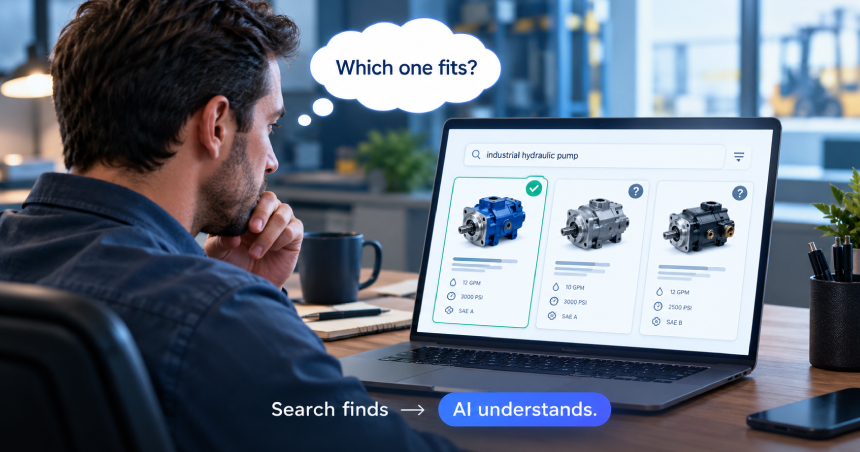
A modern storefront with search and filters, Era 05 in the tool’s framework, handles checkout and known-SKU lookups just fine. What it can’t do is judge whether a part actually fits the application a buyer is describing, because its search returns matches for the words someone typed, not a decision about suitability.
This is worth sitting with, because it’s where most well-funded sellers actually live. You replatformed. You have filters, faceted search, saved carts, maybe a customer portal with negotiated pricing built in. By any reasonable standard, you’re modern.
And you can still fail the 9pm test. A buyer who already knows their SKU checks out fine at 2am. A buyer who describes a problem instead of a part number gets a results page, not an answer. Most readers who tell themselves “we’re past that stage” mean they’re solidly at Era 05. That’s a real accomplishment. It isn’t Era 07.
Why does the tool score Era 07 only "partly" machine-readable?
Because answering a human in natural language and exposing a catalog so another machine can query it are two different engineering problems, and Era 07 only solves the first one.
Here’s the plain version. A conversational layer reads relevant pieces of your catalog and phrases a natural answer for the person in front of it. That’s flexible, and it’s fast. But phrasing a good answer for a human is not the same thing as publishing a structured feed or endpoint that another piece of software can query deterministically, without a conversation happening in between.
Most teams that get this right end up combining both. Structured fields carry the facts that need to be exact: price, stock position, part number. Retrieval handles the phrasing and context around those facts. That’s the practical middle path, and you don’t need a developer’s vocabulary to manage it, just the discipline to keep both pieces current.
If you want the retrieval mechanics underneath this, AI product search mechanics covers the deeper technical version. This section stays at the level an ops leader needs to make a decision, not the level a developer needs to build one.
Here’s the stake for the next era. Era 08 requires that same catalog to be queryable by another agent directly, with no human-phrased conversation standing between the question and the answer. Independent research backs up how early that stage still is: commercetools’ AI-readiness research puts fewer than 5% of B2B organizations at the maturity stage that includes agent-to-agent transactions. Almost everyone reading this is somewhere behind that line, and that includes sellers who feel finished.
What closes the gap between Era 07 and Era 08?
Three things: structured price-tier exposure, consistent part-number and attribute tagging, and a feed or endpoint beyond the chat widget that another system can hit directly.
None of those three is exotic. What’s rare is having all three done well at once, and the evidence for that is uncomfortable. ChatSKU ran its own catalog agent-readability audit against 20 real B2B catalogs and found only 5 of the 20 served a product page an automated reader could actually use. Even sellers who assume they’re ready mostly aren’t, at the level sitting below the chat window.
If the gap in your operation is upstream, in the export file itself rather than the website, the ERP export self-check is the field-level version of this test: part numbers, units of measure, tier pricing, all checked at the source before they ever reach a catalog assistant.
One more term worth knowing exists, without needing to master it here: a structured feed built for machine querying increasingly follows one of a small set of emerging commerce protocols. The agentic commerce glossary is where those get defined properly. This piece isn’t the place for that detail.
On the practical side, ChatSKU ingests catalog data from PDF, Excel, and ERP exports without requiring a rebuild first. The catalog integration options page lists exactly what formats connect and how.
What actually changes for your ops and sales team at Era 07?
Reps stop fielding the same spec-and-price questions after hours, and quotes move from “wait for tomorrow” to “forwarded tonight.” That’s the practical shift, and it shows up in your team’s calendar before it shows up in any dashboard.
There’s no B2B-specific study measuring exactly how much deflection or conversion lift comes from moving a catalog assistant from Era 06 to Era 07 specifically. Say that plainly instead of borrowing a number from a different industry or inventing one that sounds right.
What does exist is evidence that buyers notice and act on the difference between a good and bad buying experience. Sana Commerce’s 2025 buyer report found 75% of B2B buyers would switch suppliers for a better online buying experience. That’s not a deflection rate for your specific setup, but it’s a clear signal that the gap this article describes is one buyers actually feel and act on.
Once the structural pieces from the previous section are in place, it’s worth running your catalog back through the nine eras breakdown to confirm the score moved. A secondary check worth bookmarking alongside it: score your catalog maturity against a broader set of readiness criteria, not just the five measures this piece has walked through.
People also ask
Is a chat widget the same as being AI-ready?
No. A chat widget can answer questions instantly and still fail the readiness test if it’s trained on policies rather than your catalog. Run the self-test in this article on your own widget: ask it a real spec-and-price question and see whether it answers or hands off.
How do I know what era my catalog is actually in?
Score it yourself against the five measures in the 9 Eras tool rather than guessing from how modern your website looks. The tool is self-diagnostic, not a benchmark against other companies, so your result reflects your own setup.
What's the difference between Era 07 and Era 08?
Era 07 answers a human in natural language, in seconds, from the catalog itself. Era 08 requires that same catalog to be queryable directly by another piece of software, with no human-phrased conversation in between.
Conclusion
Your chat widget answers people. That’s Era 07, and it’s real progress, not a consolation prize.
Era 08 requires answering software directly, and that’s a different, harder claim. Era 07 is the necessary step between where most sellers are and where the market is heading. It just isn’t the finish line the widget’s sales pitch implied.
The fastest way to find out where your own catalog actually sits is to run the self-test from this article this week, on a real question, with a real SKU.
Frequently asked questions
It’s the era where a catalog answers a buyer’s question in its own words, down to the spec, with tier-aware pricing surfaced as part of the conversation. It’s defined by the catalog doing the answering, not by having any chat interface at all.
Because a conversational layer is built to phrase a good answer for a human, not to expose data in a format another system can query on its own. Those are separate engineering problems, and Era 07 only solves the first.
No. Catalog assistants like ChatSKU connect to existing PDF, Excel, and ERP data with a single line of code, without replatforming or migrating your product data first.
Era 08, Agentic Commerce, where the buyer on the other end is often software rather than a person, and that software needs to query your catalog directly rather than have a conversation with it.
Hours to days for the technical deployment itself, since it connects to catalog files you already have. The honest caveat: how long it takes to get your price-tier and spec data clean enough to answer well depends entirely on how organized that data already is.
Turn your catalog into a 24/7 sales channel