Which stage is your catalog actually stuck at?
Before you read another word, run a quick test. It is 9pm, and a buyer opens your website needing a price and a compatibility answer on one specific part. Can they get it without emailing your team and waiting until morning?
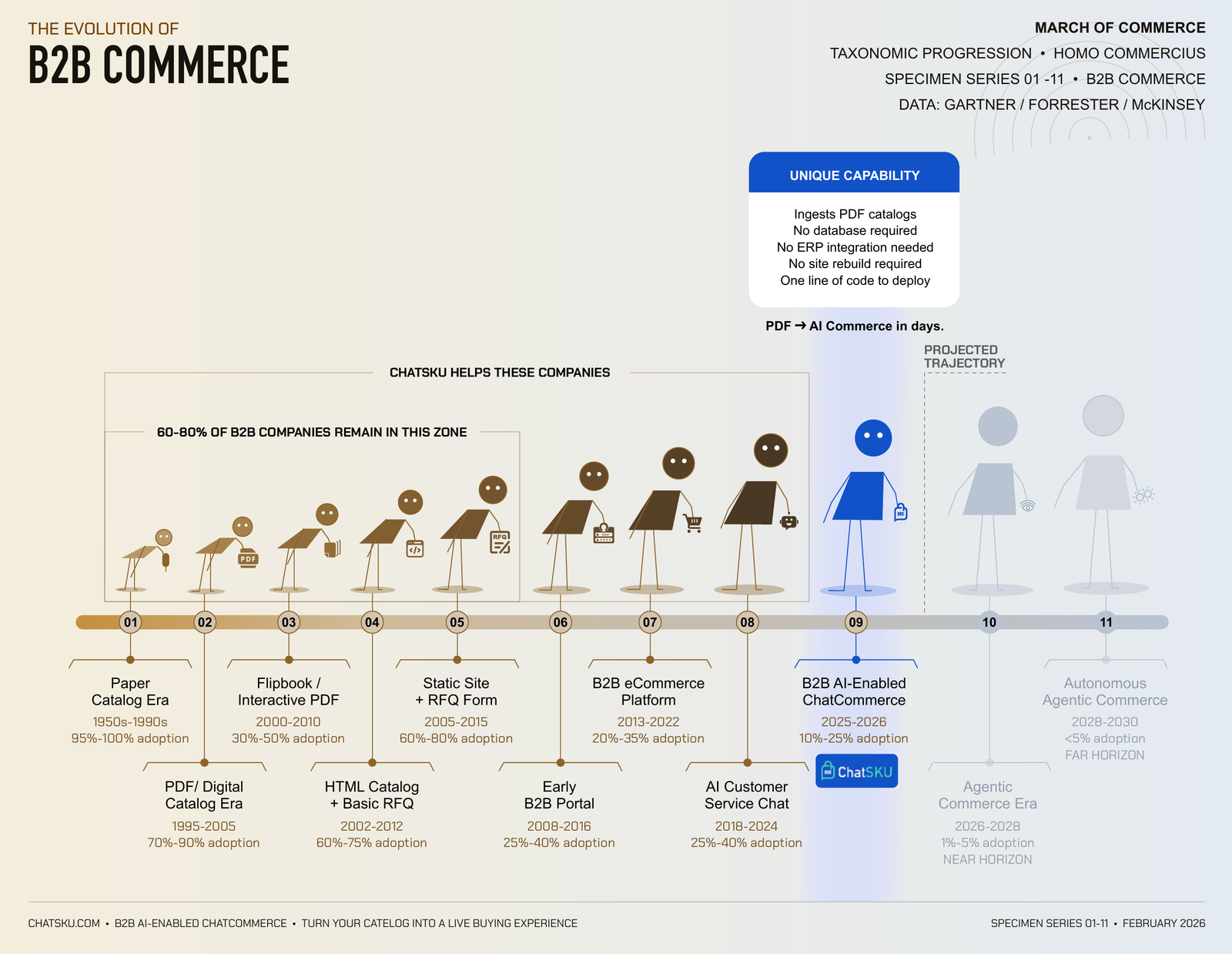
Your answer places you somewhere on a timeline that runs back to the 1950s. B2B commerce evolution has moved through roughly 11 stages, and most sellers sit far earlier on that line than they believe. Find your real stage below, then decide whether it still matches what your buyers expect.
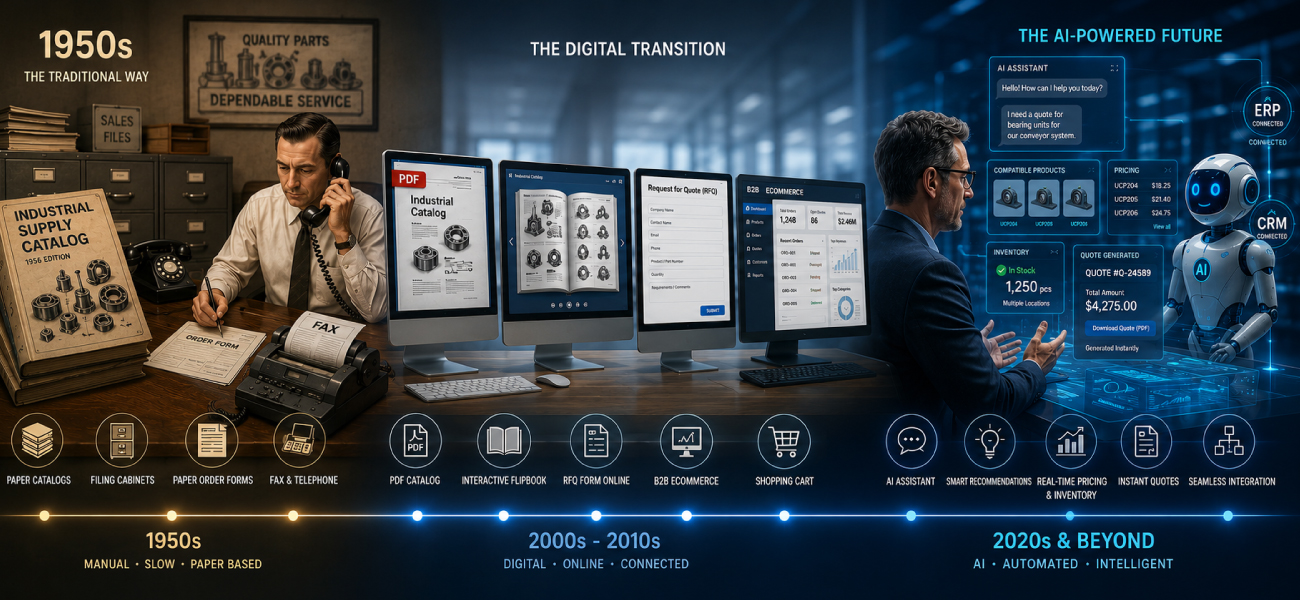
Watch the full arc in under 3 minutes before we break it down:
The 11 stages of B2B commerce evolution
- Paper catalogs (1950s). Printed, mailed, and out of date the moment they shipped.
- PDF and digital catalogs. The same static page, now delivered as a file to download.
- Interactive flipbooks. Page-turn animation on top of a document that still cannot answer a question.
- HTML catalogs with basic RFQ forms. Products live on the web, but every real question routes to a form.
- Static websites with RFQ forms. A branded site whose main call to action is still “fill this out and wait.”
- Early B2B portals. Login-gated ordering for existing accounts, thin for everyone else.
- Full B2B eCommerce platforms. Real carts, tiered pricing, and self-service checkout for known SKUs.
- AI customer service chatbots. Scripted deflection that handles FAQs but cannot read your catalog.
- AI-enabled ChatCommerce. Conversational, spec-level product answers pulled from your real catalog and pricing.
- Agentic commerce. Software agents that negotiate, procure, and reorder on a buyer’s behalf.
- Fully autonomous B2B purchasing (around 2028). Machine-to-machine buying, with humans setting the rules instead of clicking the buttons.
The gap between where you sit and what buyers expect
Your buyers are not waiting at stage 3 with you. Seventy-two percent of B2B buyers now prefer self-service over talking to a sales rep. They research, compare, and qualify on their own, often after hours, and they expect a stage 9 experience: ask a specific question, get a specific answer, no phone tag.
When your catalog forces them back to a form and a 24-hour wait, they do not call. They open a competitor’s tab. That is the real cost of the gap. It is not that your site looks dated. It is that a buyer with intent and a deadline gets stopped at the exact moment they were ready to move.
What ChatCommerce looks like in practice
Stage 9 is easier to picture with a real exchange. A procurement engineer types, “Do you carry a 316 stainless fitting rated for 250 PSI at 3/4 inch, and what is the price at 200 units?”
At stage 4, that question becomes an RFQ form, an internal email, and a reply the next afternoon. At stage 9, conversational commerce for distributors answers it in the moment: the three matching SKUs, the pressure rating, the tiered price at 200 units, and a quote-ready summary, all pulled from the seller’s own catalog data. No rep had to be awake.
This is what a conversational commerce platform actually does. It acts as a night-shift sales rep that never guesses, because it reads your real products, not the open internet. For the longer definition and the ROI math, B2B conversational commerce explained covers it, and the after-hours buyer problem shows what those unanswered 9pm questions cost over a year.

But we need to fix our data first
This is the most common reason B2B sellers stall, and it sounds responsible. The logic goes: our SKU data is messy, our pricing lives in three systems, so we cannot put anything customer-facing on top of it until we clean it all up.
That instinct quietly costs you years. A full data cleanup is a multi-year project that never quite finishes, because catalog data is never static. Meanwhile buyers keep leaving.
The better path is a phased, controlled rollout. An AI-enabled B2B commerce platform does not need a perfect catalog to start. It needs one product line, one pricing tier, and a clear boundary on what it will and will not answer. You point it at the data you already have, a spreadsheet or an ERP export, switch it on for a limited scope, and expand as confidence grows. You improve the data and serve buyers at the same time, instead of making customers wait for a cleanup they will never see. A specialized tool that reads your existing catalog turns “fix everything first” into “start where you are.”
Agentic commerce is the next frontier, so start moving now
Stage 9 is not the finish line. Agentic commerce B2B is already taking shape: software agents that negotiate terms, run procurement, and trigger reorders without a human in every loop. By around 2028, a meaningful share of routine B2B purchasing will be machine-to-machine, with your buyer’s system talking directly to your catalog and pricing logic.
Here is why that matters today. Agents transact with sellers who can answer instantly and accurately at the SKU level. A stage 3 catalog is invisible to an agent, because there is nothing structured for it to talk to. The work you do now to reach stage 9 is the same work that makes you reachable at stage 10.
You do not have to leap to autonomous purchasing this quarter. You do have to stop standing still at stage 4 while your buyers operate at stage 9. Pick one product line, give your buyers a real answer instead of a form, and move.
Conclusion
Most manufacturers and distributors are still parked at stage 3 or 4, while their buyers already expect a stage 9 experience: a real answer, not a form.
You do not need a perfect catalog or a full rebuild to close that gap. Pick one product line, point a conversational commerce platform at the data you already have, and expand from there.
See what a stage 9 quote experience looks like on your own product data. Bring the catalog files you already keep, and we will show you how buyers get spec-level answers in the moment, no form and no waiting.
Frequently asked questions
What is B2B commerce evolution, in plain terms?
It is the shift from static, filing-cabinet catalogs toward conversational, spec-level buying experiences. There are roughly 11 recognizable stages, from 1950s paper catalogs to fully autonomous, machine-to-machine purchasing around 2028.How do I know which stage my company is actually at?
Run a simple test: at 9pm, can a buyer get a specific price and compatibility answer on your site without emailing your team and waiting until morning? If not, you are likely at stage 3 or 4, a static catalog with an RFQ form bolted on.Do I need to clean up my catalog data before automating it?
No. Waiting for perfect data is what stalls most sellers for years. A phased rollout works better: point an AI-enabled platform at one product line and the data you already have, then expand as confidence grows.What is agentic commerce, and why does it matter now?
Agentic commerce is software agents negotiating, procuring, and reordering on a buyer’s behalf, with no human in every loop. Sellers who reach stage 9 today, with real-time, spec-level answers, are the ones agents can transact with tomorrow.Do I need a full website rebuild to reach stage 9?
No. A conversational commerce platform layers on top of your existing site and catalog data, so you can move from a static RFQ form to real-time, spec-level answers without a rebuild.Want the full framework as a one-page reference?
Download the B2B Commerce Evolution one-pager to share with your team.