
Executive summary
AI doesn’t take your rep’s job away. It takes over the repeat lookups, spec questions, and price checks that eat most of their day.
This article walks through what changes for four people: the rep, the sales manager, a brand new hire, and the owner.
Each one sees the job shift, not disappear.
We’re just as honest about what breaks. A careless rollout can waste the whole opportunity, and this piece covers exactly how that happens.
Introduction
It’s 9am on a Tuesday. Your rep opens their inbox to four emails.
Two buyers want the same spec sheet you sent out yesterday. One needs a stock check before placing an order. A repeat customer wants “the same as last time, but in stainless.”
None of that is selling. It’s lookup work, and it happens before your rep gets to a single real call.
That’s the actual job today, before anything changes. The real question isn’t “will this replace me.” It’s “what does my week look like without the repeat stuff in it.”
How does a rep's day change?
The repeat work moves to the assistant. The judgment calls stay with your rep.
Spec questions, stock checks, and “what’s my price on this” all get answered right away, day or night. Your rep never touches most of them.
What stays with them is everything the assistant can’t do well: negotiating a tough deal, handling an exception, reading a buyer about to walk. Those calls need a person who knows the account.
Sales reps spend just 28% of their week on real selling, per Salesforce’s 2023 State of Sales research. The other 72% goes to admin, data entry, and deal management, per that same Salesforce study.
That leftover time is exactly where a catalog assistant does its work. Not on the call where your rep closes the deal. On the four emails that came in before it.
Curious what’s actually happening behind the screen? See how a catalog assistant answers, in plain terms.
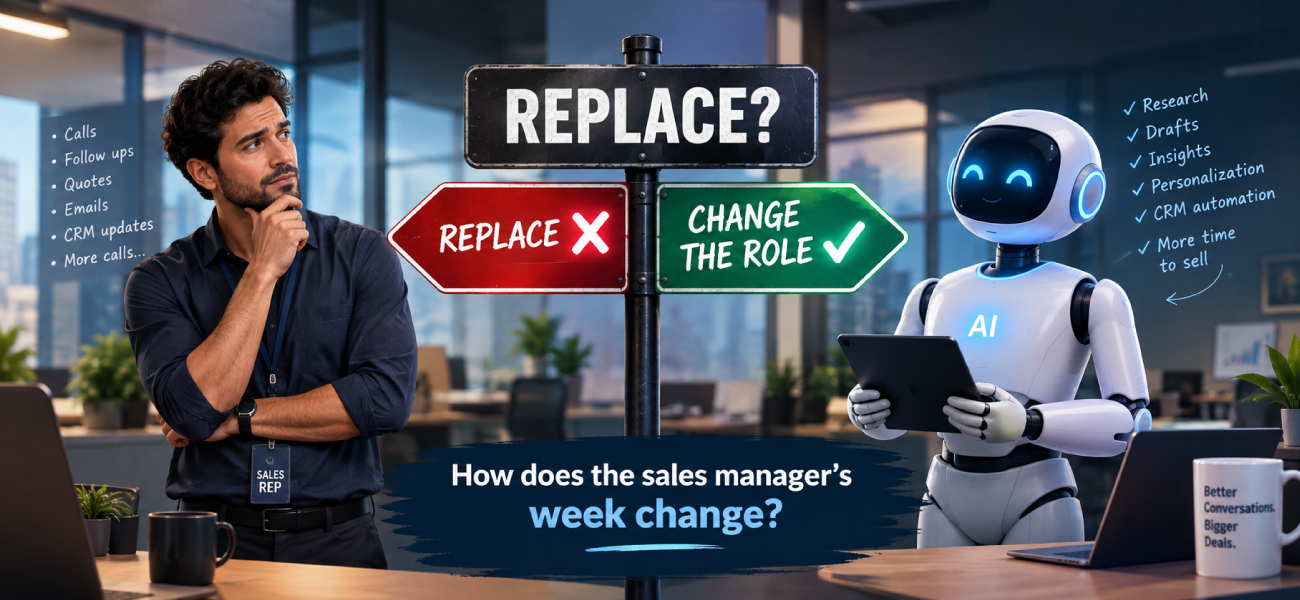
How does the sales manager's week change?

You get fewer status-chase pings and a lot more visibility into what your buyers are actually asking.
Instead of chasing your team for updates, you can just look. Spec requests, stock checks, and pricing questions all land in one place. That’s a real shift in how you spend a Monday morning.
Here’s the part that matters most. What you do with the extra hours matters more than getting them in the first place. A manager who doesn’t change what they measure won’t see much benefit from any of this. More on that shortly.
The assistant also speeds up what happens right after a quote request lands. See how quote to order automation closes that gap once pricing is settled.
What's different for a brand new hire?
A new rep still needs months to build real judgment about accounts and deals. What changes is how they spend that time.
Instead of hunting through folders or asking a coworker where a spec sheet lives, a new hire gets the answer right away. That frees up their first few weeks for learning the accounts, not the paperwork.
How long is “months,” exactly? Ramp time for new B2B sales hires runs from around three months up to nearly six, per Bridge Group research. That data comes from software sales teams, not distributors, so treat it as a rough guide, not an exact number for your shop.
There’s a real risk worth naming here too. A brand new rep can lean on the assistant instead of learning the catalog. That’s worth watching for in someone’s first month on the job.
What does the owner see change?
You get to see the questions your reps used to handle quietly, on their own.
Every spec check and price question used to disappear into someone’s inbox. Now it shows up as data you can actually look at. That’s real pipeline visibility, not a guess based on gut feel.
It also means fewer leads slipping through the cracks after hours, when nobody’s at a desk to answer.
If you run a manufacturing or distribution business, this is exactly where an AI sales assistant earns its keep. It’s built for distributors and wholesalers, not generic retail.
Want to know what that’s worth in your own numbers? The math is worth running, but we won’t hand you a made-up percentage here.
Is AI actually cutting sales jobs anywhere?
In a few corners, yes. For most small sales teams, no. Here’s the honest picture.
Forrester expects about 6% of US jobs to be automated by 2030. That same Forrester forecast puts roughly 20% in the augmented column instead. Forrester also found that more than half of AI-blamed layoffs get quietly reversed once companies feel the real cost of losing people too fast.
Where cuts are real, they land hardest on the most repetitive roles. Emergence Capital’s April 2025 research found software companies cut entry-level sales roles at 36%, mid-level roles at 25%, and specialist roles at just 14%.
Here’s the catch, in the same breath. That’s software industry data from venture-backed companies, not distributors. It doesn’t map cleanly onto your two or three person inside sales team.
Even the sources predicting job loss agree on what stays human. That’s relationship-building on bigger accounts, working through multiple stakeholders, and judgment calls that don’t fit a pattern.
Curious how far this actually goes? Here’s what agentic commerce means for a catalog, in plain English.
What goes wrong when the rollout is careless?
Plenty, and it’s worth naming plainly. There’s no single study to point to here. This is what people in the trade consistently see when a rollout goes sideways.
Reps quietly work around a tool they don’t trust. That trust breaks the first time the assistant gives a wrong stock number or an old price. It’s slow to earn back. Check its answers yourself for a week before buyers ever see it. Start with one product line, not the whole catalog.
Nobody owns the handoff. A lead the assistant captures goes cold if nobody owns picking it up. That’s exactly like a shared inbox nobody checks. Here’s what happens when the response gap opens up after the first reply, not just before it. Name one person who owns every lead it captures. Put it in writing.
The manager doesn’t change what they measure. If “calls made” stays the scoreboard after routine questions move to the assistant, the freed-up hours get eaten by busywork instead of real selling. Change the scoreboard on day one. Count quotes sent and deals won, not calls made.
A new rep leans on the assistant instead of learning the catalog. That’s the same crutch risk we flagged earlier, and it’s worth watching in someone’s first few months. Have them sit with a senior rep on the harder calls anyway.
None of these four are technology problems. Each one is a decision somebody forgot to make.
People also ask
Does AI eliminate the need for a sales team?
No. It takes over the repeat lookups and admin that eat most of a rep’s week. That frees your team to spend more time on the calls that actually close deals.
What can't AI do in B2B sales?
Negotiation, handling exceptions, working multi-stakeholder deals, and judgment calls that don’t fit a pattern. Those all still need a person who knows the account.
Will a catalog assistant make my newest rep worse at their job?
Only if nobody watches for the crutch risk. A new hire who leans on the assistant instead of learning the catalog can fall behind on judgment. Worth checking on in month one.
Conclusion
The tool changes what fills your rep’s day. It doesn’t change whether your team exists.
Your reps stop drowning in spec sheets and stock checks. They spend more time on the calls that actually close deals.
What happens in the first 90 days after rollout decides whether that turns into a stronger team or a stalled one. That part is on the manager, not the software.
Frequently asked questions
Most small teams are live within days, not months. It reads the product files you already keep, so nothing has to be rebuilt.
Yes. Tier and contract pricing are handled, so each buyer is quoted their own agreed rate.
It gets routed to your team the next morning, or sooner if you set it up that way. Someone still needs to own the follow-up.
No. It connects to your existing site with one line of code, and it can sync with the CRM you already run.
No. Relationship-building on complex accounts stays with your best people. That’s the part no assistant can replicate.
Whatever you already have. PDFs, spreadsheets, or an export from your ERP are enough to get started, no clean-data project required first. Check the catalog integration options for the full list of formats.
Turn your catalog into a 24/7 sales channel
Stop sending PDFs. Start capturing demand.
Try ChatSKU Free →
About the author
Gigi JK is the founder of ChatSKU and Virtina, bringing more than 28 years of experience across digital transformation, eCommerce strategy, AI-driven growth systems, and business modernization. His work spans startups, scale-ups, and SMBs, with a focus on turning complex operational problems into practical growth frameworks. Before ChatSKU, Gigi built and scaled a seven-figure eCommerce business and led Virtina as an eCommerce engineering and business transformation consultancy. At ChatSKU, he focuses on helping B2B manufacturers, distributors, and wholesalers make complex catalogs searchable, quote-ready, and agent-ready without forcing a full platform rebuild.