
Executive summary
Every major article on “conversational commerce” uses the same examples: WhatsApp DMs, Instagram shopping carts, Sephora bots. None of them covers what conversational commerce actually means for a manufacturer with 60,000 SKUs and 200 wholesale accounts on custom contract pricing. That is the gap this guide fills.
B2B conversational commerce is not a support widget. It is the layer between your catalog and your buyer that answers questions, quotes real contract prices, captures RFQs, and logs leads around the clock. For distributors and manufacturers, it is the difference between a buyer getting an answer at 9pm and a buyer buying from your competitor by morning.
This guide covers the definition, how it differs from chatbots and AI search, seven concrete use cases, the ROI math, and how fast you can go live. If you are evaluating whether this category applies to your business, start here.
Introduction
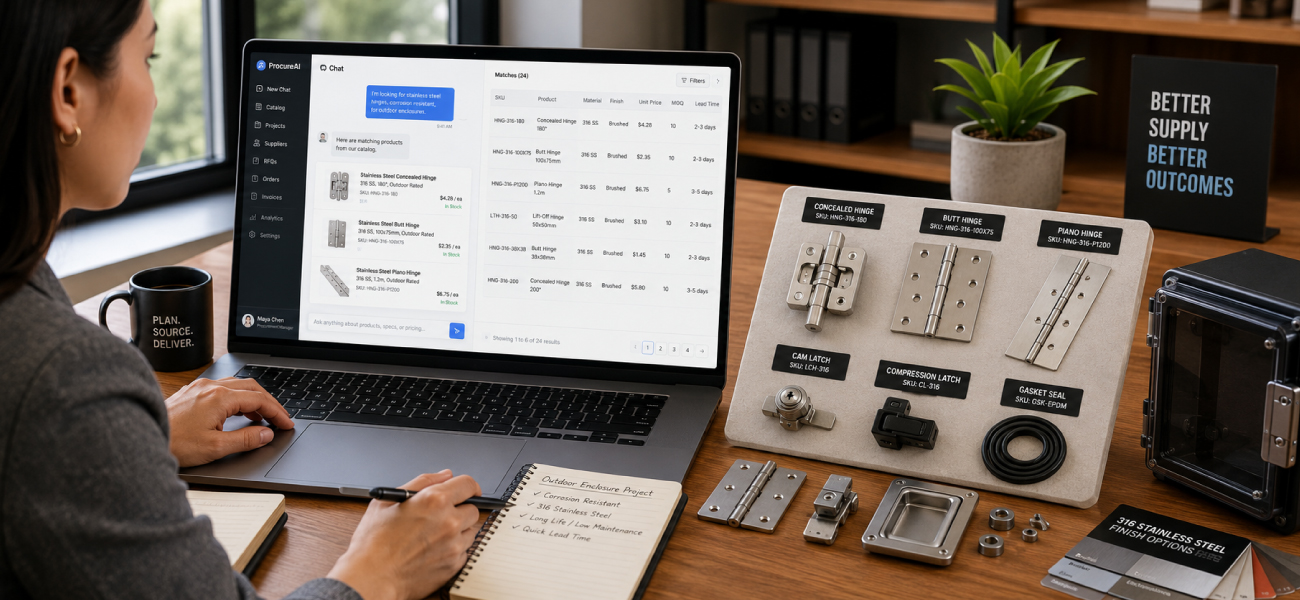
It’s 9:42pm on a Tuesday. A procurement manager at one of your top accounts needs a quote on 300 units of a part they order every quarter. They go to your website. The catalog loads. Your search bar does not recognize the part number they typed. The page shows list price, not their contract rate. Nobody is there to help. They close the tab.
By 8am Wednesday, they have sent a quote request to a competitor who had an AI catalog assistant running overnight. Your rep finds out about the lost order on Friday, in a terse email from the account.
This is not a sales rep problem. This is a catalog problem. Your catalog is passive. It shows products but cannot answer a single question, apply a contract price, or capture a lead after 5pm. B2B conversational commerce is how you fix that, without rebuilding your website or hiring a night shift.
What is B2B conversational commerce?
B2B conversational commerce is the practice of letting business buyers research, configure, price, and request orders through a natural-language conversation connected to your live catalog, pricing, and inventory. It is not a scripted support bot. It is not a B2C DM campaign. It is not a search bar. It is a buying layer, available 24/7, that knows your catalog as well as your best sales rep does.
In practice, that means a buyer can type “what is my contract price for SKU 7730-S at 500 units, and is it in stock?” and get a real answer in seconds, not an email form or a generic “contact us” response. The conversation captures the full deal context: product, quantity, account tier, delivery timeline. The rep gets a structured lead, not a blank inquiry.
The category is not new, but its application to B2B is. Gartner predicted that 80% of B2B sales interactions would be digital by 2025, a forecast that has played out. According to McKinsey’s B2B Pulse research, buyers now spend only 17% of their purchasing time with vendor representatives, and 71% say they will spend $50,000 or more via digital self-serve. The buying motion has changed. The catalog hasn’t caught up for most manufacturers and distributors.
How is B2B conversational commerce different from B2C conversational commerce?
B2C conversational commerce is built for one list price, one buyer, one cart. B2B is the opposite: multiple account tiers, contract pricing, minimum order quantities, multi-stakeholder approvals, and catalogs that run to 500,000 SKUs. The tools are not interchangeable, and the ROI math is completely different.
Here is where B2C tools break down in a B2B context:
- Pricing complexity. A retail chat widget shows the same price to every visitor. Your wholesale accounts each have a negotiated rate. A B2B conversational commerce system reads the buyer’s account tier and applies the right price in real time.
- RFQ and quote workflows. B2C buyers add to cart. B2B buyers request quotes, get approvals, and submit purchase orders. Conversational commerce handles the entire RFQ capture workflow, not just the product discovery step.
- Customer-group catalogs. Some of your accounts see products others don’t. A B2B system respects those visibility rules. A B2C chat widget does not.
- SKU depth. A typical B2C catalog is 500-5,000 products. A distributor catalog runs 50,000-500,000 SKUs with part numbers, specs, and trade names that differ from catalog titles. The AI needs to understand trade language, not just keyword search.
- Buying cycles. A retail purchase takes minutes. A B2B deal involves multiple stakeholders, procurement workflows, and often a 30-90 day cycle. Conversational commerce in B2B focuses on lead capture and qualification, not impulse conversion.
The result of deploying B2C chat tools in a B2B catalog context is what we call a passive catalog: a site that shows products but closes no deals. The other side of that problem is the response gap, where B2B buyers wait 42 hours for a human to answer a question they needed answered last night.
How is conversational commerce different from chatbots and AI search?
Three types of tools get lumped together under “AI for your catalog.” They are not the same thing. Traditional chatbots handle scripted support flows. AI search helps buyers find products faster. B2B conversational commerce does something neither can: it quotes, prices, captures RFQs, and operates on your actual catalog data, for the right account, at any hour.
| Criterion | Traditional chatbot | AI search | B2B conversational commerce |
|---|---|---|---|
| Primary job | Scripted support / FAQ deflection | Find and rank products for a query | Answer, price, quote, and capture the order across the catalog |
| Reads your catalog + pricing data | No (scripted flows only) | Indexes catalog text and specs | Yes: catalog plus ERP/PIM and pricing tiers |
| Handles contract / tiered pricing | No | No (shows list price only) | Yes: applies the right price per customer group |
| RFQ / quote capture | No | No | Yes: generates and routes the RFQ with full context |
| Trade-language and part-number search | No | Partial (keyword match) | Yes: intent, synonyms, and specs understood together |
| After-hours lead capture with context | Email form only | None | Full deal context: product, quantity, account, timeline |
| Example tools | Intercom Fin, Tidio (note: Drift was sunset March 2026) | Algolia, Coveo, Bloomreach | ChatSKU, HumCommerce, Zoovu |
| Best for | Support ticket deflection | Large-catalog navigation and discovery | B2B self-serve buying, quoting, and lead capture |
The comparison matters because many distributors evaluate AI search tools thinking they solve the quoting and pricing problem. They solve the discovery problem. Once a buyer finds the product, a search tool’s job is done. A conversational commerce system’s job is just starting. If your B2B catalog conversion rate is stuck in the 1-3% range, adding search without quoting is unlikely to move it.
What does a B2B conversational commerce conversation actually look like?
The difference shows up most clearly in a single real-world scenario. Not a polished demo. The kind of inquiry that lands on a Tuesday night.
In conversations with B2B distributors evaluating conversational commerce, the same scene comes up: a buyer asks a question after hours, the website cannot answer it, and the lead disappears before anyone finds it in the morning. The gap is not a sales rep gap. It is a catalog gap.
Here is an illustrative before-and-after for a mid-market industrial distributor (all numbers are representative, not a guaranteed outcome):
The business: $8M annual revenue, 60,000 SKUs, roughly 200 wholesale accounts on custom contract pricing, and approximately 120 catalog inquiries arriving after hours each month.
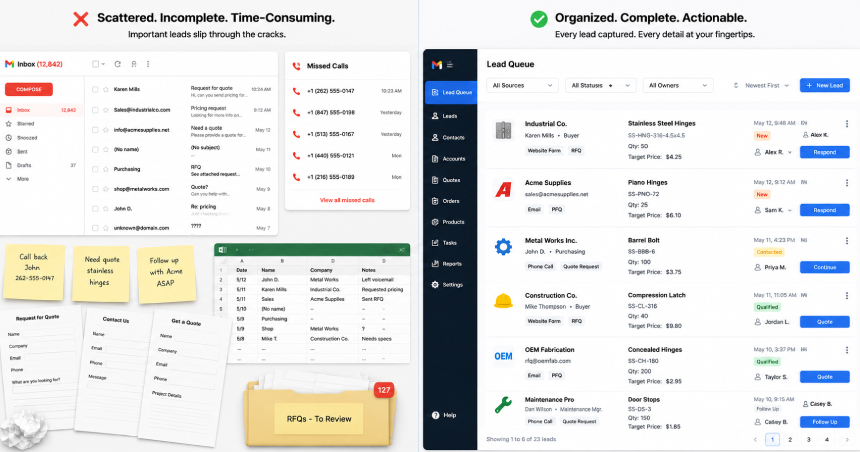
Before conversational commerce: A buyer’s RFQ arrives at 9pm. The list price on the page doesn’t match their contract rate. Site search doesn’t recognize the part number they typed. The buyer leaves without submitting anything. The lead is never logged. The next morning, three reps spend their first 90 minutes answering “what’s my price / is it in stock” emails from other accounts.
After conversational commerce: The AI catalog assistant recognizes the buyer’s account, applies their contract tier, confirms stock, generates a structured RFQ, and routes it with full context: product, quantity, timeline, and account ID. The rep opens their queue at 8am to a warm, organized lead, not a blank inquiry form.
The math on that shift: capturing 30% of those 120 monthly after-hours inquiries adds roughly 36 qualified leads per month. At an average order of $4,200 and an 18% close rate, that’s approximately $27,000 per month recovered from inquiries that previously went unanswered. The number is illustrative. The pattern is real. Use the RFQ automation framework to map this to your own catalog and close rate.
What are the main use cases for B2B conversational commerce?
B2B conversational commerce is not a single feature. It is a set of workflows that replace the manual steps between a buyer’s question and a rep’s answer. The seven use cases below cover the most common points where distributors and manufacturers lose time, leads, and revenue today.
1. After-hours buyer capture
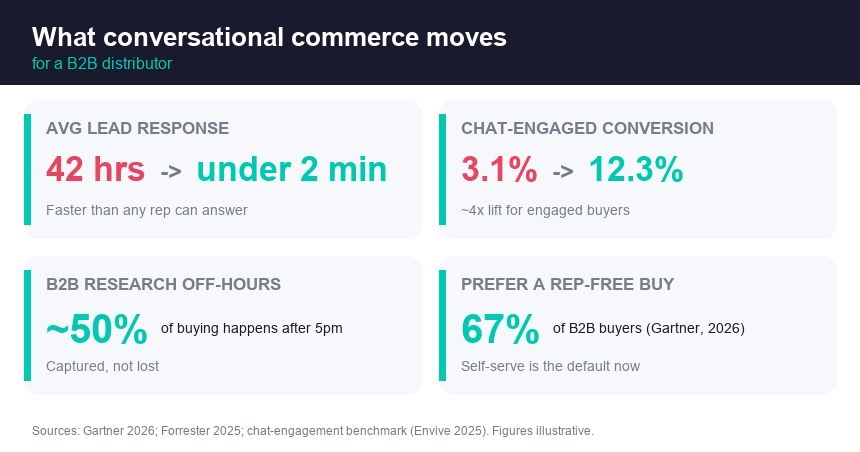
Roughly half of all B2B catalog research happens outside standard business hours. Without 24/7 coverage, those inquiries age in an email queue and the average response time reaches 42 hours. Conversational commerce captures the lead immediately, with full context, so the rep is working warm leads by morning. See how other after-hours B2B buyers behave across catalog categories.
2. RFQ and quote workflow automation
The most time-consuming part of a B2B rep’s day is building quotes from scratch. Conversational commerce collects specs, quantities, delivery requirements, and account information through a structured conversation, then generates the RFQ automatically. Reps close deals. They don’t transcribe them.
3. Product discovery across large catalogs
A 60,000-SKU catalog with part numbers, trade names, and application specs is not searchable by keyword alone. Buyers ask in the language they use on the shop floor, not the names in your catalog. Conversational commerce understands intent, asks clarifying questions, and surfaces the right product. AI search gets you to the aisle. Conversational commerce gets you to the shelf.
4. Customer-specific pricing and tier handling
Every wholesale account has its own price. A generic chat widget returns list price, which is the wrong answer for most of your accounts. A catalog-aware AI assistant reads the buyer’s account tier from your ERP or pricing table and returns the right price in the conversation. No “call your rep to confirm.” The PDF catalog chatbot use case is the simplest version of this: a buyer uploads or browses your PDF, and the system applies their pricing on top of the catalog data.
5. Complex product configuration
Some products require configuration: voltage, dimensions, material grade, load rating. A conversational interface can walk a buyer through configuration options, validate combinations, and confirm the final spec before routing to quote. That guided process replaces a 3-email thread with a 90-second conversation.
6. Sales team augmentation
Your reps spend a significant portion of their day answering the same catalog questions: price, availability, lead time, substitutions. Conversational commerce handles those repetitive inquiries automatically. Your reps get that time back and redirect it toward deals that require judgment. The system augments the team. It does not replace it.
7. Reorder and replenishment
Reorder is the highest-value, lowest-effort sale in distribution. A conversational system can proactively surface reorder prompts based on purchase history, answer availability questions instantly, and capture the repeat order without a rep involved. The fastest path to recurring revenue is making reorder frictionless.
What ROI can B2B distributors expect from conversational commerce?
The honest answer: it depends on your catalog depth, inquiry volume, and current response time. The directional answer, backed by data, is that the gap between what you capture today and what you could capture is larger than most distributors expect.
Start with buyer behavior. Gartner’s March 2026 survey of 646 B2B buyers found that 67% prefer a rep-free purchase experience. That number was 61% nine months earlier. It is rising. Forrester added another data point: more than half of B2B transactions over $1 million are now going through digital self-serve channels. This is not a trend reserved for small orders.
Now layer in response speed. The average B2B company takes 42 hours to respond to an inbound lead. Leads contacted within 5 minutes are 21 times more likely to be qualified than those contacted after 30 minutes. 78% of buyers purchase from the first company to respond. Conversational commerce collapses your response time to zero. That is the variable with the largest ROI multiplier.
On conversion: visitors who engage with catalog-aware AI chat convert at roughly 12.3%, compared to 3.1% for those who don’t, a commonly cited chat-engagement benchmark from Envive’s 2025 conversational commerce research. That is not a marginal lift. That is a structural shift in how inquiry volume turns into revenue.
McKinsey’s research on B2B distribution found that AI applied to pricing and buyer interaction delivered over 200 basis points of margin improvement for a $15 billion distributor. The mechanism for smaller distributors is the same: faster, more accurate quoting and fewer deals lost to slow response.
How to calculate your conversational commerce ROI
The inputs are simpler than most distributors expect:
- Monthly catalog inquiries (web + email)
- Percentage arriving after hours (roughly half for most)
- Current lead-to-close rate at your average response time
- Average order value
Run those numbers through the conversational commerce ROI calculator to see your specific estimate. If you want to start with the lost-revenue side of the equation, the calculate lost B2B revenue tool maps exactly how much is leaving through the after-hours and slow-response gaps.
How fast can a B2B distributor deploy conversational commerce?
Most distributors are live in under a week. The timeline depends on catalog format and pricing complexity, but the steps are consistent. There is no website rebuild, no new platform to migrate to, and no need to recode your ERP. One script tag. Your existing catalog data. A few hours of configuration.
- Connect your catalog. Upload your existing product data: PDF catalog, spreadsheet, ERP export, or PIM feed. ChatSKU ingests the data without reformatting. If your catalog exists in any structured form, this step takes hours, not weeks.
- Load your pricing logic. Define customer groups, contract tiers, minimum order quantities, and any account-specific exceptions. The system maps pricing to accounts and applies the right rate in every conversation.
- Set RFQ routing and human-handoff rules. Decide which inquiry types route to a rep immediately (high-value orders, new accounts) and which the system handles end-to-end (standard reorders, availability checks). Handoff rules take 30-60 minutes to configure.
- Test with real buyer questions and trade terms. Run your most common buyer questions through the assistant before going live. Include the part numbers, trade names, and spec-based queries your buyers actually use. Fix any gaps in catalog recognition before customers see them.
- Go live and monitor captured leads. Add the script tag to your site. The assistant is live immediately. Monitor the lead dashboard daily for the first two weeks to see inquiry patterns, resolution rates, and any questions the system cannot yet answer.
If you want to understand the technology before committing to a deployment, the clearest starting point is reviewing real buyer questions your catalog already receives. That is the input that tells you whether the ROI math applies to your business.
Who should and should not use B2B conversational commerce?
Conversational commerce works well for a specific type of B2B business. It is not universal. Here is an honest fit assessment.
You’re a strong fit if you check most of these:
- You sell to wholesale accounts or business buyers (not consumers)
- Your catalog has 500 or more SKUs
- You have tiered, contract, or account-specific pricing
- You receive catalog inquiries after business hours that go unanswered
- Your reps spend significant time on repetitive price and availability questions
- You have an existing catalog in PDF, spreadsheet, or ERP format
- Your average order value is high enough that each missed inquiry is a meaningful revenue loss
- You want to capture more leads without adding headcount
It’s probably not the right fit right now if:
- Your catalog is under 50 SKUs and pricing is uniform (standard ecommerce is simpler)
- Every sale requires a custom engineering consultation before any quote can be generated
- You have no structured catalog data in any digital form and are not ready to create one
- Your buyers are large enterprises with dedicated procurement portals that mandate EDI-only transactions
For a broader look at the tool category before making a vendor decision, the roundup of best B2B catalog chatbots covers the major players in this space with a framework for comparing them by use case, not just feature lists.
People also ask
Is conversational commerce the same as a chatbot?
No. A chatbot follows scripted flows and handles pre-set questions. Conversational commerce reads your live catalog, applies account-specific pricing, captures RFQ data, and routes qualified leads. The interaction looks similar on the surface. The underlying capability is completely different. A chatbot tells a buyer to “contact sales.” Conversational commerce is the sales interaction.
Can conversational commerce handle complex B2B pricing?
Yes, if the platform is built for B2B. Platforms like ChatSKU ingest your customer group definitions, contract tiers, and MOQs directly from your ERP or pricing tables. When a buyer identifies their account, the system applies their specific pricing in real time. Generic chatbots and B2C chat tools cannot do this because they have no connection to your pricing data.
What happens if a buyer asks something the AI can't answer?
A well-configured conversational commerce system escalates to a human when the conversation exceeds its confidence threshold. The buyer’s question, product context, account details, and conversation history transfer to the rep automatically. The handoff is warm. The buyer does not repeat themselves. The rep has full context before the first word of their response.
Conclusion
Your catalog has the answers. Your buyers are asking the questions. The problem is they’re asking at 9pm and nobody is there.
Conversational commerce closes that gap. Not with a support bot. With a catalog-aware assistant that quotes real prices, captures RFQs, and logs leads while your team sleeps. See how it works for a catalog like yours.
Frequently asked questions
What types of B2B businesses benefit most from conversational commerce?
Manufacturers, distributors, and wholesalers with complex catalogs (500+ SKUs), tiered or contract pricing, and buyers who research outside business hours see the largest ROI. If your reps spend significant time on repetitive price and availability questions, that is the clearest signal that conversational commerce will recover time and revenue.
Does conversational commerce require rebuilding my website?
No. ChatSKU deploys via a single script tag added to your existing site. There is no platform migration, no new ecommerce build, and no developer project required. Your catalog data (PDF, spreadsheet, ERP export) is the input. The assistant is live once the tag is placed and catalog ingestion is complete, typically within a week.
How does the system know a buyer’s contract price?
You define customer groups and pricing tiers during setup. The system maps each account to its tier using login, account ID, or domain recognition. When a buyer identifies themselves, the assistant applies their specific pricing from your pricing table or ERP connection. List price never shows up for an account that has a contract rate.
What catalog formats does ChatSKU support?
ChatSKU ingests PDF catalogs, Excel and CSV product files, ERP exports (NetSuite, SAP, Acumatica, Epicor, Dynamics 365), and PIM feeds. If your catalog exists in a structured format, it can be connected. Most distributors already have their data in one of these formats.
How is conversational commerce different from putting a search bar on my site?
Search finds products. Conversational commerce sells them. A search bar returns a results page. A conversational system understands the buyer’s intent, asks clarifying questions, applies their pricing, handles multi-product inquiries, and captures the RFQ. Discovery is step one of a sales conversation. Search stops there. Conversational commerce continues to close.
Will this replace my sales reps?
No. Conversational commerce handles the repetitive, high-volume, time-sensitive layer of buyer interaction: availability checks, price lookups, standard reorder capture, and after-hours inquiries. Your reps get those hours back and redirect them to consultative selling, new account development, and complex deals that require judgment. The system augments your team. It does not replace it.
How do I know if the ROI math works for my business?
The calculation is straightforward: your monthly inquiry volume times the percentage that arrives after hours, multiplied by your average order value and estimated close rate improvement. Run those inputs through the conversational commerce ROI calculator at chatsku.com/revenue-calculator for a specific estimate. Most distributors find the payback period is measured in weeks, not months.
Turn your catalog into a 24/7 sales channel
Stop sending PDFs. Start capturing demand.
Try ChatSKU Free →
About the author
Gigi JK is the founder of ChatSKU and Virtina, bringing more than 28 years of experience across digital transformation, eCommerce strategy, AI-driven growth systems, and business modernization. His work spans startups, scale-ups, and SMBs, with a focus on turning complex operational problems into practical growth frameworks. Before ChatSKU, Gigi built and scaled a seven-figure eCommerce business and led Virtina as an eCommerce engineering and business transformation consultancy. At ChatSKU, he focuses on helping B2B manufacturers, distributors, and wholesalers make complex catalogs searchable, quote-ready, and agent-ready without forcing a full platform rebuild.