
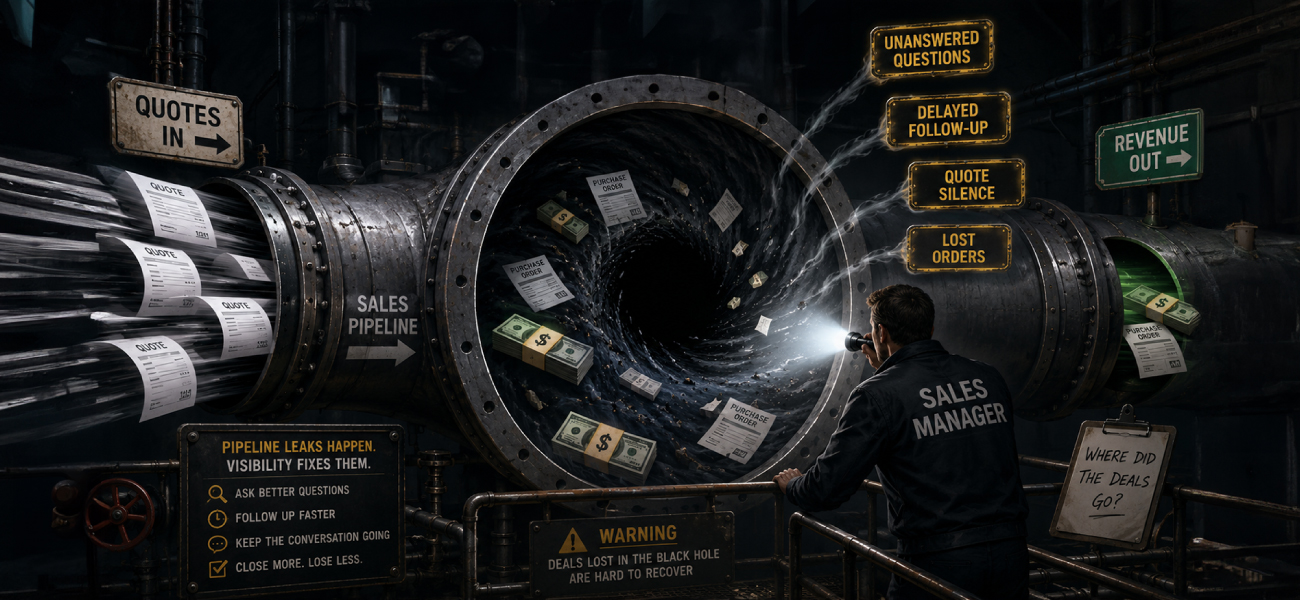
Executive summary
A $42,000 quote goes silent for six days while the buyer waits on a pricing question. The buyer signs with a competitor who answered in twenty minutes. This is the quote-to-order gap: the space between “quote sent” and “order placed,” where most closeable B2B revenue quietly disappears.
It is not a CRM problem and not a CPQ problem. It is a silence problem. Buyers who can’t get an answer while they’re deciding go find someone who’ll give them one. This article breaks down the cost, why the usual fixes (CRM reminders, drip emails) don’t touch it, and what closes the gap instead.
Introduction
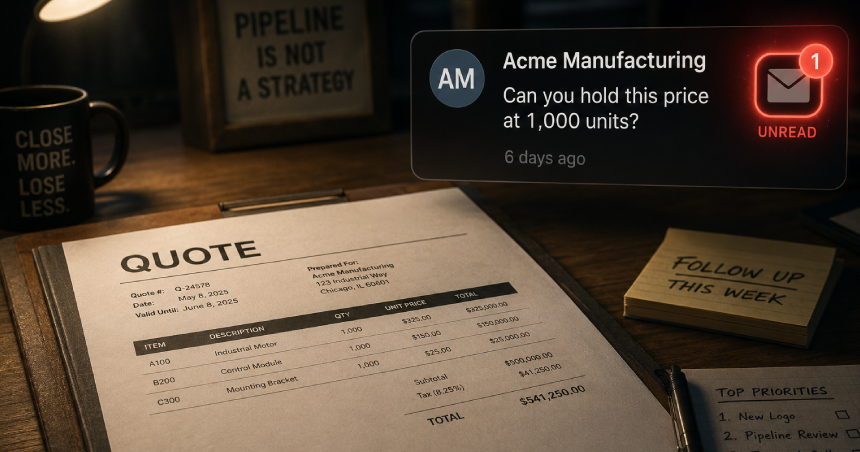
You sent the quote. $42,000. Three days later, the buyer emails one question: can the price hold if they double the order to 1,000 units?
Nobody answers for six days. By the time someone does, the buyer already signed with the competitor who answered in twenty minutes.
This is not a story about a slow CRM. It’s not a bad PDF, either. The deal died because of silence, and that silence has a name: the quote-to-order gap. It’s the space between “quote sent” and “order placed,” and it’s where most of your closeable B2B revenue quietly disappears.
What does quote silence actually cost you?
Here’s what makes this gap so dangerous: it doesn’t look like a failure. No alarm goes off. The quote just sits there, technically “in progress,” while the actual deal rots.
Companies that respond to leads within one hour are 7 times more likely to qualify them. Wait 24 hours or more, and qualification odds drop 60 times lower, according to a 114-company study from Workato.
That’s the difference between a live deal and a dead one.
Speed compounds the problem. Response time tracks almost exactly with close rate:
- Under 5 minutes: 32% close rate
- Under 1 hour: 24%
- Under 24 hours: 15%
- Past 24 hours: 12%
Despite knowing this, the average B2B lead response time sits at 42 hours. Over a third of companies take longer than a full day to respond at all.
None of this happens because reps don’t care. It happens because they’re buried.
Eighty percent of B2B deals need five or more follow-ups to close. Ninety-two percent of reps stop after four attempts or fewer. Most quit right before the deal would have converted.
Your catalog can’t help here if it’s a passive catalog that just sits there, waiting for a human like the quote in the inbox does. Most teams already know about the response gap on the front end, but the same gap reopens the moment a quote goes out.
Why don't CRM reminders and drip emails fix this?
Most teams try to solve this with more process. A CRM reminder. A drip sequence. A note to “follow up Thursday.” None of it touches the actual problem.
CRM reminders only fire if the data triggering them is clean and current. B2B contact data degrades 2-3% a month, roughly 22% a year.
A stale field means the reminder never fires, or fires too late. The rep is back to relying on memory.
Drip emails are worse in a quieter way. A “just checking in” email carries zero new information, and buyers can tell the difference between a nudge and an answer.
Meanwhile, reps are drowning. Non-value-adding work, including quotation and order management, eats roughly two-thirds of a sales team’s time. McKinsey estimates more than 30% of those tasks are at least partially automatable.
When a third of the week disappears into admin, follow-up quality drops. Not because reps are bad at their jobs. There’s just too much in the queue.
This isn’t a CPQ problem either. CPQ tools solve quote generation speed, a real but separate issue: they get the document out faster, but stop the moment it’s sent.
Even RFQ-to-quote automation tools hand off a finished PDF and walk away from everything that follows.
And the PDF itself is a dead end. If a buyer wants to change quantity, term, or configuration, someone has to manually regenerate the document. That restarts the approval clock on a deal that’s already running out of patience.
Every current fix treats this as a timing problem. It’s actually an information problem: the buyer doesn’t need a faster reminder, they need an answer. And you’ve likely got the human bottleneck of reps buried across dozens of open quotes who can’t be everywhere a question shows up.
What does it actually take to close this gap?
A working fix has three parts, and none of them work alone.
First: real-time, self-serve answers. Buyers don’t wait around for permission to keep shopping.
Seventy-five percent of B2B buyers prefer a rep-free buying experience when one’s available. They spend only 17% of their decision time actually engaging suppliers directly, dropping to 5-6% once they’re comparing vendors.
While your quote sits silent, your buyer isn’t waiting. They’re elsewhere, probably looking at a competitor’s catalog right now.
This is exactly why catalog conversion rate stalls: buyers who can’t confirm pricing mid-decision give up on the supplier in front of them and move to whoever answers first.
Second: persistence that’s actually persistent, across more than one channel. Campaigns using three or more channels see a 287% higher purchase rate than single-channel follow-up. One email thread isn’t a follow-up strategy, it’s a coin flip.
Third: a near-instant path from “approved” to “ordered.” When a buyer can convert an approved quote directly into an order instead of re-entering everything by hand, that step stops being a separate task a rep has to find time for.
Friction at the finish line kills deals just as often as hesitation does, and it’s the easier of the two to fix.
Put these three together and the gap closes. A real-time sales assistant that answers the pricing question, keeps nudging across channels, and removes the manual re-entry step does more for your close rate than any single CRM trick.
How does ChatSKU close the quote-to-order gap?
We spend our days at ChatSKU looking at where B2B quotes stall, and it’s almost always in this exact window: quote sent, buyer has a question, nobody’s there.
ChatSKU sits on top of your existing catalog, the one you already have: PDF, Excel, ERP export, whatever it is.
When a buyer asks “can you hold this price at 500 units” or “what’s the lead time on this SKU” at 9pm on day three of silence, ChatSKU answers immediately, pulled straight from your live catalog and pricing-tier data.
Not a guess. Not a generic chatbot response. It’s powered by ChatSKU’s catalog integration, which already handles tiered pricing and customer groups, the same way your team does.
While that’s happening, ChatSKU’s follow-up keeps running in the background: multi-channel, persistent, the kind that doesn’t quietly stop after attempt two because the rep moved on to the next fire.
To be clear: ChatSKU doesn’t replace your sales team, and it never will. It covers the moments your team can’t physically be there, nights, weekends, the gap between a question and an answer. Your reps see exactly what the buyer asked and when, so their follow-up is informed instead of blind.
ChatSKU is built on 14 years and 2,000+ B2B and B2C ecommerce implementations at Virtina, so the pricing logic isn’t theoretical.
It’s a PDF catalog assistant built for the files you already have, Excel sheets and ERP exports included. Same complexity your team deals with every day, just answered around the clock instead of during business hours only.

What changes when buyers get answers in real time?
Let’s go back to that $42,000 quote. This is an illustrative scenario, not a real client, but the math holds for any deal in this size range.
Without a real-time answer layer: quote sent Tuesday, buyer asks Friday whether the price holds at double the volume.
Nobody responds until the following Wednesday, six days of silence. The buyer places the order with whoever answered within the hour.
Deal gone, and your team never logs it as a loss. They just see a quote that quietly expired.
With the fix in place: same quote, same question, asked Friday afternoon. The buyer gets an accurate, tiered-pricing answer in under a minute.
No rep had to drop what they were doing. The buyer converts the approved quote into a placed order the same day, no six-day gap for the deal to die in.
| Manual quote follow-up (current default) | ChatSKU approach | |
|---|---|---|
| Buyer asks a pricing/MOQ question | Sits in an inbox or voicemail until a rep is free | Answered immediately, pulled from live catalog and pricing-tier data |
| Follow-up cadence | 1-2 attempts, then rep moves to the next quote | Persistent, multi-channel, automated, doesn’t get buried |
| Quote changes (quantity, term) | Manual PDF regeneration, restarts the approval clock | Buyer can ask and get an updated answer without waiting for a new document |
| Visibility into quote status | Rep’s memory or a CRM field that may be stale | Real-time view of what the buyer asked and when |
| Approved quote to placed order | Re-entered manually by a rep, whenever they get to it | Buyer-initiated, no rep required |
| Coverage hours | Business hours only | 24/7, including the 9pm comparison-shopping window |
The numbers in the scenario are illustrative. The stats underneath them, the close-rate tiers and the qualification multiplier, are not. Those are sourced and real. The scenario just shows you what they look like applied to one deal.
Is this costing you deals right now?
Run through this checklist. If two or more apply, the quote-to-order gap is actively costing you closed deals.
-
✓
Slow first follow-up. Quotes sit for more than 48 hours before anyone follows up.
-
✓
Reps give up early. Follow-up stops after 2-3 attempts because reps are juggling too many open quotes.
-
✓
Buyers wait on answers. Pricing, MOQ, or lead-time questions sit for hours before anyone responds.
-
✓
No visibility into losses. You don’t know how many quotes went quiet last month, or why.
-
✓
Manual regeneration bottleneck. A quote change, quantity, term, or configuration, means manually rebuilding the PDF.
-
✓
Losses discovered too late. Your team only learns a deal went to a competitor after the fact, with no record of what question went unanswered.
How do you close the gap without a rebuild?
None of this requires tearing down what you’ve already built. The setup is deliberately small.
- Connect your existing catalog. PDF, Excel, ERP export, or CSV, no data migration required.
- Add the script tag. One line, on your site or your quote-delivery page.
- Set pricing rules. Tiers, customer groups, and MOQ logic so answers are accurate from day one.
- Turn on multi-touch follow-up. Automated, persistent, running across channels for every open quote.
- Start a free trial. Watch which buyer questions come in first. You’ll likely recognize them immediately, they’re the same five questions your team answers by phone every week.
If you want a number before you commit to anything, run your real revenue and quote volume through the revenue calculator instead of relying on industry averages.
And if you’ve never been able to explain where deals go quiet, look at your black hole pipeline first. The leak isn’t your pricing. It’s the silence after the quote.
Conclusion
Every quote that sits unanswered is a buyer moving on. Not waiting. Not coming back. Moving on.
The fix isn’t a better follow-up sequence. It’s making sure no question goes unanswered in the first place — at 9pm, on a weekend, or the moment your team is tied up on another call.
Start a free trial. No credit card, live in hours. Your quotes should be working even when your team’s asleep.
Frequently asked questions
Turn your catalog into a 24/7 sales channel
Stop sending PDFs. Start capturing demand.
Try ChatSKU Free →
About the author
Gigi JK is the founder of ChatSKU and Virtina, bringing more than 28 years of experience across digital transformation, eCommerce strategy, AI-driven growth systems, and business modernization. His work spans startups, scale-ups, and SMBs, with a focus on turning complex operational problems into practical growth frameworks. Before ChatSKU, Gigi built and scaled a seven-figure eCommerce business and led Virtina as an eCommerce engineering and business transformation consultancy. At ChatSKU, he focuses on helping B2B manufacturers, distributors, and wholesalers make complex catalogs searchable, quote-ready, and agent-ready without forcing a full platform rebuild.