
Executive summary
A buyer wants to order a pallet of product. Before they click “buy,” they ask a simple question: what will shipping cost?
You can’t answer right away. Not because you’re avoiding it, but because the honest number depends on facts nobody has yet.
This post walks through why freight cost resists a single, flat number. It also covers what actually has to be true before a website can show one.
Introduction
Picture a buyer sourcing steel shelving units for a new warehouse. They add one pallet to their quote request. Then they ask the question every B2B seller dreads: “What’s shipping going to run me?”
You check the product page. There’s a price for the shelving. There’s no price for the ride there.
A parcel item like a hand tool would show a shipping cost instantly. A pallet of shelving works differently.
This scenario plays out daily for manufacturers and distributors selling anything too big for a small box. The item is priced. The freight isn’t, and it can’t be, not without more facts. That’s not a website bug. It’s how freight pricing works.
Why can't a website just show one shipping cost for a freight item?
A shipment’s price depends on its freight class, and that number isn’t printed on the product page.
The National Motor Freight Classification system sorts freight into 18 classes, numbered 50 to 500. Class is set by four things: density, stowability, handling difficulty, and liability risk.
Two products that weigh the same can land in very different classes. A compact metal bracket might land in class 65, a cheap class to ship. A pallet of lightweight plastic trim at the same weight can land in class 250, several times pricier.
Nobody can quote a real number until someone assigns that class, per SKU. That step alone rules out a single flat shipping field.
Why does a light, bulky item cost so much to ship?
Carriers bill by whichever number is higher: actual weight or dimensional weight.
Dimensional weight prices a shipment by the space it takes up, not just what it weighs. The math is length times width times height, divided by a standard factor.
That’s why a big, light box of ductwork or plastic housings can cost as much to ship as something twice as heavy. The truck cares about cubic feet, not just pounds.
A flat per-pound estimate gets this wrong in both directions, depending on the SKU. Light and bulky items get underpriced. Dense, compact items get overpriced.
Why does the freight quote balloon with extra fees?
Standard dock-to-dock delivery is the cheapest case, and most real deliveries need more than that.
Extra services, called accessorials, get priced once the seller knows where the shipment is going. Liftgate service, needed when there’s no loading dock, commonly runs $20 to $100 or more. Residential delivery can add $50 to $200. Inside delivery, past the first door, can run $50 to $150 or more.
These stack. A residential address that also needs a liftgate and inside delivery picks up more than one fee at once.
One more wrinkle, in brief: fuel surcharges sit on top of all this. They’re tied to a fuel index that resets often, sometimes weekly. Even a correct quote from last week can drift.
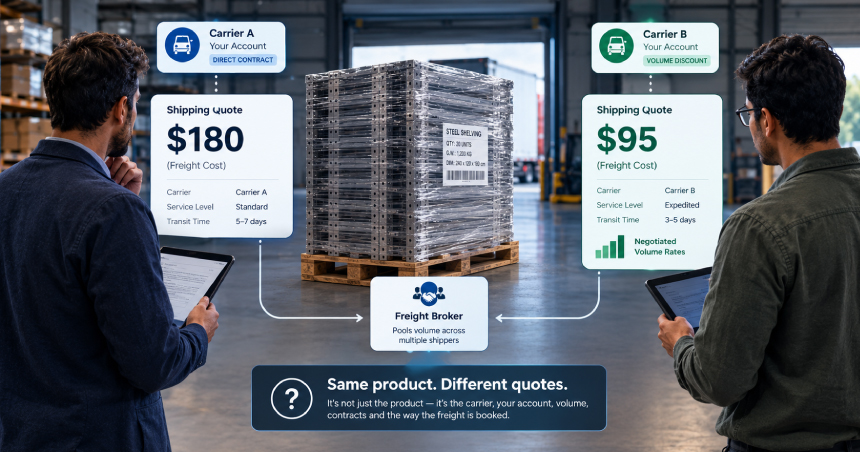
Why do two buyers get different shipping quotes for the same product?
Carriers set rates per shipper account. So what a pallet costs to ship depends on whose account it ships under.
A large distributor with years of volume might pay far less than a small shipper for the same pallet. Small shippers sometimes reach similar rates only through a broker that pools volume across many customers.
That’s not favoritism. It’s how carrier contracts work. No software invents a discount you don’t have. This is the one piece of the freight puzzle that data alone can’t solve.
That’s a big reason “freight quoted separately” shows up so often on B2B sites. It’s honest. It’s also the moment quote-to-order automation would otherwise keep moving. Instead the order waits on a person to check rates.
Does an unclear shipping cost actually cost sellers orders?
Yes, at least for the cost side of the picture. Extra costs are one of the top reasons online shoppers walk away from a purchase.
The Baymard Institute’s cart abandonment research found that 40% of shoppers who abandoned an order cited extra costs like shipping, tax, or fees. Another 12% of those shoppers told Baymard they couldn’t see or calculate the total cost up front. One caveat: this is general ecommerce data, mostly B2C, not a B2B-only study. Baymard doesn’t break B2B out on its own.
A separate 2025 B2B buyer survey looked at 750 buyers, run by Sana Commerce and SAPIO Research. It found that a large share of B2B buyers report frustrations that lead to abandoned orders. The top cause was a lack of clarity around delivery details at decision time. That study is about delivery dates and stock, not shipping cost. Treat it as a related pattern, not proof.
Here’s the honest gap. No public study measures how many B2B orders stall over a missing freight quote. That number doesn’t appear to exist. Want to see what stalled orders are worth in your own numbers? A revenue-impact calculator can help you model it. The freight-quote figure itself just isn’t out there to cite.
This silence is one more version of the response gap. A buyer needs an answer, and nobody has one ready.
What has to be true before a website can show a real-time freight number?

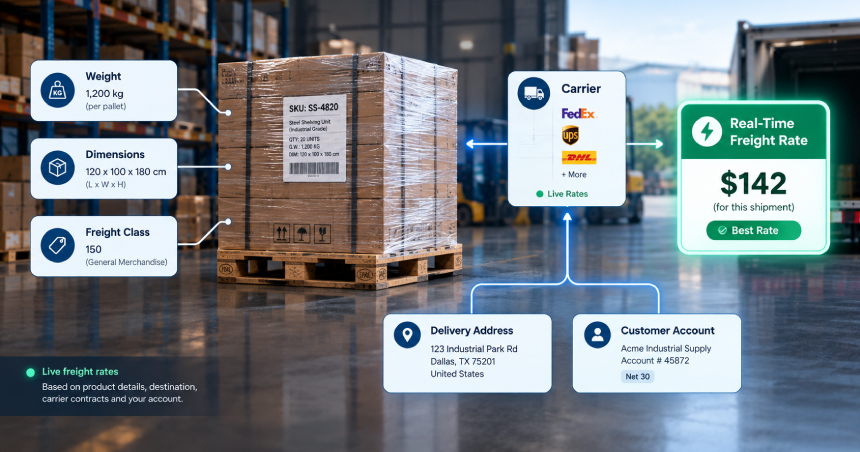
The catalog has to carry weight, dimensions, and freight class per SKU. The platform also has to connect to a carrier account. Only then can a real-time number be accurate.
That breaks down into a short list:
- Weight and dimensions per SKU. Not averaged by category or product line.
- Freight class assigned per SKU or product family. Not derived from weight alone.
- A live carrier account connection. So rates come back fresh, not static.
- A known delivery address before accessorials price. Which is why an accurate quote often can’t appear until checkout or a quote form.
- Negotiated per-account rates mapped to customer records. The same way tiered product pricing already works.
This is a data problem, not a design problem. A carrier’s live rate feed has to be wired into the store. Per-SKU freight data has to stay current across every product. That is store-level eCommerce integration work.
That per-SKU data usually lives somewhere already, most often in the ERP or PIM system first. ERP export data quality is often the real bottleneck, long before any freight number shows up on a page.
People also ask
Why can't ecommerce sites show an exact shipping cost for freight items the way they do for small packages?
Small packages ship at flat, published parcel rates. Freight items don’t. Their price depends on class, size, delivery address, and the seller’s own carrier rate. None of that lives on a typical product page.
What is the difference between LTL freight and parcel shipping?
Parcel shipping covers small boxes at flat published rates, usually under about 150 pounds. LTL means less-than-truckload freight. It covers pallets that share truck space with other companies’ goods. LTL is priced by class and size, not a flat rate.
Why do two B2B buyers get different shipping quotes for the same product?
Carriers set rates per shipper account, not per product. The cost to ship the same pallet can vary by account. It also varies by which carrier the seller uses.
What information does a supplier need before they can quote freight shipping?
A supplier needs the item’s weight, size, and freight class. They also need the delivery address. Only then can they price extras like liftgate or residential delivery. Without all of that, any number is a guess.
Conclusion
The shipping-cost question is hard for a simple reason. The honest number depends on facts you don’t have until the buyer shows up. Freight class, size, delivery address, and your own rate all have to line up first.
None of that makes the question impossible to answer. The right catalog and quote workflows can route that moment faster. The buyer isn’t left waiting on an inbox. Get the data right, and the silence gets a lot shorter.
Frequently asked questions
Less-than-truckload freight, where a shipment shares truck space with other companies’ freight. It’s typically used for palletized shipments over roughly 150 pounds.
A freight class is a category from 50 to 500, set by the National Motor Freight Classification system. It’s based on density, stowability, handling difficulty, and liability risk, and it’s a main input into LTL cost.
Dimensional weight prices a shipment by the space it occupies: length times width times height, divided by a standard factor. Carriers bill whichever is higher, actual or dimensional weight.
Accessorial charges are extra fees for services beyond standard dock-to-dock delivery. Liftgate service, residential delivery, and inside delivery are common examples.
Fuel surcharges are calculated as a percentage of the base rate, tied to a fuel-price index. They adjust on a schedule, often weekly, so the same route can price differently week to week.
Yes, but only with clean data. The catalog needs weight, size, and freight class per SKU. The store also needs a live carrier account link. Without that, a rate widget shows the wrong number.
Turn your catalog into a 24/7 sales channel
Stop sending PDFs. Start capturing demand.
Try ChatSKU Free →About the author

Gigi JK is the founder of ChatSKU and Virtina, bringing more than 28 years of experience across digital transformation, eCommerce strategy, AI-driven growth systems, and business modernization. His work spans startups, scale-ups, and SMBs, with a focus on turning complex operational problems into practical growth frameworks. Before ChatSKU, Gigi built and scaled a seven-figure eCommerce business and led Virtina as an eCommerce engineering and business transformation consultancy. At ChatSKU, he focuses on helping B2B manufacturers, distributors, and wholesalers make complex catalogs searchable, quote-ready, and agent-ready without forcing a full platform rebuild.