

Executive summary
Agentic commerce means the thing reading your website is increasingly software, not a person. And software that cannot find your answer does not call you back. It leaves you off the list.
The buying has not been automated. The choosing has. Your customer still signs the order, but the short list gets drawn before anyone at your company hears from anybody.
This guide answers the four questions owners actually ask. Does it replace your sales reps. Are your customers already doing it. What happens to your margin. And do you need a developer to deal with any of it.
Introduction
It is two o’clock on an ordinary Tuesday. Something arrives at your website looking for a half-inch stainless fitting in a pressure rating you stock.
It reads three pages. It cannot work out whether the part ships this week. So it leaves.
Nobody at your company ever knows it happened. No call, no email, no form, no abandoned cart. Your inside sales desk had a quiet afternoon, and a competitor picked up a line on a quote.
That is the part people miss. This is not an after-hours story. It happens in daylight with your whole team at their desks.
Here is the plain version. The buyer sent an assistant instead of calling, and the assistant will not ask a follow-up question. A person who cannot find the answer picks up the phone. Software that cannot find the answer scores you lower and moves on.
No acronyms in this piece. No platform project. No assumption that you employ anybody who writes code.
What is agentic commerce, in plain language?
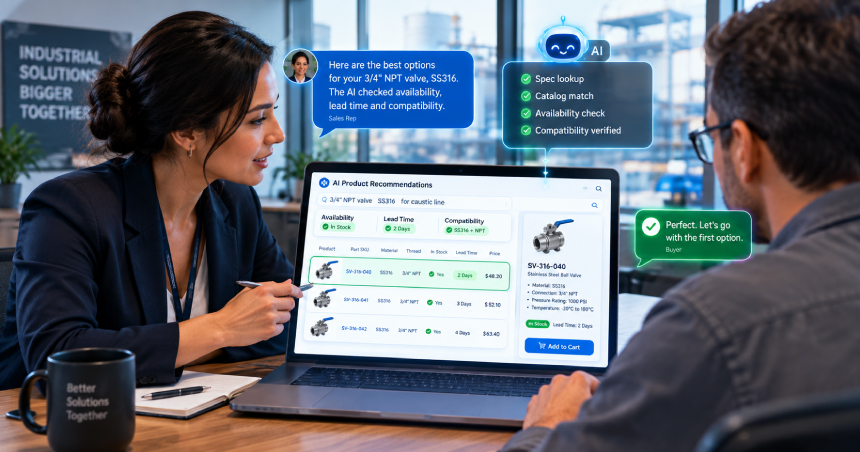
Agentic commerce is when the thing asking about your products is software, not a person. It decides on its own. Nobody rings your office. It compares, it ranks, it builds a short list. It finishes before anyone at your company hears from a human being.
Now the part that should make you feel less like a beginner. You have been selling to software since 1979.
Electronic purchase orders replaced phoned and faxed orders decades ago. If your company is over a certain size, you already have customers whose systems send orders with nobody typing them. You built that. It works.
Agentic commerce is the same idea, minus the eighteen-month onboarding project and minus the agreement signed in advance.
The old way: you and your customer agreed on a format and connected the pipes. Everybody knew it was coming. The new way: the buyer’s software shows up at your website and reads whatever it can find. No agreement. No warning.
That is the whole difference. It is also why this feels new when the underlying idea is forty-seven years old. If someone technical on your team wants the vocabulary, our agentic commerce glossary covers the terms.
Does this replace your sales reps?

No, and the data leans the other way.
Gartner published a survey in May 2026. In it, 69% of B2B buyers said they check what AI told them with a sales rep. The software gathers. The human confirms. Gartner also predicts that by 2030, 75% of B2B buyers will prefer sales experiences that put human interaction first.
Sit with that, because it is odd. The same firm forecasting that most B2B buying will run through AI is also forecasting buyers swinging back toward people. Nobody knows which wins. Anyone who says they do is selling something.
What is not in dispute is which work the software takes first.
It takes the part of your rep’s day that was never selling anyway. The stock check. The price confirmation. The spec lookup your best rep has answered ten times this week and will answer ten more next week. That is not a relationship. It is a lookup.
Your rep becomes the person the buyer calls to check the software’s answer. That is a role change, not a redundancy.
There is a quieter benefit in there too. Reps buried in lookups are why quotes take two days, which is the response gap faster competitors keep beating you on.

Are your customers actually doing this yet?
More than you think. And more than you think they think.
Deloitte’s B2B agentic research found that 40% of B2B buyers already use agentic AI in purchasing, against 24% of suppliers. Your customers moved first. They usually do.
Deloitte also found that 72% of suppliers describe their sales process as mostly or highly automated. Only 47% of buyers agree.
Read those two numbers slowly. Seven in ten suppliers believe they have this handled. Fewer than five in ten of their customers agree. That gap is not about technology. It is about self-perception, and it is the most uncomfortable finding in the pile.
Then there is timing. Forrester’s 2026 predictions put one in five B2B sellers into agent-led quote negotiation during this year. So much for waiting until 2030.
Now the honest part, and it matters more than any number above. Nobody has measured this in industrial distribution specifically. The published research covers software buyers, enterprise procurement teams, and retail. There is no study of what a fastener distributor’s customers are doing on a Tuesday, and we will not pretend otherwise.
What the research does establish is direction. Everywhere it has been measured, buyers are ahead of sellers.
If software only sees your price, what happens to your margin?
You lose on price, because price is the only thing you gave it to compare.
Think about a load board. A carrier does not win a load because the dispatcher likes them. They win it because their rate, their lane, and their availability were legible on a screen when the load posted. Nobody there gets credit for being good on the phone.
Agentic commerce is a load board being built around your product catalog. And most catalogs today publish exactly one comparable fact.
There is a sharper version of the risk. When the buyer’s software and the seller’s software negotiate, both walk straight down toward the seller’s floor price. Neither has a reason to stop. There is no relationship in the room to slow it down.
So the counter is not secrecy. The counter is giving the software more to look at than a number.
Availability. Lead time. Contract terms. Whether you can actually fill the order Thursday. Whether your cross-references are accurate, so a buyer holding a rival’s part number still lands on yours. Those facts win business every day on the phone. They are just not written down anywhere software can reach.
If the only easy-to-find fact about your company is a price, that price is your entire pitch.
That is the real business case for an AI-ready product catalog. We are not going to invent a dollar figure for what ignoring this costs you, because nobody has a credible one. If you want a number, model your own numbers against your quote volume.
Do you need to hire a developer to deal with this?

Not to start. The first moves are business decisions, not engineering ones.
Decide what you are actually willing to publish. Most suppliers hide price out of habit rather than strategy. Some of that habit protects real margin. Some of it quietly costs you inclusion. Separating the two is your call, not a developer’s.
Get stock and lead time somewhere a stranger can reach. If your own website cannot say whether a part ships this week, nothing else on this list matters yet.
Make your product information say what your reps say. If your best rep knows five things about a part that appear nowhere in your catalog, your catalog is not describing your business.
Stop hiding the facts a buyer needs to choose you. Every one of them is something you already give away freely, one phone call at a time.
If someone at your company runs the systems, give them one job. Our ERP export self-check runs about ten minutes and names the product fields you are missing.
This is where ChatSKU fits, and we will be specific about it. It reads the catalog files you already have. A PDF price list, a spreadsheet, an ERP extract. Then it answers buyer questions from them. One line of code on your site. No rebuild, no migration.
It was built for manufacturers and distributors, which is why customer groups and tiered pricing sit inside it rather than bolted on. Here is what ChatSKU connects to.
People also ask
Is agentic commerce the same as a chat window on a website?
No. A chat window waits to be asked. Agentic software goes looking, compares, and decides on its own. For the category explainer, start with what a B2B catalog chatbot actually does.
Which orders will software buy first?
The routine third of your order book. Commodity items, small repeat spend, straight reorders. Not the eleven-year account with redlined terms behind it. Complexity is a slow lane for software, and most of your best business lives there.
Can a small distributor compete when software is choosing?
Yes, and being small may be the opening. Software carries no incumbent bias. It does not know who has more branches or four decades in the trade. It knows only what it can read.
Is anyone in industrial distribution actually doing this yet?
Not in a confirmed, published way. Amazon Business has shipped buyer-facing AI tools, so the direction is not theoretical. But nobody in this trade has a verified agentic purchasing setup you can go and look at. Early is not behind.
Conclusion
Agentic commerce is not robots buying things from you. It is software deciding whether you are worth asking, using only what it can find.
The buying has not been automated. The choosing has. That is the entire story, and it is happening at two in the afternoon on ordinary Tuesdays.
So here is one thing to do this week. Open your own website as a stranger and ask it three questions. What does this cost, do you have it, and when does it ship. If you cannot get all three answers without a phone call, neither can your buyer’s software.
Frequently asked questions
It means software, not a person, researching and short-listing suppliers for a buyer. The short list then goes to the human who signs.
It will try, and it has no built-in reason to stop. Your protection is not secrecy. It is giving the software facts other than price to weigh, starting with availability and lead time.
No, but you do have to publish something. And think about what you already accept. Every time you pull a credit report, you let software judge a customer’s finances. You never re-verify that score yourself. The unfamiliar part is not software deciding. It is software deciding about you.
It happens, and it lands on your reputation either way. An assistant answering from thin information will fill the gaps itself. That makes it a data problem before it is an AI problem.
Find out what your own website tells a stranger about stock, lead time, and price. Write down every question it cannot answer. That list is your project plan, and no developer is needed to write it.
Turn your catalog into a 24/7 sales channel
Stop sending PDFs. Start capturing demand.
Try ChatSKU Free →About the author

Gigi JK is the founder of ChatSKU and Virtina, bringing more than 28 years of experience across digital transformation, eCommerce strategy, AI-driven growth systems, and business modernization. His work spans startups, scale-ups, and SMBs, with a focus on turning complex operational problems into practical growth frameworks. Before ChatSKU, Gigi built and scaled a seven-figure eCommerce business and led Virtina as an eCommerce engineering and business transformation consultancy. At ChatSKU, he focuses on helping B2B manufacturers, distributors, and wholesalers make complex catalogs searchable, quote-ready, and agent-ready without forcing a full platform rebuild.