
Executive summary
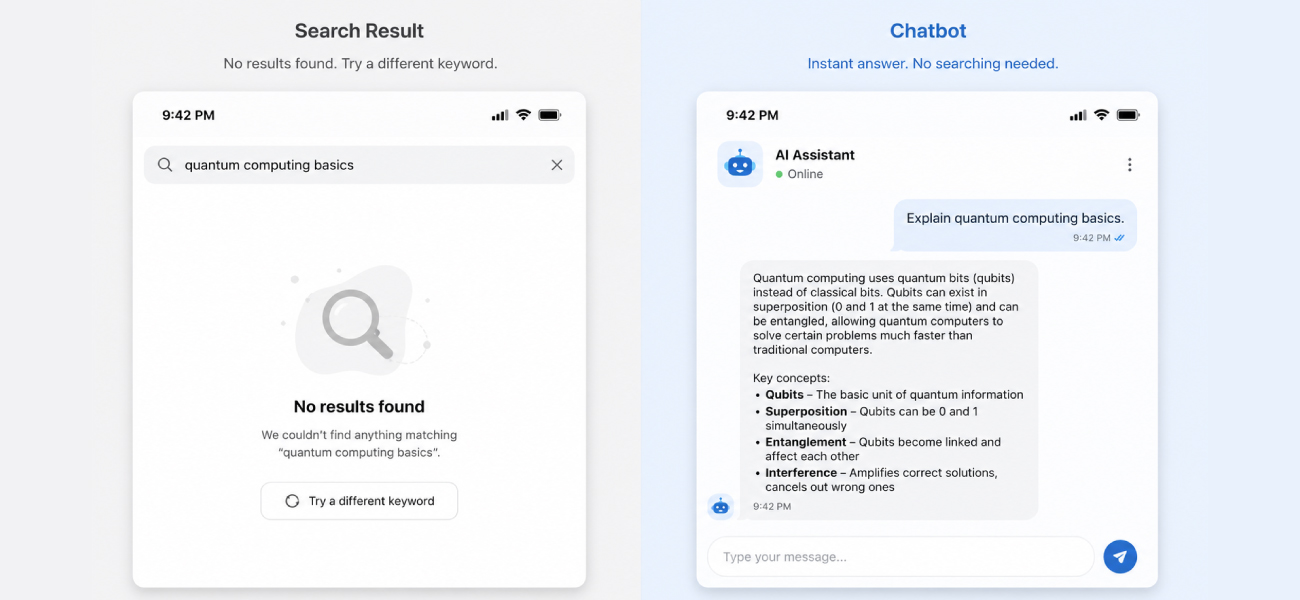
Most B2B product catalogs are static. They list what you sell, show a list price, and wait for a buyer to figure out the rest. If the buyer has a question about specs, contract pricing, or compatibility, they either call your office during business hours or move on. A B2B catalog chatbot changes that equation.
A B2B catalog chatbot is an AI assistant that reads your own product data, the PDFs, spreadsheets, and ERP exports you already have, and answers buyer questions in plain language, around the clock. It handles SKU lookups, applies customer-specific pricing, confirms availability, and captures quote requests without a rep needing to be online. It is built for catalog complexity: large SKU counts, multi-layer pricing, trade-language search terms, and the reality that buyers are researching long before your sales team is at their desk.
If you are hearing about this category for the first time, this guide covers what these tools actually do, why standard catalogs and generic chat tools cannot do the same job, and what to look for before committing to one. By the end, you will know whether it fits your operation or not.
Introduction
It is 9pm on a Tuesday. A procurement manager at a regional wholesale distributor pulls up your catalog to check three things: whether you stock a specific fitting in the grade she needs, what her company’s contract price is, and whether you can ship by Thursday. Nobody is at your company to answer. Your catalog has the product listed, but the page shows a list price that does not match her negotiated rate. Your search bar does not recognize the part number she typed. So she tabs over to another supplier, gets an answer in two minutes, and places the order before morning.
You will never know that deal was available.
This is not a rare edge case. Research from The Insight Collective (2025) found that more than 40% of B2B buyers engage with supplier content in the evenings, and 24% do so on weekends. A significant share of buying research happens outside the hours your sales team is at their desks. Your catalog is live. Your sales team is not.
The response gap is one part of the problem. The other part is that most B2B catalogs cannot answer the questions buyers are actually asking. A static product page does not know your contract pricing. Your search bar does not understand trade terminology. There is no one to ask clarifying questions, build a quote, or route a lead to the right rep. Manufacturers, distributors, and wholesalers selling complex products at scale have always felt this gap. A B2B catalog chatbot is the tool built specifically to close it.
On this page
What is a B2B catalog chatbot?
A B2B catalog chatbot is an AI assistant that reads your product catalog and answers buyer questions about specs, pricing, and availability in plain language, 24/7, without a rep.
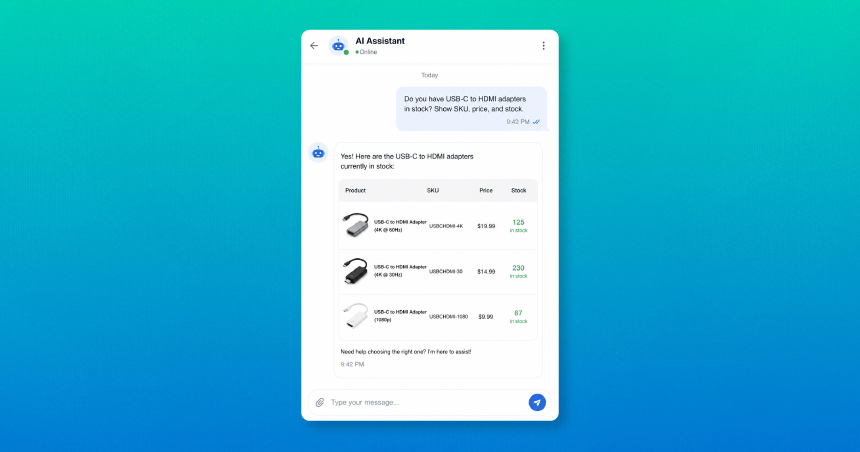
Put simply, it turns your existing product data into something a buyer can have a conversation with. Feed it your PDFs, your spreadsheet, your ERP export, or your existing product data feed, and it indexes that content. When a buyer types a question in the chat window, the assistant searches your catalog data first and returns a specific answer: which SKUs match, what the specs are, what the price is for their account, and whether it is in stock.
The critical distinction is what it reads. It reads your catalog, not the internet. When a buyer asks whether you carry a specific grade of steel fitting that meets a food-safety standard, the assistant is not drawing on general knowledge or guessing. It is retrieving the answer from your indexed product data. If the answer is not in your catalog, it says so. This is what separates a catalog assistant from a generic AI tool that might plausibly, and confidently, give a wrong answer.
Beyond answering questions, these tools capture the commercial intent behind the conversation. When a buyer asks for pricing on forty units with a delivery window, the assistant can generate a quote request and route it to your team, even at 9pm. That is where RFQ automation connects to catalog intelligence. The buyer does not wait until morning. The lead does not disappear. Your team sees a warm handoff with the buyer’s contact, product interest, and quantity already documented.
A standard support chatbot follows scripted paths about return policies and order tracking. A B2B catalog chatbot has to reason over thousands of SKUs, check availability, apply the right pricing tier for a specific buyer account, and handle the kind of precise, technical questions that only make sense if the tool knows your catalog in depth. These are fundamentally different problems, built for different moments in the sales process.
Why do B2B catalogs specifically need one?
The short answer is that B2B catalog complexity creates a class of buyer questions that no static page, no standard search bar, and no scripted support flow can handle reliably. The tool exists because the problem is real and recurring, not because AI adoption is in fashion.
Start with scale. Industrial distributors commonly carry tens of thousands of SKUs, and the largest run into the hundreds of thousands. No buyer can scroll a catalog that large. No sales rep can hold it all in memory. Buyers need to be able to describe what they need in their own words and get a specific answer. When search returns nothing because the buyer’s terminology does not match the catalog’s indexed field exactly, the buyer does not try again with different keywords. They call a competitor.
Then there is pricing. Most B2B transactions involve negotiated contract rates, volume discounts, and minimum order quantities that vary by customer. When a buyer sees a list price that does not match their rate, the natural response is to stop the self-service process and call your office to confirm the real number. That call is avoidable. A catalog chatbot that knows your customer groups can show the right price to the right buyer, instantly, without a rep touching it.
The after-hours reality makes both of those problems worse. According to Gartner’s March 2026 survey of 646 B2B buyers, 67% say they prefer a rep-free experience when researching and evaluating products. They want to find the answer themselves, on their schedule. A static catalog gives them a page. It does not give them an answer.
But here is the nuance that matters for how you think about this: a separate Gartner survey from May 2026 found that 69% of B2B buyers still turn to a sales rep to validate AI-generated insights before making a final purchasing decision. The chatbot handles discovery and qualification. Your reps close the deal. The tool is not a replacement for your sales team. It is the filter that makes sure your reps are spending their time on buyers who are already past the catalog lookup stage, not answering availability questions that a database can answer in seconds.
Speed matters here too. First-responder advantage is real: across speed-to-lead research, the supplier that answers within minutes is far more likely to win the deal than one that responds hours later. Most B2B sales teams are not built to respond in five minutes to an inquiry that arrives on a Sunday afternoon. A catalog chatbot is.
How does a B2B catalog chatbot work?
The mechanics are straightforward, even if the technology underneath is not. Here is what happens when a buyer interacts with one.
Step 1: Ingestion. You connect your catalog. Upload your PDFs, share a spreadsheet, point the system at your ERP or PIM data feed. The platform indexes your product data so it can be searched and retrieved accurately. A good PDF catalog chatbot does this without requiring you to reformat your files or rebuild your data structure first.
Step 2: The buyer asks a question. “Do you carry a half-inch stainless fitting rated for food-grade applications? What’s my price if I order 200 units?” That question goes into the chat window in the buyer’s natural language. No form. No dropdown filter.
Step 3: The assistant searches your indexed data. Not the internet. Your catalog. It identifies the relevant SKUs, cross-references specs, and retrieves the pricing for that buyer’s customer group. This is what makes the answer reliable: it is grounded in your actual product records, not a language model’s general knowledge.
Step 4: Delivery or handoff. If the question is answerable from your catalog, the assistant returns the answer with the matching SKU, spec, price, and availability. If the question is outside the scope of your catalog, or if the buyer asks for something that requires a rep, the system routes cleanly to your team. It does not guess at answers it cannot verify.
Step 5: Lead capture. The buyer’s contact information, the products they asked about, the quantity, and the delivery timeline are captured in a lead record. Your team inherits a warm, documented conversation in the morning. The buyer never knew you were offline.
Who is a B2B catalog chatbot for?
These tools fit best where catalog complexity and buyer expectations collide. If your buyers can find everything they need from a two-page product page and never need to ask about pricing variations, this is not the problem it solves. But if any of the following situations sound familiar, it probably is.
- Distributors with large SKU counts. When your catalog runs to tens of thousands of parts, no buyer can navigate it alone, and no sales rep has it memorized. The chatbot answers the questions your search bar cannot, in the buyer’s language, not your catalog’s taxonomy.
- Manufacturers with spec-heavy products. When compatibility, grade, and application matter as much as price, buyers need more than a product page. They need a spec lookup that works when they type the question the way they would say it out loud.
- Wholesalers with tiered or contract pricing. If your negotiated rates differ by customer, a static catalog always shows the wrong number. A catalog chatbot applies the right price for the right account without a rep confirming it manually.
- Any team losing after-hours inquiries. If buyers are researching while your reps are offline, you are leaving deals available to whoever responds first. The after-hours B2B buyer problem is not limited to a handful of late-night inquiries. It is the majority of the time your catalog is being viewed.
If any of these match your situation, the next question is what to look for when you start evaluating specific tools.
What should you look for when evaluating a B2B catalog chatbot?
The category is growing and every vendor describes their product in similar language. The questions that actually separate useful tools from ones that create more work than they save are grounded in your operation, not a feature checklist.
Can it actually read your catalog? Not a demo catalog. Yours. In the format it already exists in, whether that is a PDF, an Excel file, or an ERP export. Some tools require a structured data migration before they can go live. If a vendor’s answer to “can you ingest my existing files?” starts with “first you will need to…” treat that as a cost item. The setup process is part of the product.
Does it understand your pricing logic? Contract rates, volume tiers, and MOQs are the core of most B2B transactions. A tool that can only surface list prices will create a new problem: buyers who get a price from the chatbot, then call to confirm their real rate, because the two numbers do not match. You have not saved a call. You have doubled it.
Can it answer honestly when it does not know? This is not a soft question. A catalog assistant that confidently returns a wrong spec or an unavailable SKU is worse than no assistant. Buyers will place orders based on what it tells them. The tool needs to know the boundaries of its own knowledge and stay inside them.
Does it hand off to your team cleanly? When a buyer’s question is beyond the catalog’s scope, or when they are ready to commit, what happens? The conversation, the buyer’s contact data, and the specific products and quantities they asked about should all transfer to your team in a form they can act on immediately. A handoff that loses the context makes your rep start over from scratch.
Can it start from what you already have? If deploying the tool requires a PIM migration, a developer engagement, or a database rebuild, the project cost is the vendor’s cost plus your IT cost. Most operations should be able to go live by connecting an existing file or data feed. Ask this question directly before you commit to a contract.
Once you have worked through these questions for your own situation, you are ready to compare specific vendors side by side. The best B2B catalog chatbots 2026 roundup covers seven tools with those exact angles in mind.
How is a B2B catalog chatbot different from a generic chatbot?
The difference is clearest in what happens when a real buyer asks a real question.
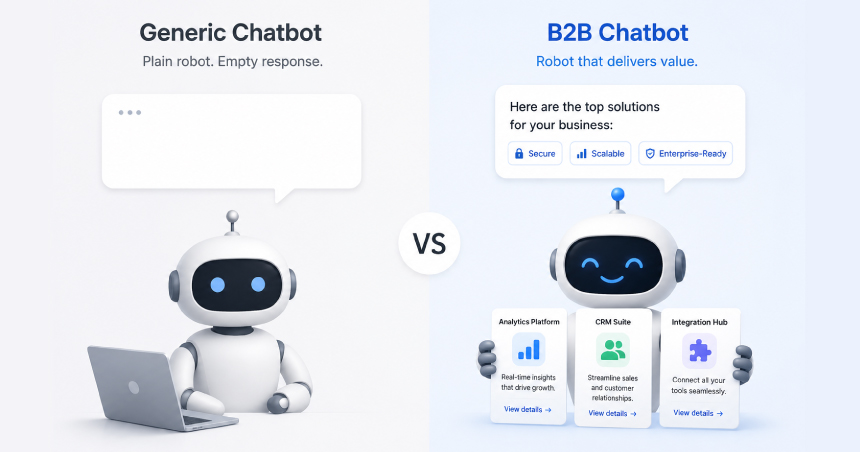
A buyer types: “I need 150 units of your 316 stainless hex bolt, half inch, for a food processing line. What’s my price, and can you ship by the end of the week?” A generic chatbot, the kind built for customer service and scripted FAQ flows, responds with something like: “I would be happy to help. Let me connect you to a sales representative.” The buyer was not asking for a sales rep. They were asking for an answer. They close the chat and try a different supplier.
A B2B catalog chatbot gets the same question and does something different. It searches the indexed catalog for 316 stainless hex bolts in the half-inch size, confirms the product is in stock, retrieves the contracted pricing for that buyer’s account, checks whether the order quantity clears their MOQ, and responds with the SKU, the price, and the shipping estimate. It then asks whether the buyer wants to generate a quote. The buyer books the order without ever speaking to a rep.
The structural reason for this difference is what the tool was built to do. Generic chatbots are built for support: return policies, order tracking, ticket routing. They work from scripted flows and company FAQ content. B2B catalog chatbots are built for pre-sale product intelligence: SKU-level lookups, real-time pricing, compatibility checks, and RFQ capture at scale. Support and pre-sale product intelligence are not the same problem, and the tools that solve one do not naturally solve the other.
The difference is not the underlying AI. It is what the AI is allowed to know.
People also ask
What types of companies use B2B catalog chatbots?
Manufacturers, industrial distributors, and wholesale suppliers are the most common users, particularly those with large or complex product catalogs. The common thread is not industry sector or company size. It is catalog complexity paired with buyers who need spec, availability, or pricing answers before they can commit to a purchase.
How long does it take to set up a B2B catalog chatbot?
Setup time depends heavily on the tool and how your catalog data is currently structured. Some platforms can ingest an existing PDF or spreadsheet and go live within a day. Full ERP integrations take longer, typically days to a few weeks depending on the ERP and the data quality.
Can a B2B catalog chatbot handle custom pricing for different customers?
It should. Customer-specific pricing, volume tiers, and MOQ logic are the core reasons this category exists as a separate tool from generic chat. A catalog assistant that can only show list prices will push buyers to call your office to confirm their real rate. Before evaluating any specific product, confirm that it supports your pricing structure: customer groups, contract rates, volume breaks, and any account-level exceptions your team currently manages manually.
Is a B2B catalog chatbot the same as a product recommendation engine?
No. A product recommendation engine suggests what a buyer might want to purchase next based on browsing behavior or past orders. A B2B catalog chatbot answers specific questions the buyer is already asking: does this SKU fit my application, what is my price, is it available in my timeframe. The two tools solve different problems and typically coexist in the same operation rather than replacing each other.
How does a B2B catalog chatbot compare to a CPQ tool?
They solve different stages of the buying process. A CPQ tool is usually internal and rep-facing, helping your team configure complex products and build accurate quotes once a deal is in motion. A B2B catalog chatbot is buyer-facing. It answers catalog, spec, and pricing questions at the moment a buyer is researching, then captures the request. The two often coexist: the chatbot front-ends discovery and qualification, and the CPQ handles deep configuration further down the funnel.
Conclusion
B2B catalog complexity is the reason this category of tool exists. The SKU volumes, the contract pricing layers, the trade-language search terms, the after-hours buyers who are not waiting until your office opens. These are the problems that standard catalogs and generic chat tools were not built to handle.
Your catalog is already live around the clock. The buyers searching it at 9pm have questions. The question is whether your catalog can answer them or whether it just shows a page and waits.
Frequently asked questions
Is a B2B catalog chatbot the same as live chat or a sales rep?
No. A B2B catalog chatbot is automated software that answers catalog questions; live chat and a sales rep are humans.
No. Live chat connects a buyer to a human support agent or sales rep in real time. A B2B catalog chatbot is automated. It reads your catalog data and answers product questions without a rep present. It does not replace your reps for complex negotiations or relationship-driven deals. What it does is handle the initial catalog lookup and qualification layer, so your reps spend their time on buyers who are already past the “can you carry this, and at what price?” stage. The buyers who get that far with the chatbot are warmer, better qualified, and arrive with their product interest already documented.
Do I need to rebuild my catalog or website to use one?
No. The right tool ingests your existing catalog data, so you do not need to rebuild your site or database.
Not if you pick the right tool. The better platforms ingest your existing catalog data directly. A PDF price list, an Excel spreadsheet, an ERP export, a product data feed, all of these are valid starting points. You do not need a new website, a PIM system, or a restructured database before you can go live. Ask any vendor you speak with whether their onboarding requires a data migration or developer work before anything is functional. If the answer involves significant infrastructure changes, factor that into the true cost of deployment.
Will it work if my catalog is just a PDF or a spreadsheet?
Usually yes, if the tool supports file-based ingestion. Confirm it can index your actual PDF or spreadsheet before you commit.
It should, provided the tool supports file-based ingestion. Not all do. Some platforms require structured data in a specific format, which means your PDF or spreadsheet would need to be converted before they can use it. If your catalog currently lives in a PDF or a spreadsheet, confirm that the platform can index it directly before you sign anything. PDF catalog chatbot capabilities vary significantly by vendor, and it is worth testing your actual files during any evaluation process.
Does this replace my sales team?
No. It handles catalog lookups and qualification, while your reps still close deals and handle negotiation.
No. According to Gartner (May 2026), 69% of B2B buyers still turn to a sales rep to validate AI-generated insights before making a final purchasing decision. The chatbot handles the catalog lookup and qualification stage. Your reps handle the close, the relationship, and the deals that require judgment and negotiation. The practical effect is that your reps’ time goes toward buyers who are already in motion, not toward answering availability questions that a database can resolve in a few seconds. You do not need fewer reps. You need your current reps working on the right conversations.
Is this only for large distributors, or does it work for smaller wholesalers too?
No. It fits any business with catalog complexity and after-hours buyers, regardless of headcount.
Both. The shared condition is catalog complexity and after-hours buyers, not company headcount or revenue. A wholesale supplier with 8,000 SKUs and two sales reps has the same core problem as a national distributor with a hundred reps. Buyers are researching outside business hours. Catalog questions are going unanswered. Deals are going to whoever responds first. The scale of the catalog and the size of the sales team change the scope of the solution. They do not change whether the problem exists. If your buyers are researching your catalog at hours when your team is not available, this tool is relevant to your operation.
How is this different from the search bar on my website?
A search bar matches text; a catalog chatbot understands intent, applies your pricing, and can build a quote in one conversation.
Your search bar finds matching text. Type a product name that matches an indexed field, and you get a results list. Type the same product using a different term, a trade name, or a part number formatted differently from how it appears in your system, and you get nothing. A B2B catalog chatbot understands the intent behind the question. It can ask a clarifying question, cross-reference your specs, apply your pricing logic for that customer’s account, and generate a quote, all in one conversation. The experience is not an incremental improvement on search. It is a different kind of interaction entirely.
Turn your catalog into a 24/7 sales channel
Stop sending PDFs. Start capturing demand.
Try ChatSKU Free →
About the author
Gigi JK is the founder of ChatSKU and Virtina, bringing more than 28 years of experience across digital transformation, eCommerce strategy, AI-driven growth systems, and business modernization. His work spans startups, scale-ups, and SMBs, with a focus on turning complex operational problems into practical growth frameworks. Before ChatSKU, Gigi built and scaled a seven-figure eCommerce business and led Virtina as an eCommerce engineering and business transformation consultancy. At ChatSKU, he focuses on helping B2B manufacturers, distributors, and wholesalers make complex catalogs searchable, quote-ready, and agent-ready without forcing a full platform rebuild.