
Executive summary
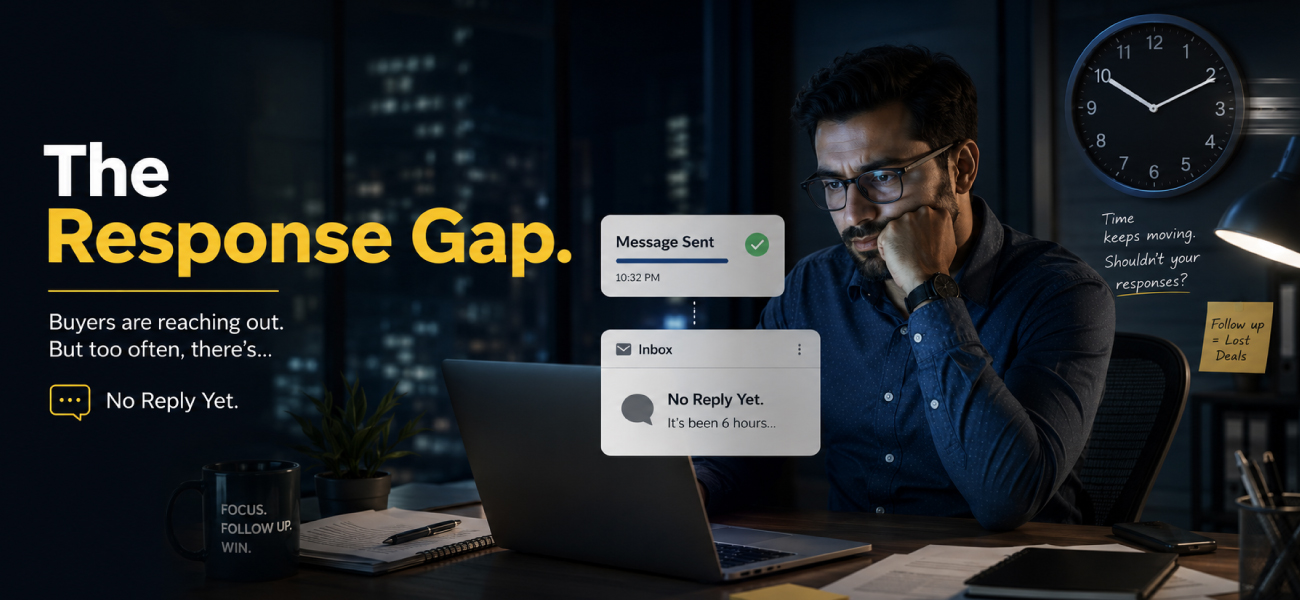
The response gap is the time between a buyer’s first question and your first human reply. That’s it. No jargon, no funnel diagram required. A buyer submits an RFQ, asks a spec question, or fills out a contact form, and then waits. Sometimes for hours. Sometimes for days.
This isn’t a staffing problem. It’s a timing problem. Your sales team isn’t lazy or understaffed. Your website simply wasn’t built to answer anyone in real time. It was built to display products and collect forms, then hope a human gets to them before the buyer gives up.
This guide defines the response gap, names its two failure moments, shows what it actually costs using independently sourced research, and walks through how a catalog-aware AI assistant closes it the same day you deploy it. One deployment. Problem closed.
Introduction
It’s 9:40pm. A buyer is comparing three suppliers for a bulk order. He asks your site a spec question through the contact form: does this part come in a food-grade rating, and what’s the lead time on 500 units?
Nobody answers. There’s no one to answer. Your team left at 5:30. The form sits in an inbox, unread until morning.
He doesn’t wait around. He opens the next tab, asks the same question to your competitor, and gets a real answer in nine minutes. By the time your rep opens that form at 8:15am, the order is already placed. Somewhere else.
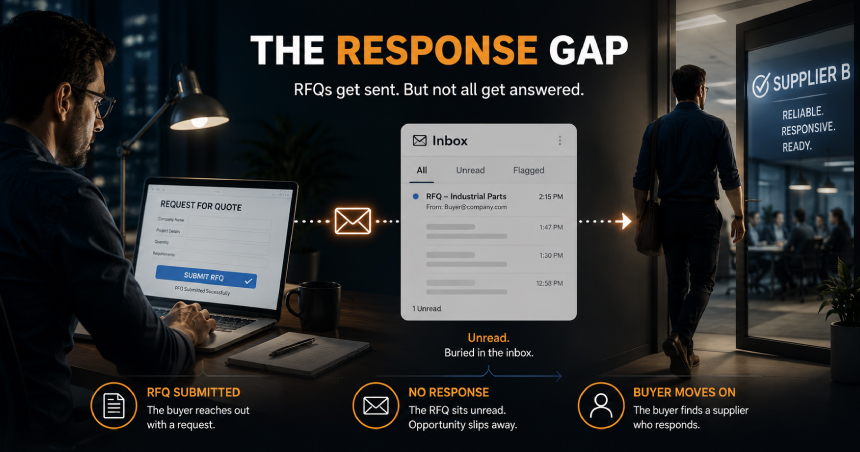
Or picture the daytime version. A buyer submits an RFQ through your website at 11am on a Tuesday. Three days later, someone finally replies with a quote. By then the buyer has already qualified two other vendors and picked one.
Here’s what’s actually happening when that happens.
What is the response gap, exactly?
The response gap is the delay between a buyer’s first inquiry, whether that’s an RFQ, a spec question, or a plain contact form, and the first reply from an actual human at your company. It doesn’t matter how good your product is or how competitive your pricing is if nobody answers before the buyer moves on. This hits B2B distributors and manufacturers hardest, since their buyers ask precise spec and quote questions a generic contact form was never built to handle.
There are two concrete moments where this shows up, and they’re worth naming separately because they have different causes.
RFQ and quote-request delay. A buyer asks for pricing on a specific quantity or configuration. Without automation, the average time to a first reply runs around three days. Three days is an eternity when the buyer is comparing you against two other vendors who might answer same-day.
After-hours inquiry silence. A buyer researches on their own schedule, evenings, weekends, whenever they have a spare ten minutes. If they land on your site outside business hours and ask a question, the honest answer is that your revenue captured from that inquiry is zero. Not low. Zero. Nobody was there to take it.
Layer on top of both of those a hard truth about buyer patience: most buyers give a supplier about one hour before they move on to a competitor. Not a day. Not “by end of week.” An hour. If the response gap stays open past that window, you’ve usually already lost the deal, you just don’t find out until later, if at all.
This is a different problem than a slow-loading site or a confusing product page. Buyers aren’t leaving because your catalog looks bad. They’re leaving because they asked a question and got silence back. That’s a close cousin of the passive catalog problem, where the catalog itself has no way to answer at all. The after-hours buyer problem covers one half of that silence in more depth. This piece is about the whole condition, both halves, and why it happens in the first place.
Why does the response gap happen? (it isn't staffing)
The instinct is to blame headcount. Hire another rep, add a night shift, staff up the inbox. That instinct is wrong, and it’s expensive to act on.
This isn’t a staffing problem. It’s a timing problem. The real cause is architectural. Most B2B websites are built to display products, not to answer questions the moment they’re asked. A product page is a static page. A contact form is a mailbox, not a conversation. Somewhere between the buyer typing a question and a human reading it, there’s a delay built into the structure of the site itself, not into the people working it.
Think about what a contact form actually does. It collects information and routes it to a queue. Nobody is watching that queue in real time, because nobody can watch a queue 24 hours a day without burning out or costing a fortune. The form was designed as a secondary feature, an afterthought bolted onto a catalog built to show products, not to hold a live exchange with the person looking at them.
The data backs up how bad this structural gap really is. Harvard Business Review’s research on B2B lead response times found that a typical B2B seller lets 42 hours slip by before replying to a fresh inquiry. Worse, 23% of companies never respond at all. Only 37% manage to reply inside an hour, the window most buyers actually need.
Forty-two hours is not a staffing failure at any one company. It’s the industry default. It’s what happens when websites are built around product display and sales teams are built around business hours, and buyers are neither.
What does the response gap actually cost you?
Start with qualification odds, because they change fast. That same HBR research found that companies who reply within an hour are roughly seven times more likely to qualify the lead than companies who reply later. Not seven percent more likely. Seven times. The window where a reply actually converts a buyer is short, and most companies miss it by a wide margin.
Now translate the two failure moments into dollars, using the same figures the response gap itself is built on.
A three-day average RFQ response time means every quote request sitting in that queue is a deal quietly slipping toward a competitor who replied first. It doesn’t show up as a lost sale on your dashboard. It shows up as a quote that simply never converts, and nobody flags why.
Zero dollars captured from after-hours inquiries means every evening and weekend visitor who asks a question gets nothing back. Multiply that across a month of evening traffic and you’re looking at real revenue that never had a chance to close, not because the buyer wasn’t interested, but because nobody was there when they were.
Buyers aren’t willing to wait around for that callback either. Gartner’s 2026 buyer survey found that 67% of B2B buyers would rather finish a purchase without talking to a sales rep at all. That doesn’t mean they don’t want answers. It means they want the answer immediately, self-serve, without booking a call or waiting on a human to get back to them. A response gap left open is a direct mismatch with how buyers actually want to shop.
If you want to see what this looks like against your own traffic and average order value, calculate your revenue gap using your real numbers instead of averages.
Response gap open vs response gap closed
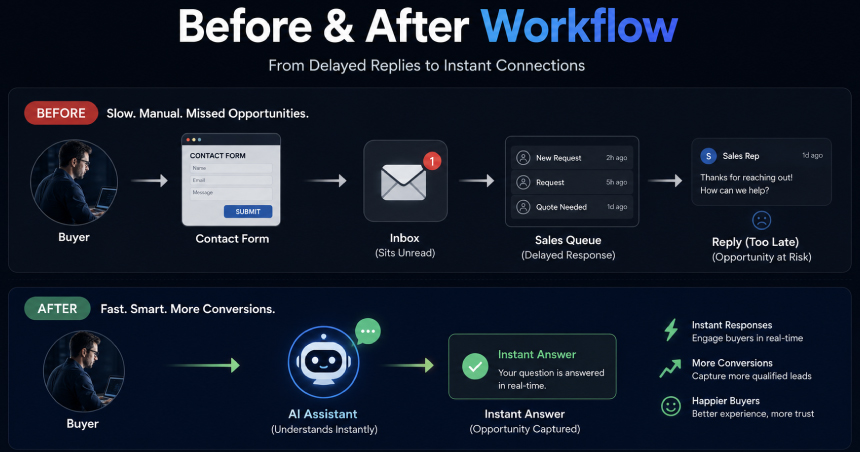
Here’s the same buyer journey, side by side, with the response gap open and with it closed.
| Moment | Response gap open | Response gap closed |
|---|---|---|
| RFQ response time | Average of 3 days | Instant, in the conversation |
| After-hours coverage | None, revenue captured is $0 | 24/7, no rep required |
| Spec question turnaround | Waits for a rep to open the form | Answered on the spot |
| Buyer’s next move | Moves to a competitor within about an hour | Stays in the conversation, moves toward a quote |
| Revenue captured after hours | $0 | Captured same as business hours |
| Staffing required to fix it | Assumed to be more reps | None, it’s a deployment, not a hire |
Most B2B websites sit firmly in the left column. Not because the team is bad at their jobs, but because the site was never built to close that gap in the first place.
How do you close the response gap overnight?
The fix is structural, not a hiring decision. You don’t close a timing problem by adding more people to a queue that’s already too slow. You close it by putting something on the page that can answer the moment the question is asked, whether that’s 11am on a Tuesday or 9:40pm on a Sunday.
That’s what a catalog-aware AI assistant does. It sits directly on your product and RFQ pages, already knows your inventory, pricing, and specs, and answers the buyer in the same window they’re asking. One deployment. Problem closed.
Deploying it is not a website rebuild. It’s usually a same-day process:
- Connect your catalog. A PDF, a spreadsheet, or a direct ERP feed all work as they are. No reformatting required first.
- Set your rules. Pricing tiers, customer groups, and RFQ routing get configured so the right buyer gets the right answer.
- Set after-hours behavior. Decide what happens outside business hours, full self-serve, quote capture, or both.
- Paste one line of code. That’s the whole deployment. Your site starts answering the moment it’s live.
This isn’t about replacing your sales team. It’s about making sure nobody has to wait until your team is back at their desk to get an answer. Think of it as the night-shift rep that catches everything your daytime team can’t be there for, and hands off anything that needs real judgment. It’s the same shift behind what a conversational catalog looks like when it’s actually working: not a brochure, an assistant that talks back. If you want the full before-and-after picture, see how ChatSKU closes it.
If your team is buried answering the same three questions every day instead of closing deals, that’s a related but distinct issue. Slow, inefficient replies from an overloaded team are the human bottleneck, a cousin problem to the response gap, not the same thing. The response gap is about no answer in time. The human bottleneck is about an answer that’s too slow or inconsistent even when someone’s trying.
And this is a different moment in the funnel than what happens after a quote already went out. If you’ve sent the quote and heard nothing back, that’s the silence after a quote goes out, a separate failure point worth solving on its own.
People also ask
Is the response gap the same as slow customer service?
No. General customer service slowness covers support tickets, returns, and account issues after someone is already a customer. The response gap is specifically the window between a buyer’s first inquiry, before they’ve bought anything, and your first human reply. It’s a pre-sale problem, not a post-sale one, and it’s the moment where a prospect decides whether to keep considering you at all.
How fast is fast enough for a B2B buyer?
Roughly one hour is the benchmark worth aiming for. HBR’s research found that companies replying within an hour are about seven times more likely to qualify the lead than companies who take longer, and most buyers move on to a competitor within about that same window if nobody’s answered yet.
Does the response gap only happen after hours?
No. After-hours silence is one failure moment, but RFQ delays happen just as often during business hours. A quote request submitted at 11am can still sit for three days if there’s no system built to answer it faster than a human can get to the inbox. Two separate moments, same underlying gap.
Can a small sales team actually close this without new hires?
Yes, and that’s the entire point of the reframe. The response gap isn’t caused by too few people. It’s caused by a website with no real-time answer layer. A catalog-aware AI assistant closes the timing gap without adding a single hire, freeing your existing team to work the deals that actually need a human.
Conclusion
Every unanswered inquiry is a closed deal. Just not yours. The response gap isn’t about how hard your team works. It’s about how long a buyer has to wait before someone, or something, answers them.
Close that gap and the math changes. RFQs stop stalling for three days. After-hours visitors stop leaving with zero revenue captured. Buyers stop drifting to whoever answered first, because this time, you did.
See how ChatSKU turns your existing catalog into a night-shift rep that never misses a question, deployed in a day, no new hires required.
Frequently asked questions
What is the response gap in B2B sales?
What causes the response gap?
How much revenue does the response gap cost?
How is the response gap different from the human bottleneck?
Can the response gap be fixed without hiring more staff?
How long does it take to close the response gap?
Does closing the response gap replace my sales reps?
Turn your catalog into a 24/7 sales channel
Stop sending PDFs. Start capturing demand.
Try ChatSKU Free →
About the author
Gigi JK is the founder of ChatSKU and Virtina, bringing more than 28 years of experience across digital transformation, eCommerce strategy, AI-driven growth systems, and business modernization. His work spans startups, scale-ups, and SMBs, with a focus on turning complex operational problems into practical growth frameworks. Before ChatSKU, Gigi built and scaled a seven-figure eCommerce business and led Virtina as an eCommerce engineering and business transformation consultancy. At ChatSKU, he focuses on helping B2B manufacturers, distributors, and wholesalers make complex catalogs searchable, quote-ready, and agent-ready without forcing a full platform rebuild.