
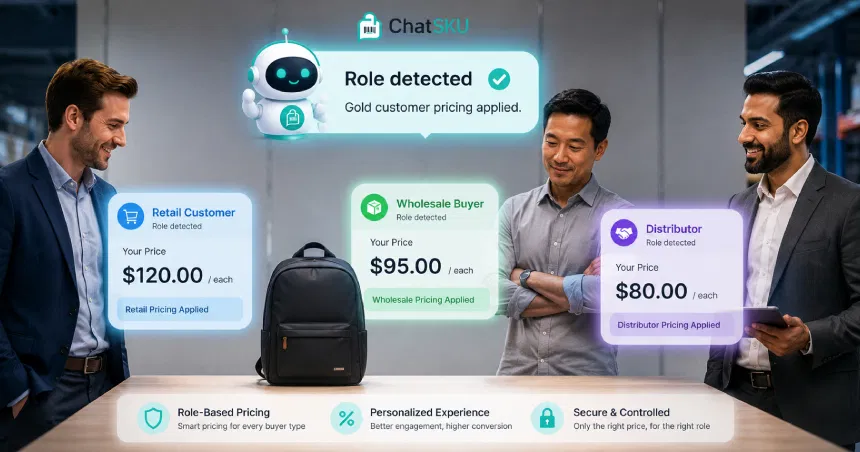
A single public price list is not a B2B pricing strategy. It is a revenue leak.
The answer is direct: manufacturers and distributors need one digital product catalog with controlled customer access, account-specific price lists, and volume tiers applied before a buyer sees a price.
That sounds complex. It is. B2B pricing is not one number per SKU. It is a matrix of customer groups, contract terms, quantities, locations, minimum order quantities, and exceptions.
Your website must handle that matrix without exposing one buyer’s negotiated price to everyone else. It must also work without forcing a website rebuild.
The Problem: One public price for every buyer
A manufacturer may sell the same valve to a retail customer, a regional wholesaler, and a national distributor.
The SKU is identical.
The commercial rules are not.
One customer receives standard pricing. Another receives a 10% wholesale discount. A strategic account receives a negotiated contract price. A distributor unlocks a lower tier only after ordering 500 units.
A static catalog cannot safely manage that structure. It shows one public number, hides every number, or sends every buyer to a manual quote process.
Each option creates a casualty.
- Show one price, and you expose negotiated margin.
- Hide every price, and buyers cannot self-serve.
- Route every question to sales, and quote response time expands.
- Put the logic in spreadsheets, and pricing errors multiply.
Imagine a buyer searching for 2,500 units at 9:42 p.m. They need a price, lead time, and confirmation that the product meets their specification. Your site shows a generic price. Your sales team is offline. The buyer opens a competitor’s website.
The lost order never enters your CRM.
The Business Impact: Margin erosion and conversion loss
The commercial damage appears in three places: margin, conversion rate, and customer lifetime value.
Margin erosion. If every visitor sees the lowest negotiated price, you give away margin to buyers who never earned it. If every visitor sees the highest price, you create sticker shock for strategic accounts.
CVR erosion. Buyers who cannot see a relevant price cannot evaluate the purchase. They abandon the session or submit an incomplete RFQ. Either way, your digital product catalog fails to convert intent.
LTV erosion. Existing accounts expect fast reorders and familiar terms. If the online experience ignores their contract pricing, they return to email, phone, or a competitor portal. The buying relationship becomes harder to maintain.
Industry benchmarks make the exposure visible. ChatSKU’s ROI calculator models 67%–70% of B2B buyers preferring rep-free or fully self-service research, with LinkedIn reporting approximately 75% preference for self-service. The same model uses 75% as the share of buyers who would switch for a better experience, rising to 91% among US buyers.
Those buyers do not wait for a pricing administrator.
They capture the fastest credible answer.
How to Spot It
Run these checks:
- Can a logged-in customer see their negotiated price online?
- Can a distributor see quantity breaks without calling sales?
- Can an anonymous visitor see products without seeing restricted pricing?
- Does your quote team manually look up customer price lists?
- Does your ecommerce price match the price in your ERP?
- Is the price shown online the same price a sales rep quotes?
If the answer changes by channel, your pricing architecture has a structural defect.
Use the ChatSKU ROI calculator to quantify the revenue at risk from self-service leakage, abandonment, and lost repeat orders.

The Problem: Customer groups exist, but the website cannot use them
Most B2B companies already have the pricing logic.
It lives in the ERP. The CRM. A PIM. A spreadsheet. A sales rep’s memory.
The problem is not the absence of rules. The problem is the failure to enforce those rules inside the buying experience.
A website may know that Acme Industrial belongs to the “Distributor West” group. It may know that Acme receives contract pricing on 400 SKUs. But if the storefront only supports one public price, that information stays trapped in the back office.
The buyer sees the wrong price.
The rep corrects it later.
The deal slows down.
The Business Impact: Quote delays become competitive casualties
A manual price lookup adds friction to every RFQ. That friction compounds across product variants and quantities.
A buyer asks:
“What is my price for 500 units of the stainless version?”
The response requires a person to:
- Identify the account.
- Confirm the customer group.
- Locate the SKU and variant.
- Check the correct contract list.
- Apply the quantity tier.
- Confirm availability and lead time.
- Build the quote.
- Send it back.
That is not automated quoting software. It is an administrative queue.
While the queue grows, your conversion rate falls. Sales reps spend time processing low-complexity requests instead of pursuing high-LTV accounts. CAC becomes harder to recover because the website fails to convert demand already acquired.
ChatSKU’s features support customer groups, contract pricing by customer, tiered and volume pricing, minimum order quantities, quote management, and order conversion. The point is not another isolated pricing table. The point is a controlled path from product discovery to quote.
How to Spot It
Measure these KPIs for the last 90 days:
- Median time from RFQ submission to first response.
- Quote-to-order conversion rate.
- Percentage of quotes requiring manual price correction.
- Sales hours spent on price and SKU lookups.
- Average order value by customer group.
- Repeat-order CVR for logged-in buyers.
- Gross margin variance between online and approved quote prices.
If the same SKU produces multiple manual corrections, your customer-group logic is not operating at the point of purchase.
Start with one product category. Compare your public price, group discount, contract price, and volume tier. Then calculate the margin erosion and response delay created by the current process.
The Problem: Tiered pricing is hidden behind a static catalog
A static PDF can document a price list.
It cannot interpret a buyer’s identity, quantity, or buying history.
A basic ecommerce page can display a tier table.
It may not know which tier a buyer is allowed to see.
This is where many wholesale e-commerce solutions fail. They provide a storefront but leave the commercial logic disconnected from the product conversation.
A serious B2B buying assistant must understand more than product names. It must understand:
- SKU and variant relationships.
- Customer group permissions.
- Account-specific contract prices.
- Quantity thresholds.
- Minimum order quantities.
- Units of measure.
- Availability and lead time.
- RFQ and approval rules.
Without that context, AI produces a faster version of the same pricing error.
The Business Impact: The wrong price destroys trust
Price inconsistency is a conversion defect.
A buyer sees $120 online. The sales representative quotes $95. The contract says $80. The buyer does not see a sophisticated pricing engine. They see a supplier they cannot trust.
That trust failure attacks CVR and LTV at the same time.
The buyer may still complete the order. But the next order moves to a competitor with clearer self-service. The account becomes harder to retain. The supplier absorbs another casualty.
The fix is not to expose every price. The fix is to expose the right price to the right buyer.
How to Spot It
Test the same SKU with four identities:
- Anonymous visitor.
- Standard logged-in buyer.
- Wholesale customer.
- Contract account or distributor.
Then test three quantities:
- Below the first tier.
- At the first tier.
- Above the highest tier.
Record what each user can see. Check the product page, assistant, cart, quote, and sales notification.
Any mismatch is a pricing-control failure.

The Fix: Group-based access with customer-specific pricing
The correct architecture separates catalog visibility from price visibility.
A buyer may be allowed to discover a product without seeing a price. Another buyer may see only products assigned to their customer group. A verified account may see contract pricing immediately. A distributor may see volume tiers applied to the exact quantity requested.
This requires four connected controls.
1. Group-based access
Assign buyers to groups such as:
- Retail.
- Wholesale.
- Distributor.
- Strategic account.
- Region or market.
- Internal sales.
- RFQ-only buyer.
Each group receives defined catalog, pricing, and quote permissions.
2. Customer-specific price lists
A contract account can have a negotiated price for one SKU, a category, or the entire catalog. That price overrides the standard list price only for the authorized account.
The contract price stays private.
3. Tiered and volume pricing
Quantity changes price automatically. The buyer can ask, “What is my price at 2,500 units?” and receive the correct result without waiting for a rep.
The assistant must also enforce the MOQ and unit of measure. A case-based product cannot be quoted as individual units without creating a commercial error.
4. ERP e-commerce integration
The ERP remains the source of truth for customers, products, inventory, and pricing rules. The ecommerce layer and AI assistant use that data to deliver the correct buying experience.
This is the foundation of reliable B2B e-commerce AI. The assistant does not invent a price. It applies governed pricing logic to a known buyer and a known SKU.
The Business Impact: Self-service without uncontrolled exposure
With the right controls, self-service becomes a margin protection system.
A retail visitor sees retail pricing. A wholesale buyer sees their group price. A distributor sees their contract price and volume tiers. An unverified visitor sees the product and can submit an RFQ without seeing protected commercial terms.
Everyone gets a path forward.
No one gets the wrong price.
The gain appears in measurable KPIs:
- Higher self-service CVR.
- Shorter quote response time.
- Lower sales cost per quote.
- Fewer pricing corrections.
- Higher average order value.
- Improved repeat-order LTV.
- Lower margin leakage.
- More qualified RFQs captured after hours.
This is the role of an AI-powered B2B buying assistant. It does not replace the sales team. It removes the repetitive work that blocks the sales team.
ChatSKU can be deployed on an existing website with a single line of code. It can work from a PDF catalog, CSV, ERP export, or current ecommerce data. The site does not need to be rebuilt before the pricing problem is addressed. See the PDF catalog chatbot to understand how a static catalog becomes an interactive sales channel.
How to Spot It
Your pricing system is ready for controlled online selling when:
- Customer groups map cleanly to accounts.
- Contract exceptions are documented.
- SKU variants have stable identifiers.
- Quantity tiers have explicit thresholds.
- ERP or PIM data has clear ownership.
- Quote and order events are measurable.
- Anonymous and authenticated experiences are intentionally different.
Start with one high-volume category. Connect one customer group. Test five accounts. Compare online pricing, approved quotes, gross margin, and CVR before expanding.
How ChatSKU Makes the Catalog Commercially Useful
A generic chatbot answers general questions.
A B2B buying assistant handles commercial context.
A buyer can ask:
“Show me the 3/8-inch stainless fitting for 500 units. I am with a wholesale account. What is my price and lead time?”
The assistant identifies the product and variant. It recognizes the customer group. It applies the correct quantity tier. It confirms MOQ and availability. Then it builds an RFQ or quote with the same context attached.
That is automated quoting software connected to product discovery.
It is also a practical wholesale ecommerce solution for companies that cannot justify rebuilding an entire storefront.
The deployment path is simple:
- Upload or connect the existing catalog.
- Configure customer groups, access rules, contract prices, and volume tiers.
- Add the assistant to the existing website.
- Measure quote completion, response time, margin variance, and assisted CVR.
- Expand by category and account group.
Your catalog already contains the product knowledge. The missing layer is commercial intelligence.

The Final Diagnostic: Is your catalog protecting revenue or leaking it?
One catalog can support a thousand prices.
It cannot support a thousand uncontrolled prices.
The difference is governance. Group-based access. Customer-specific price lists. Tiered pricing. ERP e-commerce integration. A buying assistant that understands every SKU, variant, specification, and account rule.
Track these five numbers this month:
- Online CVR by customer group.
- Quote response time.
- Gross margin variance between online and approved prices.
- Percentage of buyers who self-serve without sales assistance.
- Repeat-order LTV from authenticated accounts.
If your website shows one generic price to every buyer, the leakage is already active.
Calculate the exposure with ChatSKU’s ROI calculator. Then see the live demo or start free.
The catalog is not the problem.
The uncontrolled pricing layer is.
Conclusion
Tiered B2B pricing is hard to get right online for a simple reason. Every buyer is looking at the same SKU but has different commercial terms. One public price list can’t show all of those terms without leaking margin or losing the sale.
The fix isn’t another catalog or a website rebuild. It’s control over who sees which price. That means group-based access, customer-specific price lists, volume tiers, and pricing that stays in sync with your ERP. Buyers then get their correct price the first time, and your sales team only steps in where it adds value.
Your catalog already has the product knowledge. Once you add the pricing rules, every buyer can see their own price, and it stays hidden from everyone else.
Frequently asked questions
What is tiered pricing in B2B?
What is customer-specific pricing?
How do you show different prices to different B2B customers online?
Can I hide prices from public visitors on my B2B website?
Why does ERP integration matter for B2B pricing?
Do I need to rebuild my website to support tiered B2B pricing?
Turn your catalog into a 24/7 sales channel
Stop sending PDFs. Start capturing demand.
Try ChatSKU Free →