
Executive summary
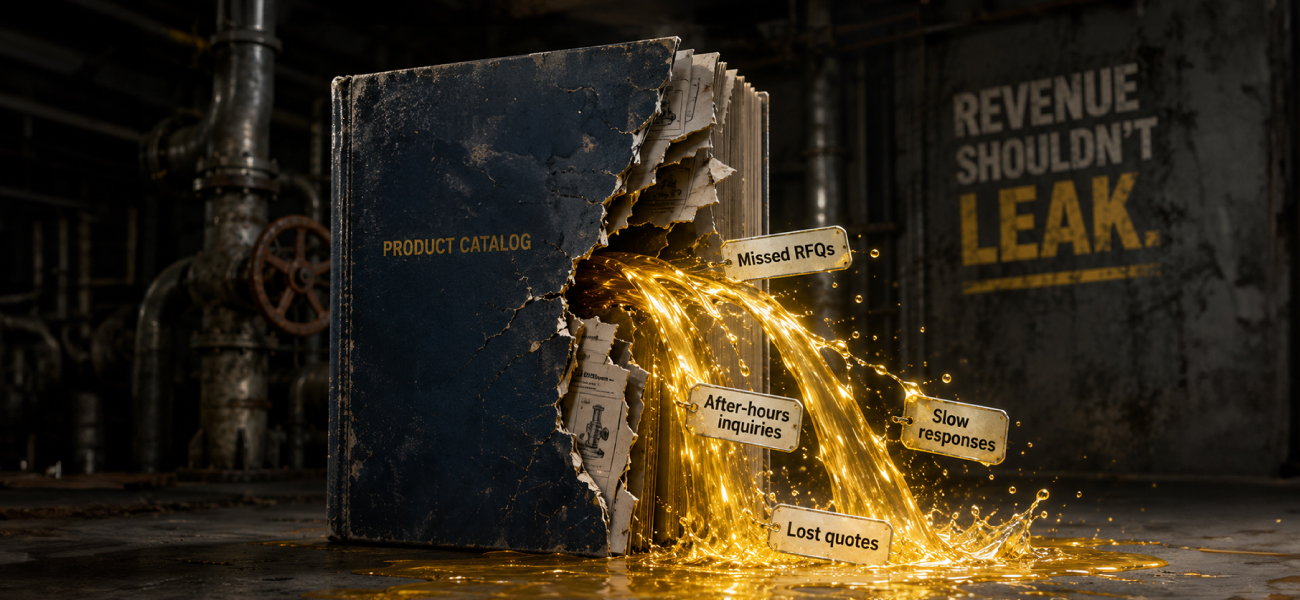
Your B2B catalog has a revenue leak. Not a vague one. A calculable one, tied to your annual revenue, your catalog stage, and the percentage of buyers your current experience cannot close.
The March of Commerce Revenue Model is a real calculation. Not a guess. Your catalog stage determines your leakage rate. The model shows what that costs in actual dollars and what recovery looks like with ChatSKU.
Use the ChatSKU revenue calculator to run your own numbers.
Introduction
It is 9pm on a Tuesday. A purchasing manager finds your site, needs 400 units of a specific SKU, and fills out your contact form. Your team sees it at 8am. Your competitor responded at 7am. The deal is gone.
That story stings. But here is the part most distributors miss: that was not bad luck. That was stage leakage: a structural feature of where your catalog sits in the March of Commerce.
At a PDF catalog stage, that scenario does not happen once. It happens dozens of times a month. The March of Commerce Revenue Model puts a dollar figure on the aggregate. Not a gut feeling. An actual number, built from your revenue and your stage.
What does "revenue left on the table" actually mean for a B2B distributor?
It is not a feeling. It is a calculable percentage of revenue that walks because the catalog experience cannot complete the transaction.
The model starts with your contestable share: the portion of your revenue where buying experience determines who wins. Not all revenue is contestable. Long-term contract work, locked accounts, sole-source specs. Those are sticky. But a meaningful slice of every distributor’s revenue sits in deals where the buyer had options and chose based on who responded, who answered their question, and who made it easiest to quote. That slice is what the model measures.
Within that contestable share, different catalog stages have structurally different leakage rates. A company running PDFs loses a bigger percentage of contestable revenue than a company with a live eCommerce platform. The gap is not small. Understanding what a passive catalog actually costs starts with knowing where your stage sits on that curve.
What is the March of Commerce and where does my catalog sit?
The March of Commerce is a framework that maps catalog maturity across three broad stages. Each stage has a different structural leakage rate because each one serves buyers differently.
Stage 01-03 is the PDF catalog world. Buyers find your products on a static file. They cannot search, configure, or quote. They have to call or email. Most do not. The ones who do wait.
Stage 04-05 is the HTML catalog with an RFQ form. Better. Buyers can browse and submit requests. But the form creates a delay. Nobody answers at 9pm. Self-serve is partial at best.
Stage 06-08 is the platform and eCommerce layer. Buyers can search, configure, price, and quote on their own, any time. Leakage drops sharply because the catalog does the work the sales rep used to do.
| Stage | Catalog type | Typical stage leakage | Self-serve buyers served | After-hours coverage |
|---|---|---|---|---|
| 01–03 | PDF catalog | 20–25% | Low (<30%) | None |
| 04–05 | HTML + RFQ form | 10–15% | Moderate (30–55%) | Partial |
| 06–08 | Platform / eCommerce | 3–6% | High (55–80%) | Full |
Illustrative ranges based on March of Commerce Revenue Model default assumptions.
Which stage does your catalog sit at? That answer drives every number in the passive catalog problem and in the revenue model.
What inputs does the revenue model use, and where do I find each one?
The calculator takes seven inputs. All of them are findable. Here is what each one means and where your real number lives.
-
✓
Annual Revenue. Your total top-line revenue for the last full fiscal year. Find it in your P&L or ERP. Use actual, not projected.
-
✓
Stage. PDF catalog (01-03), HTML + RFQ form (04-05), or Platform / eCommerce (06-08). Honest answer. If buyers cannot quote without calling a rep, you are stage 01-03.
-
✓
Contestable Share (default 40%). The percentage of your revenue where a better or worse buying experience determines who wins. Cross-reference your won/lost analysis in CRM. If you do not have won/lost data, use the 40% default.
-
✓
Self-Serve Buyers (default 70%). The share of your buyers who prefer to research and quote without a sales rep. Ask your sales team what percentage of inbound leads arrive already knowing what they want. Most B2B companies are surprised how high this is.
-
✓
Stage Leakage (default 22%). The percentage of contestable revenue lost because the catalog experience cannot close the deal. Pull from the table above if you are not sure. A PDF catalog defaults to 22%, which sits in the middle of the 20-25% range.
-
✓
Recoverable (default 35%). The realistic portion of leaked revenue that a better catalog experience could capture. Not all lost deals come back. Some buyers are price-driven, some are locked to another vendor. 35% is a conservative floor.
-
✓
Customer Lifetime (default 4 years). How long does a typical account stay with you? Check your CRM retention data. B2B relationships compound. A 4-year lifetime means 4 years of recovery, not just one order.
If you cannot find these numbers from your CRM, use the defaults. They are calibrated to B2B distribution benchmarks and will give you a directionally accurate floor estimate.
What does the calculator output actually mean?
The model produces four outputs. Here is what each one tells you.
Lifetime Value Recovered is the total revenue you could realistically capture over the full customer lifetime if the catalog experience improved. It is not a ceiling. It is what the math says is sitting in your pipeline unserved.
Lifetime ChatSKU Cost is the total cost of the tool over that same customer lifetime. Setup plus monthly fees, multiplied by the lifetime period. This is the investment side of the comparison.
Net Lifetime Gain is what remains after subtracting the cost from the recovery. If the number is positive, the catalog upgrade more than pays for itself. If it is very large, the cost of waiting is the real number to focus on.
Return on Spend is the ratio that matters most for a decision. A 22x return means every $1 of ChatSKU cost returns $22 in recovered revenue. The cost of not using ChatSKU is 22 times the cost of using it. Review ChatSKU’s catalog integration features to understand what powers that return.
What does an example calculation look like?
Here is a worked example with concrete numbers. Mid-market industrial distributor, $5M annual revenue, PDF catalog at stage 02.
Illustrative example: mid-market industrial distributor
- Annual revenue: $5,000,000
- Catalog stage: 02 (PDF catalog)
- Contestable share: 40% = $2,000,000 contestable revenue
- Stage leakage: 22% of contestable = $440,000 at risk annually
- Recoverable: 35% of leakage = $154,000 annual opportunity
- Customer lifetime: 4 years = $616,000 lifetime value recoverable
- ChatSKU cost (illustrative): $12,000 over 4 years
- Net Lifetime Gain: ~$604,000
- Return on Spend: ~51x
Numbers are illustrative. Run your own inputs at the ChatSKU revenue calculator.
The important note is that the model accounts for customer lifetime, not just the first order. B2B accounts that stay for 4 years compound the leakage. The recovery compounds too. A single year of $154K in recovered opportunity becomes $616K when the relationship holds.
How does after-hours buyer loss show up in this model?
The 9pm buyer scenario is not a separate problem. It is stage leakage with a timestamp on it.
A PDF catalog company at stage 02 cannot self-serve a buyer at 9pm. The buyer arrives, finds your catalog, needs a quote, and hits a wall. They fill out a form. Nobody answers. They move on. That moment, repeated across dozens of inquiries each month, is exactly what stage leakage measures. The model counts it in aggregate. The 9pm story just makes it concrete.
According to HubSpot’s research on lead response management, 52% of inbound B2B leads arrive outside standard business hours. Stage 02 companies have no coverage for any of it. That is the structural exposure behind the leakage rate.
Speed matters beyond coverage. Research from Google and the Corporate Executive Board on digital B2B buying behavior shows 35 to 50% of B2B deals go to the vendor who responds first. Not best. Not cheapest. First.
Response time vs. B2B conversion rate
21%
14%
8%
5%
2.3%
Source: HubSpot Lead Response Management research; Google/CEB B2B digital buying behavior. Illustrative visualization.
Response time drives conversion in a way that is not gradual. It falls off a cliff:
- 5 minutes: 21% conversion rate
- 30 minutes: approximately 14% conversion rate
- 1 hour: approximately 8% conversion rate
- 4 hours: approximately 5% conversion rate
- 24 hours or more: 2.3% conversion rate
The move from stage 02 to stage 04+ is not just a catalog upgrade. It is a shift from zero after-hours capability to partial or full coverage. That shift alone changes the leakage rate from 20-25% down to 10-15%. A catalog-aware AI assistant pushes the buyer experience further. That is what closes the after-hours B2B lead problem and bridges the B2B response gap.
What is the fastest path from your current stage to meaningful leakage reduction?
Three options exist. They are not equal.
- Manual follow-up improvement. Hire, train, or incentivize faster response from your sales team. Cost: $60,000 to $80,000 per additional rep per year. Limitation: does not scale with lead volume, and does not work after 5pm. The best sales team in the world cannot respond to a 9pm inquiry by 9:01pm.
- HTML + RFQ form upgrade. Moving from PDF to a web catalog with a form takes leakage from 20-25% down to 10-15%. That is real progress. But an RFQ form still creates a delay. Buyers submit and wait. After-hours coverage is partial. Self-serve quoting is still not possible.
- Catalog-aware AI assistant. Full fix. Buyers get answers in real time, any time, from your actual catalog. No rep required. Stage leakage drops toward the 3-6% range because self-serve buyers can complete their research and begin the quoting process without waiting. This is the structural solution.
“From conversations with our manufacturing and distribution customers, the most common surprise is not how high the stage leakage rate is. It is how much of it was recoverable once the catalog started answering questions in real time.”
ChatSKU team, based on onboarding conversations with 50+ B2B manufacturers and distributors
Learn more about ChatSKU’s B2B AI sales assistant and how ChatSKU works for manufacturers and distributors.
Conclusion
Your catalog has a leakage rate. It is determined by your stage, not your effort. And it is calculable right now from numbers you already have.
The March of Commerce Revenue Model exists because gut feelings are not enough to justify a change. The math does that job. A $5M distributor at stage 02 is looking at $440,000 of contestable revenue at risk annually. Most of that walks quietly, one unanswered buyer at a time.
Start with the model. Run your own number. Then decide.
Frequently asked questions
Turn your catalog into a 24/7 sales channel
Stop sending PDFs. Start capturing demand.
Try ChatSKU Free →
About the author
Gigi JK is the founder of ChatSKU and Virtina, bringing more than 28 years of experience across digital transformation, eCommerce strategy, AI-driven growth systems, and business modernization. His work spans startups, scale-ups, and SMBs, with a focus on turning complex operational problems into practical growth frameworks. Before ChatSKU, Gigi built and scaled a seven-figure eCommerce business and led Virtina as an eCommerce engineering and business transformation consultancy. At ChatSKU, he focuses on helping B2B manufacturers, distributors, and wholesalers make complex catalogs searchable, quote-ready, and agent-ready without forcing a full platform rebuild.