
Executive summary
Many B2B owners already pay for ChatGPT and ask the obvious question: can we use it for our catalog and let it answer buyers? For internal work such as drafting replies and summarizing spec sheets, it helps. For answering a buyer’s product question on your website, it runs into five problems. It does not know the price this buyer should pay. It does not see current stock or lead times unless someone keeps feeding it. It can state a spec with confidence when your source says something else. It cannot turn a question into a quote. And the conversation leaves your control.
A catalog chatbot is built around those five problems. This post compares the two on the questions B2B buyers actually ask, says where ChatGPT is the right tool, and gives you a one-hour test to run on your own catalog before you decide.
Introduction
Picture a distributor with 12,000 SKUs, three price lists, and a sales team that spends the morning answering the same thread-size and substitute-part questions. Someone in marketing says what many people say: we already have ChatGPT, so why not upload the price list and let it answer?
It is a fair question, and it is getting more common because buyers are doing the same thing from their side. More of the first research on suppliers is now done by software, a shift we cover in what agentic commerce means for B2B owners. If software is asking about your products, the answer it finds has to be correct, current, and tied to the right customer. That is the standard to hold ChatGPT and any catalog chatbot to.
The short version: ChatGPT is a very good writer and reader. A catalog chatbot is a very good lookup, built on top of a model like ChatGPT. The difference is not how well they talk. It is what they are connected to and who answers when they are wrong. The rest of this post walks through where that difference shows up, using the questions your buyers send every day.
Can ChatGPT answer questions about a B2B catalog?
Yes, within limits. Give it a spec sheet and it will summarize it, compare two products, and draft a clear reply. That works well for one rep, one document, and one afternoon, because the rep reads the answer before it goes anywhere.
The job changes when the question comes from a stranger on your website at 9 p.m., about any of your 12,000 products, and nobody reviews the answer. At that point the work is no longer language. It is retrieval, pricing rules, and accountability for what was said.
A simple example. A buyer asks, “Does the 3/8 inch stainless fitting come in a 90 degree version, and do you have 200 in stock?” That is three separate lookups: the product family, the variant, and live inventory. A general assistant can only answer the first one from whatever you pasted in. The other two need a connection to your data, and ChatGPT on its own does not have one.
Does ChatGPT know the price this buyer should pay?
No. B2B pricing is rarely one number. It depends on the customer group, the contract, the quantity break, and sometimes the ship-to location. A distributor may sell the same part at $4.10 to a walk-in buyer and $3.42 to a wholesale account on a volume tier.

If you paste a price list into ChatGPT, it can only quote what is in that list, and it has no idea which buyer is asking. If the list contains negotiated prices, you have also copied commercial terms into a tool outside your systems. A catalog chatbot applies the price rules for the logged-in buyer, so the wholesale account sees the wholesale price and a new visitor sees the public one.
What happens to the answers when your catalog changes?
With ChatGPT, you re-upload. Every new product, discontinued part, and price change needs someone to refresh the file, and nobody is assigned to notice when the file goes stale. The failure is quiet: the answer still sounds right, it is just last quarter’s answer.

A catalog chatbot reads from the files and systems you already maintain, such as your product feed, spec sheets, and ERP exports, and refreshes when they change. The rule of thumb: if a human has to remember to update it, it will be out of date within a month.
Will it make up an answer when it does not know?
It can. General assistants are tuned to be helpful, which means they tend to produce a fluent answer even when the source is silent. In a casual chat that is a small annoyance. In B2B it can mean a wrong thread type, a wrong voltage, or a compatibility claim your team now has to honor or walk back.
Here is a real pattern we see in testing. Ask any assistant for a part that is not in your catalog, such as a competitor’s model number. A general model often suggests a “close equivalent” with a confident specification. A catalog chatbot is designed to say it does not have that product and hand the buyer to a rep. That one behavior, saying “I don’t know” at the right time, is worth more to a B2B team than a smoother tone.

Can it turn a question into a quote?
A buyer rarely wants an answer for its own sake. They want a quote or an order. ChatGPT ends at the answer. A catalog chatbot continues: it collects quantity, ship-to, and contact details, and passes a complete request for quote to your team or your CRM, including outside business hours.
This is where the revenue difference sits. A good answer that ends in a closed chat window is a lead lost. A good answer that ends in a filled-in request for quote is a lead your team can price on Monday morning. Our AI chatbot buyer’s guide covers what to look for in that handoff.

Where does the conversation go?
When a buyer asks a public assistant about your product, you never see the question. Even on your own site, you need clear answers on who stores the transcripts, who owns them, and how they are used. An on-site catalog chatbot gives you the questions buyers asked, including the ones you could not answer, which is useful product and content data in its own right.
Think of it as a free market research feed. The unanswered questions tell you which specs are missing from your product pages, which substitutes buyers look for, and which terms they use that your catalog does not.
What about custom GPTs and file uploads?
A custom GPT is the best version of the ChatGPT approach, and it is worth trying as a prototype. You can load your spec sheets, give it instructions, and share it with your team. Many companies get real value from this internally.
The gaps appear when you try to put it in front of buyers. It does not log buyers in, so it cannot apply their pricing. It does not connect to live inventory. It does not hand a qualified lead to your CRM. And you would still own the upkeep of every file. If you are curious how far a prototype can go, run the test later in this post and see which questions it misses.
How do ChatGPT and a catalog chatbot compare side by side?
| Question | ChatGPT (general assistant) | Catalog chatbot |
|---|---|---|
| Answers from your own catalog | Only what you upload or paste | Your catalog files, spec sheets, and ERP exports |
| Customer-specific pricing | Not unless you paste it in, which exposes it | Applied for each logged-in buyer |
| Staying current | Manual re-upload | Tied to the files and systems you maintain |
| When the source is silent | May answer fluently anyway | Designed to say it does not know and route to a rep |
| Quote and lead capture | Ends at the answer | Sends a complete RFQ to your team or CRM |
| Visibility into buyer questions | Only in your own account | Every conversation, including unanswered questions |
| Effort to run it | You design, test, and maintain the workflow | One line of code on your site |
Is a catalog chatbot worth it when ChatGPT costs so little?
Compare the real cost, not the subscription price. ChatGPT looks cheap because the software is cheap. The work around it is not: someone designs the workflow, cleans the data, refreshes the files, reviews the answers, and builds the handoff to sales. That is a small project that never ends.
A catalog chatbot moves that work into the product. Setup on ChatSKU is a single script on your site, described on our one line of code page, and plans are listed on the pricing page. The better comparison is the hours your team spends answering repeat questions today, plus the quotes you lose after hours, against a fixed monthly price.
When is ChatGPT the right choice?
ChatGPT is the right tool when a person reads the output before it reaches a customer. Drafting emails and product descriptions, summarizing long spec sheets, translating, brainstorming content, and preparing internal training are all strong uses. Keep it for work where a human is the final check.
A catalog chatbot is the right tool when the buyer is on the other end and nobody reviews the answer first. Most B2B teams end up using both: ChatGPT behind the scenes, a catalog chatbot in front of buyers.
How can you test both on your own catalog this week?
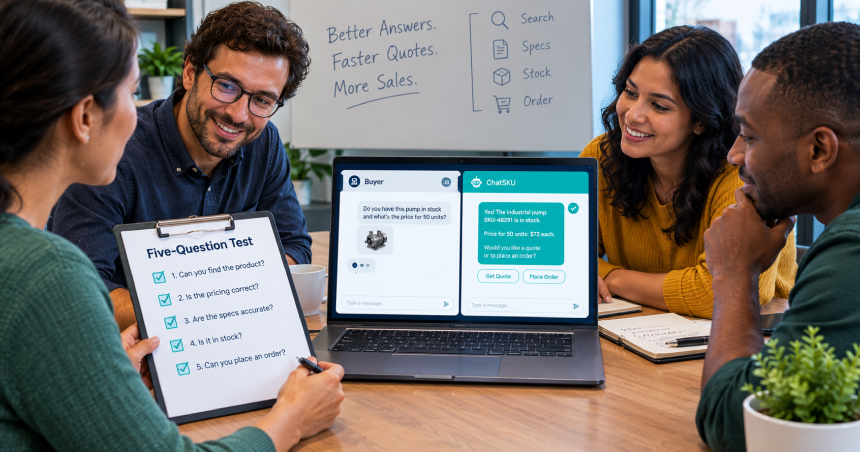
You do not need a vendor to run this. Take one hour and ten of your real buyer questions, then ask the same questions to both tools.
- Ask for the price of a product as a wholesale buyer and as a first-time visitor. Does the answer change?
- Ask about stock for a product you changed yesterday. Is the answer current?
- Ask about a product you do not sell. Does it say so, or invent one?
- Ask for a quote on 500 units. Does it collect the details and pass them on?
- Ask where the transcript is stored and who can read it.
People also ask
Can ChatGPT replace a B2B sales chatbot?
Not for buyer-facing work. It can replace a lot of the writing and research your team does, but it does not apply buyer-specific pricing, read live inventory, or deliver a complete quote request to your team.
Is it safe to upload my price list to ChatGPT?
Treat it like sharing the file with any outside tool. Check your plan’s data settings, remove negotiated or customer-specific prices, and keep confidential terms out of anything a public assistant can see.
Will buyers find my products through AI assistants?
Increasingly, yes. Clear product data, specifications, and plain-language answers on your own site help assistants describe your products accurately. Our agentic commerce glossary explains the terms behind this shift.
Does a catalog chatbot work with my store platform?
Yes, for the major B2B platforms. See how it works on Shopify and BigCommerce, and read the WooCommerce buyer’s checklist if you run a pricing plugin.
Conclusion
ChatGPT and a catalog chatbot are not rivals. One writes and reads. The other answers buyers on your behalf, with the right price, the current stock, an honest “I don’t know”, and a quote request at the end. Use ChatGPT for work a person will review, and use a catalog chatbot where the buyer is talking directly to your business.
The fastest way to decide is to see both on your own products. If you want to watch the second one answer your real questions, you can request a demo built on your catalog.
Frequently asked questions
Can I build my own catalog chatbot with a custom GPT?
You can build a useful prototype, and it is worth running the five-question test on it. The gaps to plan for are pricing rules per customer, keeping the data current, capturing quotes, running it on your own site, and owning the conversation data. Each one is something you would have to build or buy.
Does a catalog chatbot use the same AI models as ChatGPT?
Many catalog chatbots use large language models to write natural replies. The difference is what feeds and constrains the model: your approved catalog data, your pricing rules, and a handoff to your team when the answer is not in the source.
What kinds of files can a catalog chatbot read?
ChatSKU works from the files you already have, including PDF catalogs, spreadsheets, and ERP exports, so you do not need to rebuild your catalog first.
How long does it take to set up?
ChatSKU installs with one line of code on your existing site, and most teams go live within a day.
Will a chatbot replace my sales team?
No. It handles the routine questions and first-pass quote requests so your reps spend their time on the deals that need a person.
We already pay for ChatGPT. Do we still need a catalog chatbot?
They do different jobs. ChatGPT helps your staff work faster. A catalog chatbot answers buyers from your catalog, at their price, at any hour.
Turn your catalog into a 24/7 sales channel
Stop sending PDFs. Start capturing demand.
Try ChatSKU Free →