
Executive summary
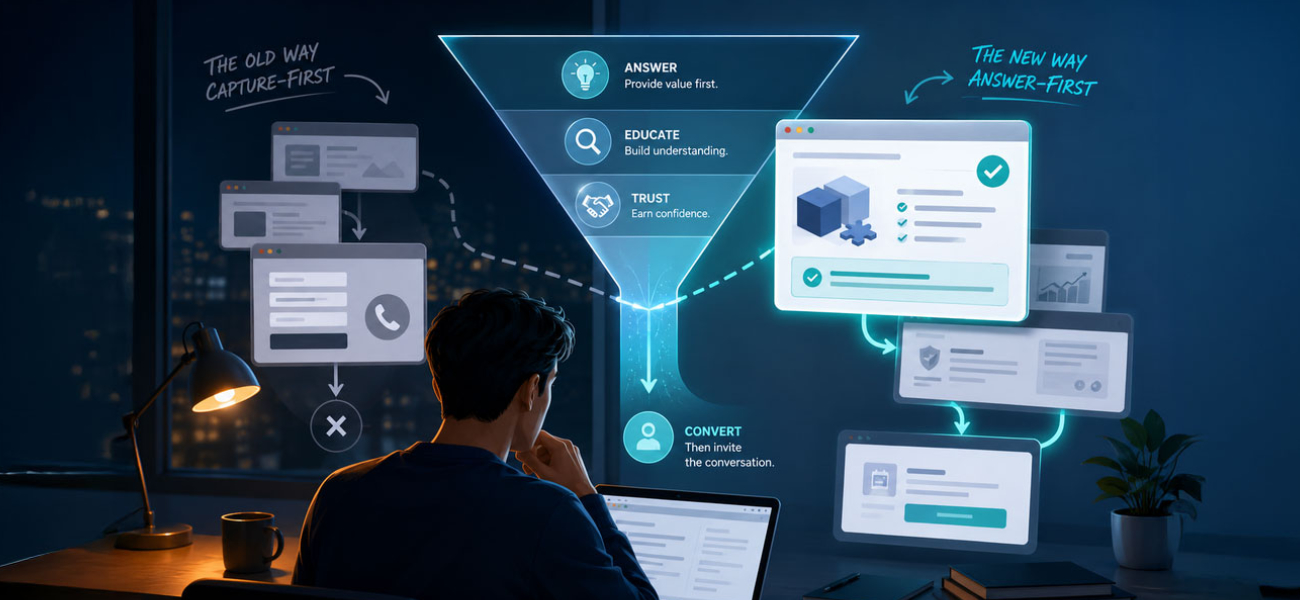
Buyers get the answer before they ever reach you. That one change rewrites the funnel, from capture-first to answer-first. Here is the data behind the shift, and what it means for your website and your pipeline.
TL;DR: The old funnel assumed attention was scarce and answers were expensive, so the smart move was to capture the lead first and ration the answer behind a rep. Both assumptions have flipped. Answers are now cheap to deliver, and attention is brutally expensive to hold. Making a buyer wait for an answer in order to capture them spends the expensive thing to protect the cheap one. The funnel does not die. It inverts, and you answer first so the answer becomes the capture.
Introduction
It is late, and a buyer is three tabs deep on your product page. They have read enough to be close, and only one question is standing between them and a decision: does this work with the system they already run? On a consumer site they would know in a second. On yours, there is a phone number and a contact form, both of which translate, at this hour, to the same flat sentence: come back during business hours.
They will not. They will open a fourth tab, ask your competitor, and the competitor’s page will answer the question on the spot. The deal did not turn on price or product. It turned on who answered first.
That small moment contains the entire shift. Here are the mechanics underneath it.
What actually changed: two assumptions flipped at once
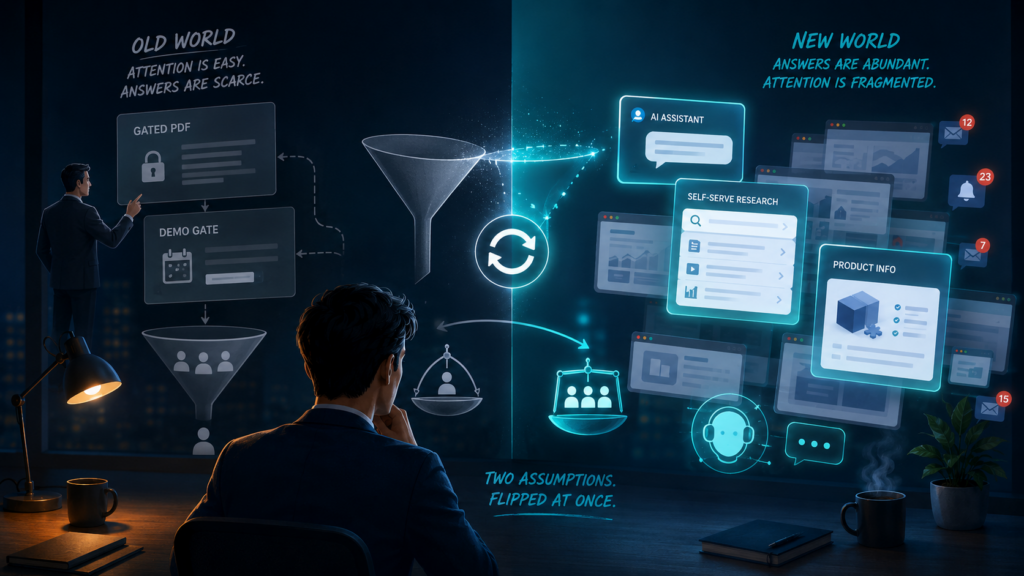
The funnel most companies still run was designed for a particular world, one where attention was relatively cheap to buy and answers were relatively expensive to produce. Answers lived in a rep’s head, a gated PDF, a scheduled demo. Given those conditions the logic was airtight: capture the lead while you have their attention, then release the answers later, through a person. Form first, answer second.
Both of those inputs have since inverted.
Answers got cheap. Self-serve research and AI assistants now hand buyers most of what a rep used to walk them through, and the behavior has moved fast. In Gartner’s 2025 survey of B2B buyers, 67% said they prefer a sales-rep-free experience and 70% prefer a fully digital, self-service buy; the typical buyer pulled from seven information sources on a recent purchase, and 45% used generative AI, mostly to research vendors and products. The answer is no longer scarce. It is ambient.
Attention, on the other hand, got expensive. Industry estimates put the rise in customer acquisition cost at roughly 60% over the past five years, and the B2B sales cycle keeps stretching as more stakeholders and more touchpoints crowd into every deal, so each additional day you hold a buyer’s attention costs more than it did a year ago.
Put the two together and the old play quietly breaks. Forcing a buyer to wait for an answer so you can capture them means spending the expensive resource, their attention, to protect the cheap one, the answer. That is the wrong trade, run at scale, all day long.
What B2B buyers actually do now
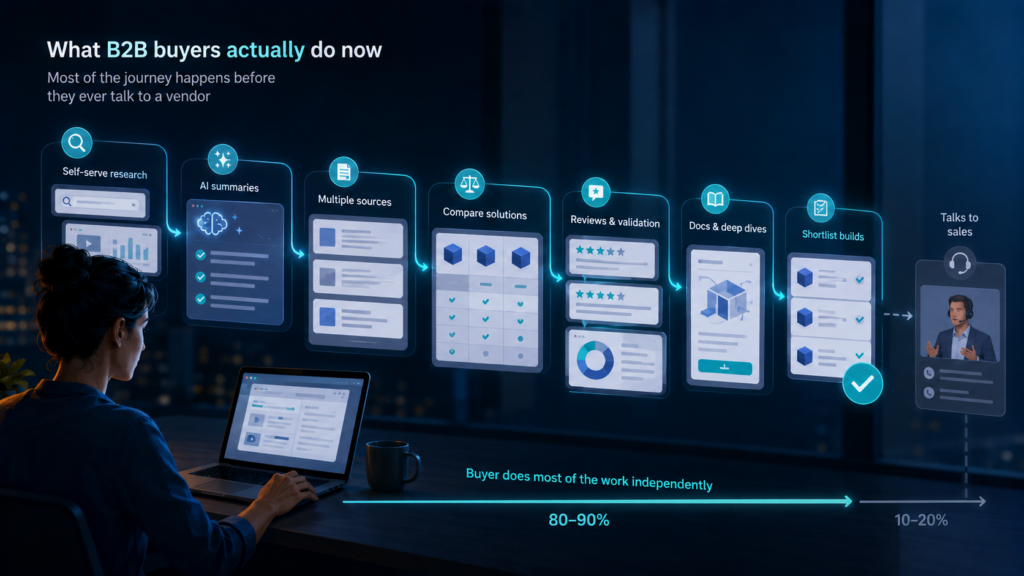
The buying journey moved off your calendar and onto their screen, and most of it happens before you ever enter the picture.
Gartner finds that B2B buyers spend just 17% of the entire purchase journey meeting with potential suppliers, and when they are weighing several vendors at once, as little as 5 to 6% of their time goes to any single rep. 6sense, surveying more than 900 buyers, found they hold off on contacting a vendor until roughly 70% of the way through their process. So by the time a form gets filled out, most of the deciding is already done. You are not entering the race. You are learning that it already ran, and where you placed.
Search shifted in exactly the same direction, and the numbers are stark. According to SparkToro and Datos clickstream data, about 58.5% of U.S. Google searches now end without a single click to any website. Pew Research, tracking nearly 69,000 real searches, found that when an AI Overview is present people click a traditional result only 8% of the time, versus 15% without one, and click a link inside the AI answer just 1% of the time. Bain & Company puts it more bluntly still: when an AI summary appears, roughly 83% of those searches end with no click at all, and about 80% of consumers now lean on AI-generated summaries for at least 40% of what they search.
Here is the finding that should reorganize your strategy. Bain also reports that 85% of B2B buyers purchase from a “day one” vendor list, the companies they already had in mind before they ever started searching. If the discovery moment is now resolved inside an AI answer, before anyone reaches a website, then the question was never whether your form converts. It is whether your answer was the one that put you on the shortlist to begin with.
Why your contact form quietly taxes the expensive thing
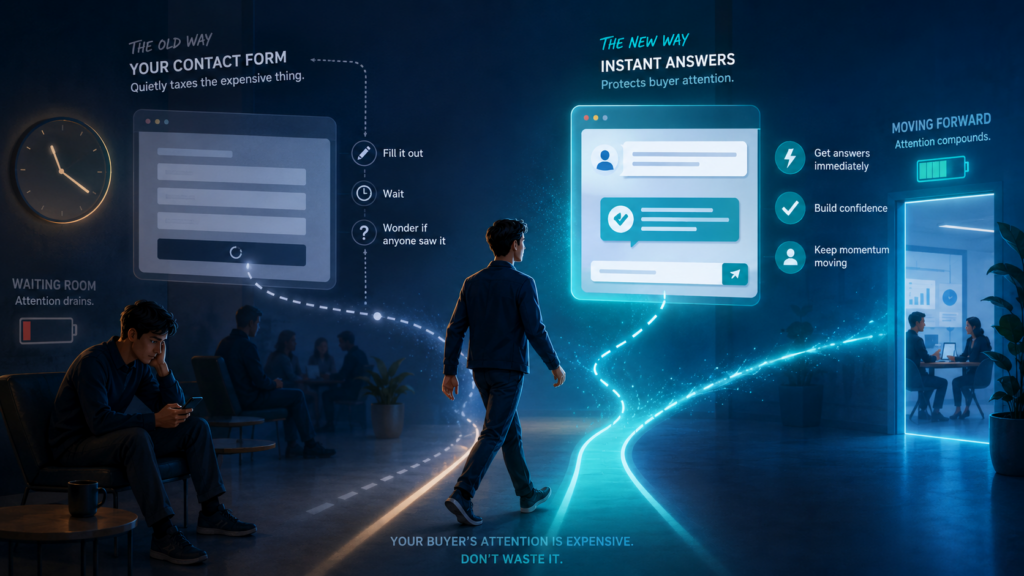
Even when a buyer does reach out, the capture-first model springs a leak at the worst possible moment.
The classic MIT and InsideSales study (Oldroyd, 2007) found that contacting an inbound lead within five minutes rather than thirty makes you about 100 times more likely to reach them and 21 times more likely to qualify them. A separate Harvard Business Review audit of 2,241 companies found the average firm took 42 hours to respond, and that 23% never responded at all.
A contact form is a polite “we’ll get back to you.” But the buyer never wanted to reach you. They wanted the answer. The form takes a high-intent, attention-rich moment and turns it into a waiting room, and the research says the value of that moment decays by the minute. You paid the rising price to win that attention, and then the form spent it.
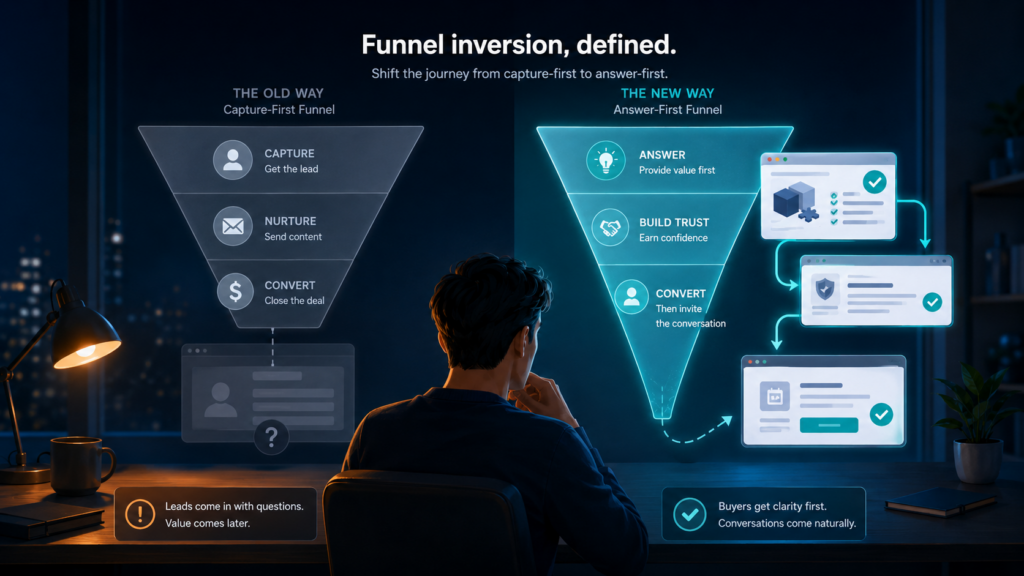
Funnel inversion, defined
Funnel inversion is the shift from a capture-first funnel, where you collect the contact and then dole out answers, to an answer-first funnel, where you resolve the buyer’s real question on the spot and let the satisfied answer become the conversion event.
The funnel itself does not disappear. The order is what flips. In a capture-first world you trade an answer for a contact; in an answer-first world you give the answer, earn the trust, and the contact follows naturally from a buyer who has already decided you are credible.
And the buyers who arrive this way are simply better. Semrush’s 2025 analysis found that visitors referred from AI search convert at roughly 4.4 times the rate of traditional organic visitors, because the AI pre-qualified them by synthesizing the answer before they ever clicked through. Answering first does not only capture more people. It captures more of the right ones.
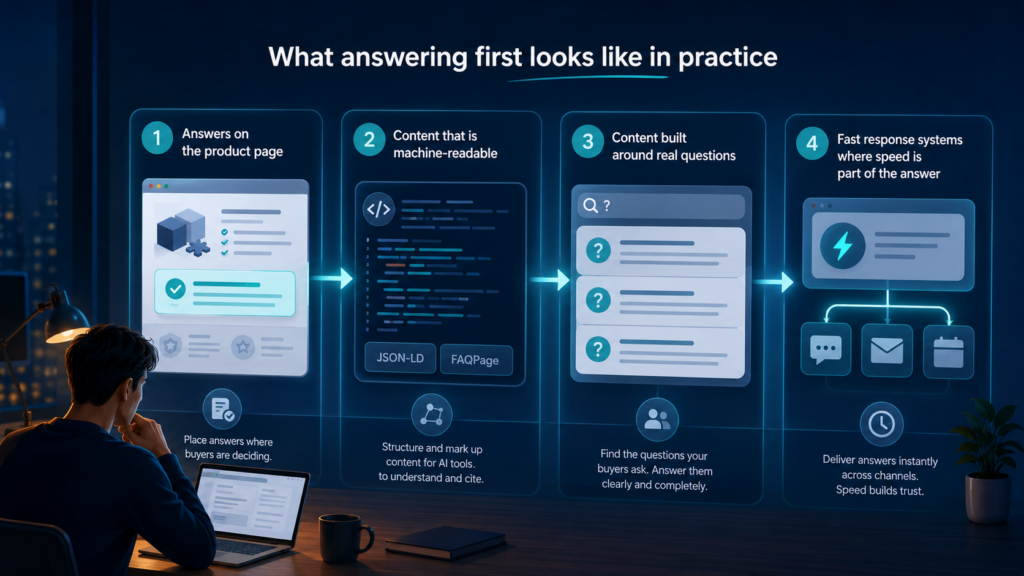
What answering first looks like in practice
None of this means “add a chatbot” and declare yourself transformed. It is a reordering of where the answers live, and it shows up in four concrete moves.
Move the answer to where the question gets asked
The integration question, the pricing question, the “will this work for a team my size” question, those belong on the product page in plain language, not locked behind a form. If a rep answers it ten times a week, the page should be answering it ten thousand times.
Make your answers machine-readable, not just human-readable
A buyer’s first “search” increasingly happens inside an AI tool that reads your site, your docs, your reviews, and your comparison pages and then summarizes them on your behalf. Clear specs, real FAQ headings, transparent pricing signals, and structured content are what get cited. If your answer is not legible to the model, you are not in the room where the shortlist is being built.
Build for the question, not the keyword
Buyers ask “does this connect to X,” not “best [category] software.” Answer-first content mirrors the actual sentence a person would type or speak, because that sentence is the unit AI engines extract and surface.
Treat speed as a feature of the answer, not the follow-up
The fastest answer beats the better-written one that lands 42 hours later. Wherever a human still has to respond, the system around them should make “now” the default rather than the exception.
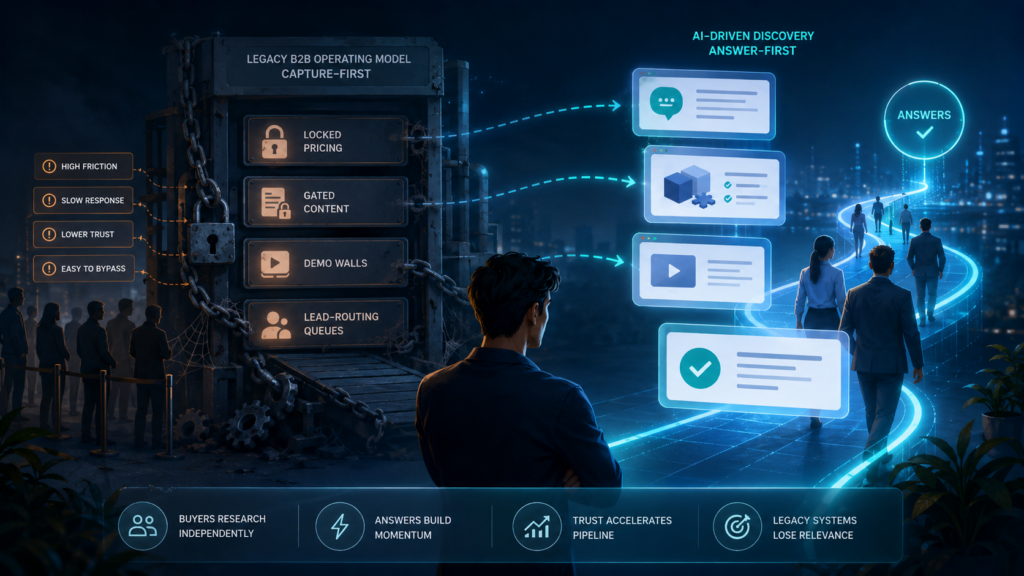
Who's most exposed
The companies in the most danger are not the ones with a slightly clunky form. They are the ones whose entire operating model was built to capture attention first and answer later: the gated-content machines, the “talk to sales to see pricing” walls, the demand-gen stacks tuned to harvest contacts and route them to a queue.
Gartner predicted in early 2024 that traditional search volume would fall 25% by 2026 as AI assistants absorbed query share. For a business that depends on intercepting buyers mid-search and trading information for an email address, that is not a slow erosion of a channel. It is the discovery layer relocating to a place the form was never invited into. The funnel did not vanish from under these companies. It quietly turned around, and they are now pouring their best effort into the exact wrong end of it.
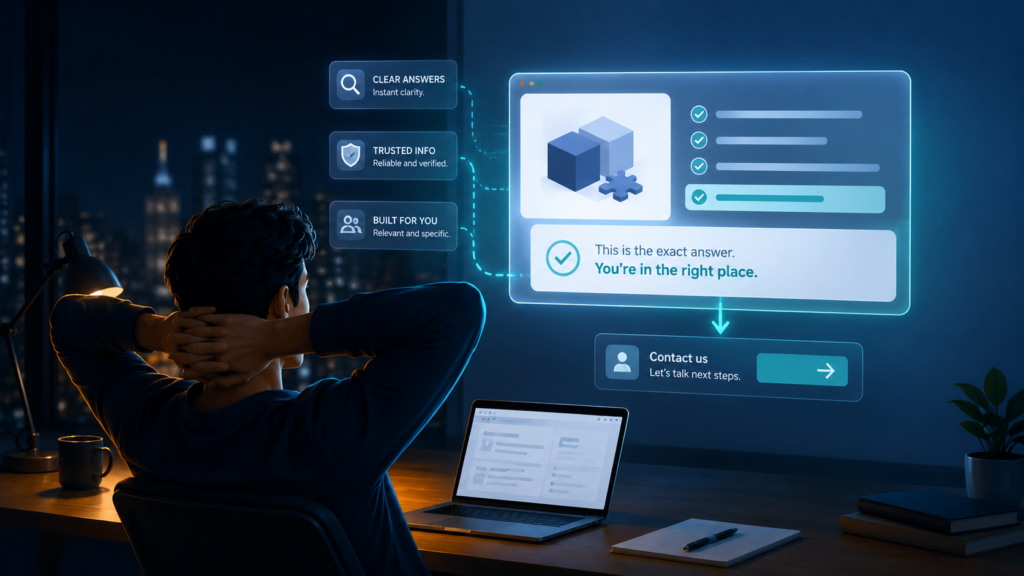
The buyer, revisited
Same buyer, same product page, same single question. Only this time the answer is sitting right there, clear and specific, no form and no wait. They read it, they exhale, and they are done deciding. The “contact us” still comes, but now it is a formality from someone who already chose you.
That is funnel inversion in one scene. You stopped charging admission for the answer, and the answer started selling. The companies that work this out first will not have a better funnel than everyone else. They will just have theirs pointed the right way.
Conclusion
Funnel inversion is not a redesign project, it is a change in sequence. Buyers already expect the answer before the form, and the businesses winning the deal are the ones putting real answers where the questions get asked instead of behind one. The catalog you already have can carry that conversation. It just needs to talk back.
Frequently asked questions
What is funnel inversion?
Funnel inversion is the shift from a capture-first funnel, where you collect the lead and then release answers, to an answer-first funnel, where you resolve the buyer’s question immediately and let that satisfied answer become the conversion. The stages do not disappear; the order flips.
Why are contact forms losing effectiveness in B2B?
Because buyers now complete most of their research and decision-making before they ever contact a vendor. Gartner puts time spent with suppliers at just 17% of the journey, and 6sense finds buyers wait until roughly 70% of the way through before reaching out. A form asks a high-intent buyer to wait, and lead-response research shows the value of that moment decays within minutes.
How is AI search changing the B2B buyer journey?
AI summaries increasingly answer the buyer’s question before they click. SparkToro and Datos data shows about 58.5% of U.S. searches end with no click, and Bain finds roughly 83% of searches end without a click when an AI summary is present. Buyers form their shortlist inside that answer, and Bain reports that 85% of B2B buyers buy from a vendor they already had in mind before searching.
Does answering first actually convert better?
The buyers it captures tend to be higher quality. Semrush’s 2025 analysis found AI-referred visitors convert at roughly 4.4 times the rate of traditional organic visitors, because the answer pre-qualifies intent before the click ever happens.
What's the first step to building an answer-first funnel?
Find the questions your reps answer most often, then put those answers, clearly and specifically and in the buyer’s own words, directly on the pages where the questions get asked, and make them readable by both people and AI tools.
Turn your catalog into a 24/7 sales channel
Stop sending PDFs. Start capturing demand.
Try ChatSKU Free →
About the author
Gigi JK is the founder of ChatSKU and Virtina, bringing more than 28 years of experience across digital transformation, eCommerce strategy, AI-driven growth systems, and business modernization. His work spans startups, scale-ups, and SMBs, with a focus on turning complex operational problems into practical growth frameworks. Before ChatSKU, Gigi built and scaled a seven-figure eCommerce business and led Virtina as an eCommerce engineering and business transformation consultancy. At ChatSKU, he focuses on helping B2B manufacturers, distributors, and wholesalers make complex catalogs searchable, quote-ready, and agent-ready without forcing a full platform rebuild.