

Executive summary
Your catalog works 9 to 5. Your buyers don’t. They research at 9pm, on weekends, between meetings, long after your sales team has gone home. When they land on a static PDF or a plain category page, they hit a wall. No answers, no pricing, no way to ask a question. So they leave.
That is a passive catalog. It lists what you sell and waits. It cannot answer a spec question, confirm stock, or quote a price. This isn’t a staffing problem. It’s a catalog infrastructure problem. And it costs you orders you never even see.
This guide defines the passive catalog, shows the difference between passive and active, breaks down the five ways it bleeds revenue, and walks through the dollar math on a real distributor scenario. By the end, you’ll know whether your catalog is passive, and what it takes to fix it.
Introduction
It’s 9:14pm. A maintenance engineer needs a specific industrial valve, 2-inch, stainless, rated for a food-grade line. He finds your site. You stock it. He just can’t tell.
Your catalog is a PDF he has to download and scroll. The part number he types into your search bar returns nothing. There’s no price, just a “request a quote” form. He fills it out anyway and waits. Nobody’s there.
By 8am, he’s already ordered from a competitor whose site answered him in two minutes. Your rep sees the form at 9:30am and calls a buyer who has already moved on.
Your catalog didn’t fail because of design. It failed because it can’t talk back.
What is a passive catalog?
A passive catalog is a static product listing that buyers have to read and work through entirely on their own. It shows products but answers nothing. A PDF, a basic HTML category page, an Excel export, even a large ecommerce site with no guidance layer. If the buyer does all the work to find, evaluate, and request information, the catalog is passive.
The defining trait isn’t the format. It’s the silence. A passive catalog can’t confirm whether a part is in stock. It can’t apply a buyer’s contract price. It can’t answer “do you have this in 1-inch?” without a human stepping in. The buyer carries the entire load.
This term matters more in 2026 than it did five years ago. B2B buyers now expect to self-serve. They research independently, on their own schedule, and they compare suppliers in minutes. A catalog that only works when a rep is online is a catalog that loses to whoever answers first. A PDF catalog chatbot is one way teams close that gap, but the first step is naming the problem.
One honest caveat. If you sell three products at one fixed price to a handful of repeat buyers, a passive catalog might be fine. The problem shows up at scale: large SKU counts, variable pricing, and buyers who research after hours.

What's the difference between a passive catalog and an active catalog?
A passive catalog waits to be read. An active catalog answers. The passive version hands the buyer a document and hopes they find what they need. The active version holds a conversation: it knows your inventory, answers in natural language, quotes a price, and captures the lead, at 9pm or 3am, without a rep online.
Here is the difference, side by side.
| Passive catalog | Active catalog (ChatSKU-style) |
|---|---|
| Static PDF or HTML page | Conversational interface |
| Buyer searches manually | Buyer asks a question |
| No real-time inventory | Live SKU and stock answers |
| Hidden pricing or “contact sales” forms | Answers pricing in the conversation |
| Lead time unclear | Lead time stated up front |
| No follow-up | Captures intent, routes to sales |
| Same experience for every visitor | Customer-specific pricing and groups |
Most B2B sites sit firmly in the left column. They were built to display products, not to sell them when nobody’s watching. That gap, between a catalog that shows and a catalog that sells, is the heart of the passive catalog trap.
Why are most B2B catalogs still passive in 2026?
Three reasons, and none of them is that the technology is hard. Most catalogs are passive out of habit, assumption, and a misread of what buyers actually want.
Legacy investment. Companies spent real money building PDF catalogs and category pages years ago. They work, sort of, so nobody wants to rip them out. The sunk cost keeps a broken buying experience alive long past its expiration date.
“We already have ecommerce.” Having an online store feels like the box is checked. But ecommerce alone is still passive. A product page with an add-to-cart button can’t answer a spec question, apply a contract price, or handle an RFQ. Without an assistant layer on top, even a polished store leaves buyers to fend for themselves. This is the same gap that B2B distributors and wholesalers run into when they assume a catalog upload equals a sales channel.
The “buyers prefer to browse” myth. The old assumption is that buyers enjoy scrolling a catalog. They don’t. They want an answer. Gartner’s 2026 survey of 646 B2B buyers found that 67% prefer a rep-free buying experience. Rep-free does not mean answer-free. It means they want to get the answer themselves, instantly, without booking a call.
How does a passive catalog actually cost you sales?
A passive catalog costs you sales in five specific, measurable ways. Each one is a leak. Together they add up to a number most distributors would not want to see on a whiteboard. After helping hundreds of B2B distributors audit their catalogs, we see the same five patterns every time.
1. After-hours buyers drop off
More than 60% of B2B research now happens outside business hours. A buyer searches at 8pm, hits a passive catalog, gets nothing, and is gone by morning. That’s the moment ChatSKU was built for: a night-shift sales rep that answers when your team is asleep. Without one, the after-hours visit is a silent loss. You never know it happened. The mechanics of that loss are covered in depth in the after-hours buyer problem.
2. Product discovery fails on large catalogs
With 5,000 or more SKUs, no buyer can browse their way to the right part. They search a part number formatted differently from yours and get zero results. They don’t try again with new keywords. They leave. A passive catalog punishes the buyer for not knowing your exact taxonomy.
3. RFQ submissions stall
The buyer fills out your quote form, then waits. Speed is the whole game here. Harvard Business Review found the average company takes 42 hours to respond to an inbound lead, and that responding within an hour makes you seven times more likely to qualify it. Lead-response research from MIT and InsideSales puts it sharper: reach a buyer within five minutes and you’re 21 times more likely to qualify them than at 30 minutes. A form that sits in an inbox overnight loses. RFQ automation answers in the moment instead.
4. Customer-specific pricing stays hidden
Your best accounts have negotiated rates. A passive catalog shows list price, which is the wrong number for them. So they call to confirm their real price. Your rep stops what they’re doing and spends 15 minutes building a quote a system could have served instantly. Multiply that across a week.
5. Sales reps drown in repetitive questions
“Is this in stock?” “What’s the lead time?” “Do you have it in 1-inch?” Your reps answer the same handful of questions all day. Every one of them is a question a passive catalog could have answered on its own. Instead of selling, your team is doing lookup work a database could handle in seconds.
A real example: what passive catalog drop-off looks like
Numbers make this concrete. Here is an illustrative scenario for a mid-market distributor. The figures are representative, not a guaranteed result, but the pattern is one we see constantly.
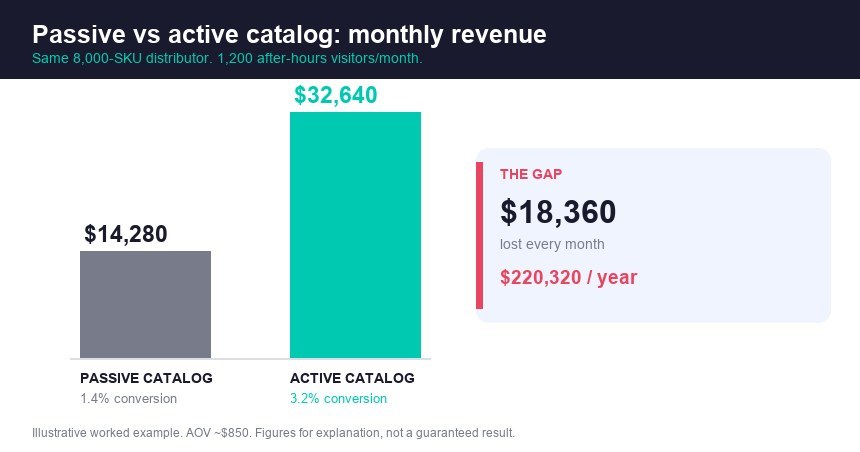
Picture an industrial fittings distributor. 8,000 SKUs. Roughly 1,200 visitors a month arrive after hours, and the average order is about $850.
With a passive catalog converting at 1.4%, those after-hours visitors generate around $14,280 a month. Swap in an active catalog that answers in real time, and conversion moves to 3.2%, generating about $32,640 a month from the same traffic.
| After-hours performance | Passive catalog | Active catalog |
|---|---|---|
| Conversion rate | 1.4% | 3.2% |
| Monthly revenue (1,200 visitors) | $14,280 | $32,640 |
| Annual revenue | $171,360 | $391,680 |
That’s $18,360 a month, or $220,320 a year, leaking out of the same traffic you already paid to attract. The buyers showed up. The catalog just couldn’t sell to them. This is the structural reason your B2B catalog conversion rate stays stuck no matter how much you tweak the design.
What does an active catalog actually look like?
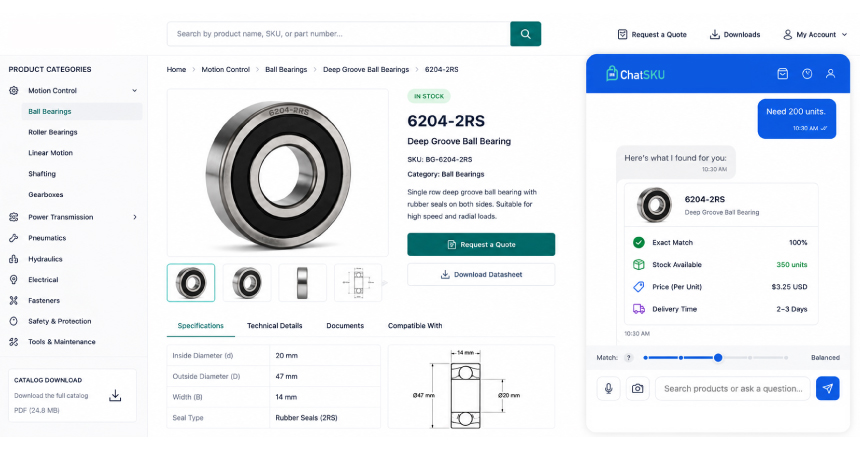
An active catalog talks back. It knows your full inventory, every SKU, every variant, every spec, and it answers buyer questions in plain language at 8pm or 3am. It quotes a price, confirms stock, states a lead time, and captures the buyer when they’re ready, all without a rep online.
Here is what that looks like in practice:
- It knows every SKU, spec, and variant. Ask for a 2-inch stainless fitting rated for food-grade use and it returns the exact match, not a results page to scroll.
- It handles RFQs in conversation. The buyer asks for pricing on 200 units with a delivery window, and the system builds the quote request and routes it with full context.
- It bakes in customer-specific pricing. A logged-in account sees their contract rate, not list price. No call required.
- It routes serious buyers to sales. When a deal needs a human, your rep inherits a warm, documented conversation instead of a blank form.
This is what ChatSKU is. Not a chatbot. Your active catalog layer. It’s the same idea behind AI sales assistant tools and the broader shift toward B2B conversational commerce, applied directly to the catalog buyers already use.
How fast can you turn a passive catalog into an active one?
Faster than you’d expect. Most distributors go live in under a day. There’s no website rebuild, no migration project, no developer sprint. One line of code, one day.
- Upload your catalog. PDF, Excel, ERP export, whatever you already have. No reformatting required.
- Configure your rules. ChatSKU sets up your pricing tiers, customer groups, and RFQ workflows so the right buyer sees the right answer.
- Paste one line of code. Drop a single snippet on your site and your catalog starts answering. That’s the whole deployment.
No rebuild. No quarter-long project. If you want to see the before-and-after on your own catalog, see how ChatSKU fixes this and stop losing revenue to a catalog that can’t sell.
Is your B2B catalog passive? A 7-point check
Run through this quickly. Count your yes answers. Three or more, and your catalog is passive.
- Buyers must download a PDF to see full product details.
- Pricing is hidden behind a “contact sales” form.
- You rely on RFQ forms for quotes.
- Your sales team answers the same product questions every day.
- After-hours visitors leave without converting.
- Your catalog hasn’t been updated in six or more months.
- You can’t answer “do you have X in 1-inch stainless?” without a sales rep.
Three or more yes answers means buyers are doing work your catalog should be doing for them. That work is where deals leak out, and it’s the same silence behind the response gap that lets faster competitors win.
Conclusion
Go back to that 9:14pm buyer looking for a 2-inch stainless valve. With a passive catalog, he leaves and you never know. With an active one, he gets his answer, his price, and his lead time, and you get the order.
Your catalog doesn’t have to be passive. ChatSKU turns it into your night-shift sales rep, the one that knows every SKU, never takes PTO, and sells while your team sleeps. See it work on a catalog like yours.
Frequently asked questions
Is a passive catalog the same as a static catalog?
Mostly, yes. “Static” describes the format (it doesn’t change or respond). “Passive” describes the consequence (it can’t sell, answer, or capture a lead). A static PDF is the most common passive catalog, but a fully dynamic ecommerce site can still be passive if it leaves buyers to find and evaluate everything alone. The point isn’t whether the page moves. It’s whether it answers.
Are PDF catalogs always passive?
By default, yes. A PDF is a document, not a conversation. It can’t confirm stock, apply a contract price, or answer a spec question. That said, you don’t have to throw the PDF away. An active catalog layer can read your existing PDF and turn it into something buyers can actually ask questions of, without you rebuilding anything.
Can ecommerce stores have passive catalogs?
Absolutely. This is the most common blind spot. Having an online store feels like the problem is solved, but a product page with an add-to-cart button still can’t answer “do you have this in 1-inch?” or show a buyer their negotiated price. Ecommerce handles the transaction. It doesn’t handle the questions that come before it. Without an assistant layer, the store is still passive.
Does an active catalog replace my sales team?
No. It handles the repetitive, around-the-clock layer: stock checks, spec lookups, pricing questions, and after-hours inquiries. Your reps keep the work that needs judgment, like complex negotiations and relationship deals. The practical effect is that your team spends time on buyers who are already qualified, not on answering “is this in stock” for the hundredth time.
How long does deployment take?
Usually under a day. You upload your existing catalog, ChatSKU configures your pricing and RFQ rules, and you paste one line of code on your site. There’s no website rebuild and no migration project. One line of code, one day, and your catalog starts answering buyers.
What about my customer-specific pricing?
That’s a core capability, not an add-on. You define customer groups and contract tiers during setup, and the system applies the right price to the right account in the conversation. A logged-in buyer sees their negotiated rate instead of list price, which removes the “call us to confirm your price” step that slows every quote down.
Will this work with my existing website?
Yes. An active catalog layer sits on top of whatever you already run. There’s no need to replace your site, your store, or your ERP. You paste a single snippet, connect your catalog data, and the assistant goes live alongside your current setup. Nothing gets ripped out.
Turn your catalog into a 24/7 sales channel
Stop sending PDFs. Start capturing demand.
Try ChatSKU Free →
About the author
Gigi JK is the founder of ChatSKU and Virtina, bringing more than 28 years of experience across digital transformation, eCommerce strategy, AI-driven growth systems, and business modernization. His work spans startups, scale-ups, and SMBs, with a focus on turning complex operational problems into practical growth frameworks. Before ChatSKU, Gigi built and scaled a seven-figure eCommerce business and led Virtina as an eCommerce engineering and business transformation consultancy. At ChatSKU, he focuses on helping B2B manufacturers, distributors, and wholesalers make complex catalogs searchable, quote-ready, and agent-ready without forcing a full platform rebuild.