

Executive summary
B2B distribution averages a 2.4% session-to-purchase conversion rate. Industrial equipment sits at 1.8%. Even after investing in AI search and bringing zero-result rates under 5%, most distributors still see B2B catalog conversion rates at 2.1%-3.1%. The numbers barely move.
83% of B2B sellers now prioritize AI when selecting search tools, per Algolia’s 2026 B2B report. AI search delivers a 10-15% relative lift in search-assisted conversion. A 15% lift on a 2.4% baseline is 2.76%. Still under 3%. The problem is structural, not tactical.
70% of abandoned carts in complex B2B catalogs happen because buyers cannot confirm specs, contract pricing, or compatibility at the moment they need to. Those are not search queries. They are conversational questions. Chat-engaged B2B visitors convert at 12.3% vs. 3.1% for non-engaged visitors. That 4x delta is what this article explains.
Introduction
Your Algolia implementation is working. Buyers find the right product on the first search. Your zero-result rate is under 5%. Your conversion rate is still 2.1%.
You’re not imagining it. The search is working. The conversion isn’t.
Here’s what that looks like in practice. A buyer searches for a 3-phase motor with a specific frame size. AI search returns the right product in position one. The buyer clicks through. The product page shows list price. The buyer has a negotiated contract rate. The page says “in stock.” The buyer needs to know which warehouse. The add-to-cart button is right there. The buyer still needs MOQ confirmation and net-30 terms. So the buyer emails their sales rep. The sale stalls for 48 hours. That window has a name: the response gap. The buyer may or may not come back.
Algolia did its job. The failure happened in the gap between “found it” and “bought it.” That gap is what this article is about.
What is B2B catalog conversion rate and what's a good benchmark?
Simple definition: your B2B catalog conversion rate is the percentage of product page sessions that result in a completed purchase or qualified quote. Now move past the definition. Here’s where you stand relative to everyone else.
Per Elogic’s 2026 benchmarks, B2B distribution averages 2.4%. B2B manufacturing sits at about 2.1%, per Mida’s 2026 data. Industrial equipment drops as low as 1.8%, per Atwix. Top-performing B2B ecommerce operations exceed 5%. Only 8%-15% of product page visitors add anything to a cart.
Frame it in revenue terms. A distributor with 10,000 monthly product page sessions at 2.4% closes 240 orders. At 5%, they close 500. That 260-order gap is not a hypothetical. It’s a revenue decision you’re making every month. For a deeper look at what that gap costs, see how much your B2B catalog is costing you. AI search buyers often expect post-implementation numbers to be higher than these baselines. They’re not. A 10-15% relative lift from search optimization moves a 2.4% baseline to roughly 2.7%. Still far from top-performer territory.
Why does AI search improve discovery but not conversion?
Here’s the part nobody tells you. Buyers were never really struggling to find products.
83% of B2B sellers now prioritize AI when selecting search tools. Algolia’s 2026 report describes a strategic shift from “expansion to optimization”: companies that adopted AI search are now trying to extract more value from it because the initial adoption didn’t move the numbers they expected. That’s not an indictment of AI search. It’s a sign that discovery was already a solved problem for most repeat B2B buyers. They knew the part number. What they needed was a set of answers that no search results page has ever been able to provide.
The AI search vs. conversational commerce distinction comes down to what each tool is designed to do. AI search matches queries to relevant results. It does this extremely well. But B2B buyers ask questions that go beyond finding a product: Can I order this at my contract price? Does this ship from my preferred warehouse? Is the MOQ compatible with my project scope? What are the lead times? These are not search queries. They require access to account-specific data, real-time inventory, and business logic that lives in the ERP, not in the search index.
Elogic puts it plainly: for complex B2B and enterprise ecommerce, conversion rate is often constrained by architecture, not only UX. That validates what you already suspected. The problem isn’t the interface. It’s what the interface cannot answer.
What happens between "found it" and "bought it" in B2B catalogs?
The buyer found the product. So why is the cart empty? This is the passive catalog problem: the catalog shows what is available but cannot close the sale.
69%-75% of B2B shopping carts are abandoned, per HumCommerce’s 2026 data. In complex B2B catalogs with 50,000+ SKUs and 100+ attributes per product, 70% of that abandonment happens because buyers cannot confirm specs, compatibility, or pricing at the moment of decision. The buyer already found the product. That’s not the problem.
Here are the 12 questions a B2B buyer needs answered before they place an order:
- Contract pricing. What is my account-specific price for this product?
- Minimum order quantity. What is the MOQ, and does it match my project scope?
- Inventory location. Is this in stock at my preferred or nearest distribution center?
- Lead time. What are the lead times if it’s not locally available?
- Compatibility. Does this work with my existing equipment or system?
- Payment terms. What payment options apply to my account tier?
- Order history. Has my company ordered this before, and at what quantity?
- Volume discounts. Are there breaks above a certain quantity?
- Return terms. What are the exchange or return conditions for this category?
- Documentation. What SDS sheets, certs of conformance, or CAD files come with the order?
- Substitute products. Are there alternatives if this item has a long lead time?
- Order workflow. Does this require an RFQ, or can I place it directly? For teams with high quote volume, RFQ automation handles this step end-to-end.
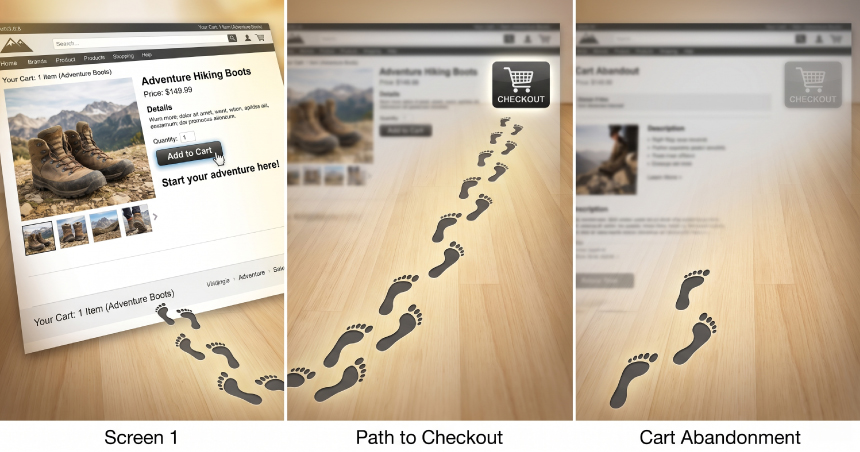
None of those are answered by a search results page. Some aren’t even answered by a well-designed product detail page. Every unanswered question sends the buyer to the phone or email. And every one of those contacts is a delay, a friction point, and a chance for a faster competitor to close the deal instead. Per HumCommerce, 48% of B2B abandonment comes from unexpected costs, 22% from inventory and delivery uncertainty, and 18% from checkout complexity.
Why do sophisticated buyers with AI search still abandon at checkout?
You solved the obvious problems. The abandonment is still there.
If you’re reading this, you’re not dealing with a catalog data problem or a zero-result search issue. You’ve already fixed those. Your abandonment is happening after a successful search interaction. That means the problem is upstream of checkout, not in checkout design. Here’s where the conversion is actually escaping:
- Contract pricing not surfaced at the product level. AI search indexes catalog data. It does not index account-specific pricing tables from the ERP. The buyer finds the right product and sees list price. That’s not Algolia’s fault. It’s an architecture gap. The buyer needs a system that knows who they are and what their negotiated rate is.
- Inventory specificity. “In stock” is not sufficient for a B2B buyer who needs products from a specific warehouse to meet a project deadline. Most distributors haven’t built branch-level inventory surfacing at the product-display layer. The buyer doesn’t know if this ships from the right location.
- MOQ and order logic. A 24-pack minimum doesn’t communicate itself on a search result. The buyer adds 12 units, gets to checkout, and hits an error or a call-to-inquire block. That’s a sale that walked out.
- Approval workflow uncertainty. Many B2B orders above a dollar threshold require internal approval. A buyer who isn’t sure if an order needs a PO is less likely to complete it without confirmation first.
38% of B2B searches on legacy keyword systems return zero results. AI search reduced that. But even after improving search relevance, the remaining conversion gap is driven by these post-search friction points. You solved the discovery architecture problem. The next problem is the conversation architecture problem. The same gap costs distributors leads after hours too.
What is conversational commerce and how does it layer on top of existing search?
Conversational commerce is not a replacement for search. Let’s be precise about that from the start.
A conversational commerce layer sits between the buyer and the catalog, answering the questions that a search results page cannot. Unlike generic customer service chatbots, which handle ticket deflection and return FAQs, a B2B-specific conversational layer knows the buyer’s account, pricing tier, order history, and the full catalog. It answers the specific questions that block B2B purchase decisions: contract pricing, MOQ, compatibility, lead time. If you’re evaluating options, here are the questions to ask before you commit.
The architecture is additive. The buyer uses Algolia (or whatever they’re using) to find the product. Once on the product page or at the cart, the conversational layer picks up the questions the page can’t answer. The buyer doesn’t leave the page. They don’t call the sales rep. They get an answer and place the order. ChatSKU is built for exactly this layered architecture. It connects to existing catalog sources (PDF catalogs, Excel, ERP exports) and answers account-specific questions without requiring a site rebuild. You can explore how ChatSKU’s catalog integration works if you want to see what that looks like in practice.
1 in 4 B2B buyers now use generative AI more often than conventional search when researching suppliers, per Digital Commerce 360’s October 2025 data. Two-thirds rely on AI chat tools as much as or more than Google when evaluating vendors. Buyers are training themselves to expect conversational answers. If your site still only offers a search bar, that expectation gap is widening every quarter. The term “conversational commerce B2B” has moved from early-adopter vocabulary to active buying-decision category in under 24 months.
How does conversational commerce improve B2B catalog conversion rate?
conversion rate
chat-engaged visitors
conversational commerce
Here are the numbers. Chat-engaged B2B visitors convert at 12.3%. Non-engaged visitors convert at 3.1%, per HumCommerce’s 2026 data. That’s a 4x delta. Site-wide conversion increases by 23% with AI catalog assistant deployment. Average order value increases by 15% from contextual upsells and cross-sells surfaced during the conversation.
Run the math on your own catalog. Take 10,000 monthly product page sessions. At 2.4% conversion, you close 240 orders. Apply a conservative scenario: 30% of visitors engage with the conversational layer and convert at 12.3%. That’s 369 orders from engaged visitors alone. Add the remaining 70% at baseline. Even before the full blended 23% site-wide lift kicks in, the delta is clear. At $2,000 average B2B order value, a 23% site-wide lift on 240 orders adds roughly $110,000 in incremental monthly revenue. That’s not a feature improvement. That’s a structural gap being filled.
The reason the lift is this large is not a minor UX tweak. It is because conversational commerce answers the 12 questions that were blocking purchase completion for the majority of interested buyers. The B2B catalog conversion rate improvement is not coming from better product discovery. Discovery was already working. It’s coming from turning product page visits into answered questions and answered questions into orders. See the conversion impact for your catalog to get a sense of what the deployment looks like in a real distributor environment.
Is conversational commerce an Algolia alternative or a complement?
A complement. Not a replacement. Not a competitor. Let’s make that concrete.
Algolia’s strengths are real. Fast, scalable, relevance-tuned search with rich filtering, faceted navigation, and intelligent ranking. It gets the right product in front of the right buyer in milliseconds. That capability is exactly as valuable as it sounds, and nothing in this article challenges it. If you deployed Algolia, you made a good call. It does what it was built to do.
Where Algolia ends is also precise. Algolia was built to optimize finding, not buying. It does not surface account-specific contract pricing from an ERP. It doesn’t conduct a guided compatibility conversation. It can’t generate an RFQ from a natural language request. It can’t confirm MOQ requirements dynamically for a specific account. These are not criticisms: they are scope boundaries. Algolia is a search engine. The “Algolia alternative B2B” framing misses the point: you don’t need an alternative to Algolia. You need the layer that does the job Algolia was never designed to do.
Here is a side-by-side breakdown of what each tool is designed to do:
| Capability | AI search (e.g. Algolia) | Conversational commerce (ChatSKU) |
|---|---|---|
| Product discovery | Fast, relevance-ranked, faceted | N/A – discovery is search’s job |
| Contract pricing | No – indexes catalog data only | Yes – pulls from ERP/account data |
| MOQ confirmation | No | Yes – account-specific |
| Compatibility check | No | Yes – guided Q&A |
| Lead time by location | No | Yes – real-time inventory data |
| RFQ generation | No | Yes – natural language to RFQ |
| After-hours coverage | Partial (finds product) | Full (answers and qualifies) |
| Integration required | Catalog index | ERP + catalog |
The correct architecture: Algolia handles discovery. ChatSKU’s B2B AI sales assistant handles the buying conversation. The buyer searches, finds the product, and gets their remaining questions answered without leaving the page, without calling a sales rep, and without a 48-hour delay. You don’t re-platform. You don’t replace your search investment. You add the layer that closes the gap between finding and buying.
How do I get started improving my B2B catalog conversion rate?
Three diagnostic questions before you spend another dollar.
-
✓
Diagnose the gap. Look at your session-to-purchase conversion rate by traffic segment. What is the rate for visitors who interact with product pages vs. visitors who bounce before the cart? If most exits happen from the product detail page or after adding to cart, you have a post-discovery conversion problem, not a search problem. That distinction tells you exactly where to invest.
-
✓
Audit your product detail pages. Do your PDPs show account-specific pricing for logged-in buyers? Do they show branch-level inventory? Do they answer MOQ questions inline? If any of those answers is “no” or “inconsistently,” that’s where revenue is escaping. Not from search. From the page that comes after search.
-
✓
Model the conversational layer ROI before committing. Take your monthly product page sessions, multiply by your current conversion rate to get order volume, then apply a 23% site-wide lift and a 12.3% chat-engaged conversion rate to a realistic engagement percentage. If the incremental orders at your average B2B order value outweigh the tool cost, the decision is straightforward. You can model the impact with the revenue calculator or check ChatSKU’s pricing to run that math directly.
ChatSKU connects to your existing catalog sources (ERP exports, PDFs, Excel files) and deploys via one line of code. No site rebuild. No Algolia migration. It layers on top of what you already have. You can explore how ChatSKU connects to your catalog to see the integration options, or start a free trial and have it running before end of day. Improving your B2B catalog conversion rate doesn’t require replacing anything you’ve already built.
Conclusion
Your catalog is already doing its job. Now get it to close the sale.
AI search solved discovery. Your buyers are finding the products. The missing piece is the conversation that answers the questions only your sales rep used to answer: contract pricing, MOQ, compatibility, lead time. ChatSKU puts that conversation on your product page, 24/7, without rebuilding your site.
See the live demo.
Frequently asked questions
Turn your catalog into a 24/7 sales channel
Stop sending PDFs. Start capturing demand.
Try ChatSKU Free →
About the author
Gigi JK is the founder of ChatSKU and Virtina, bringing more than 28 years of experience across digital transformation, eCommerce strategy, AI-driven growth systems, and business modernization. His work spans startups, scale-ups, and SMBs, with a focus on turning complex operational problems into practical growth frameworks. Before ChatSKU, Gigi built and scaled a seven-figure eCommerce business and led Virtina as an eCommerce engineering and business transformation consultancy. At ChatSKU, he focuses on helping B2B manufacturers, distributors, and wholesalers make complex catalogs searchable, quote-ready, and agent-ready without forcing a full platform rebuild.