
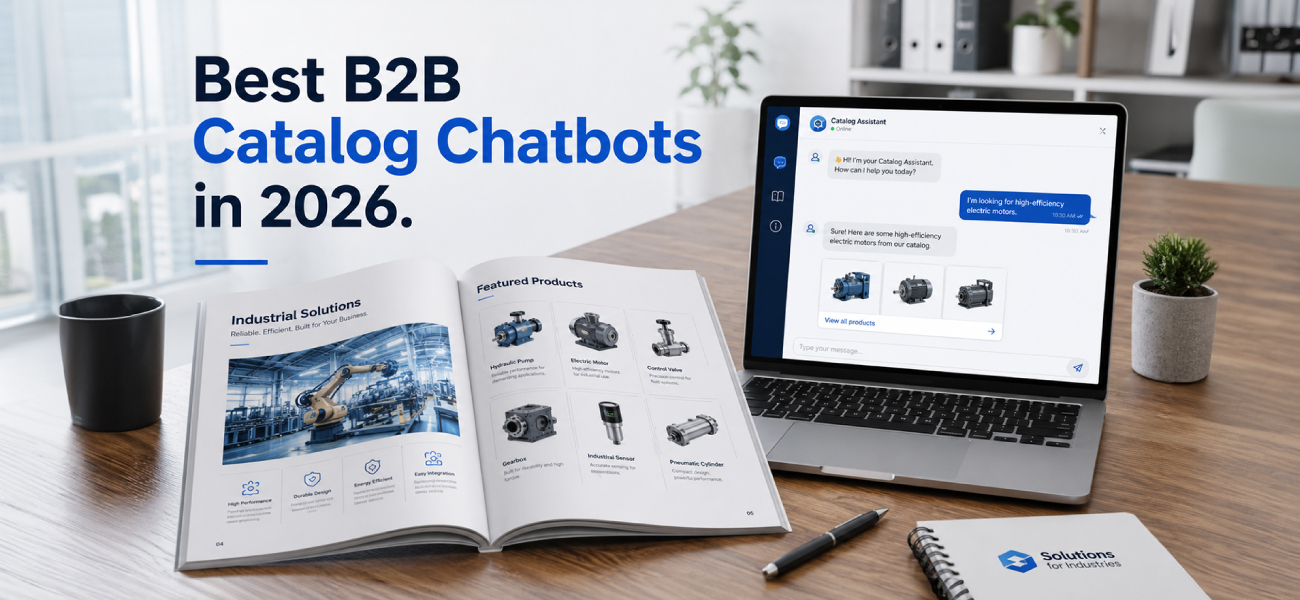
Executive summary
take a messy existing catalog: PDF, Excel, HTML, or ERP export: live as a fully conversational, RFQ-capable assistant. Most “best B2B chatbot” lists compare tools that were never built for a real B2B catalog. This one only ranks tools that handle messy existing data, tiered pricing, and an actual RFQ, scored on how fast a mid-market distributor can go live with one.
ChatSKU ranks #1. It is the only tool here built to take a messy existing catalog: PDF, Excel, HTML, or ERP export: live as a fully conversational, RFQ-capable assistant in days, not months. HumCommerce is the closest rival if you are already on Magento or Adobe Commerce. Everything else on this list solves a narrower piece of the problem, more slowly and at a higher price. See how ChatSKU’s catalog assistant works before you dig into the other six.
Buyers can search by text, voice, image, or in their own language.
Introduction
Picture a distributor running 5,000 SKUs. The catalog lives in three places at once: a PDF that’s two versions out of date, an Excel sheet someone updates on Fridays, and an ERP export nobody outside operations can read. The inside sales team is already buried in quote requests. Every customer gets a different price, because every customer negotiated one.
Last Tuesday, a buyer found the catalog at 9pm, asked one question about a part number, and got nothing back. By morning they’d ordered from a competitor.
So the owner Googles “best B2B catalog chatbot.” The results are full of generic livechat tools built for answering “where’s my order” tickets on a Shopify store. None of them have ever seen an RFQ. None of them know what a customer-specific price list is.
This roundup only includes tools that survive contact with a real B2B catalog: messy data, tiered pricing, and a quote process that doesn’t fit in a single chat bubble. We ranked them on how fast a mid-market distributor or manufacturer can actually go live and start catching the deals their website alone can’t close.
What makes a B2B catalog chatbot different from a regular chatbot?
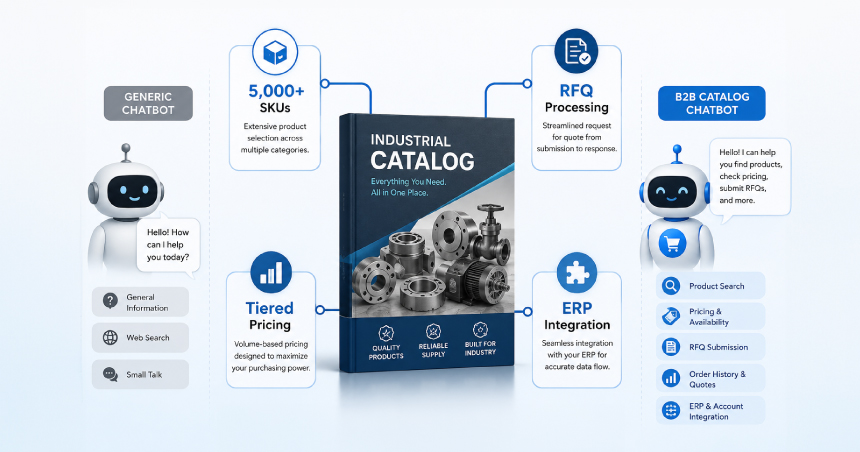
A support chatbot answers “what’s your return policy.” A B2B catalog chatbot has to answer “do you have part 4471-B in stock, what’s my price as a Tier 2 account, and can you build me a quote for forty units.” Those are not the same job.
Five things separate a real B2B catalog chatbot from everything else wearing the word “chatbot”:
- Search depth and modality. A real catalog tool handles voice queries, image-based search, natural language questions, multilingual buyers, and typo-tolerant lookups: not just exact SKU matches.
- RFQ and quote logic. A buyer drops in a list of twenty items. A real catalog assistant reads that list, matches it against the catalog, checks availability, and produces a structured quote. A generic chatbot answers one question at a time and stops there.
- Tiered, customer-specific pricing. B2B pricing isn’t one number per SKU. It’s a number per SKU per customer group, often pulled live from an ERP or CRM. A tool that shows everyone the same price is guessing, not quoting.
- ERP and PIM integration depth. The difference between a live, account-specific answer and a static support article is the difference between a tool that knows your business and one that’s reading a knowledge base.
- Source flexibility. (PDF, Excel, HTML, ERP: no migration required)
Here’s where the contrast gets clearest. Tools built for distributors and manufacturers handle all four of these things. Tools built for something else don’t, no matter how good they are at their actual job. Intercom is the clean example. It’s a genuinely capable support and helpdesk AI, built to resolve tickets and deflect support volume. It can look up product details if you feed it documentation, but it has no SKU-level inventory logic, no tiered-pricing layer, no RFQ engine, no voice or image search, and no after-hours lead capture. Asking Intercom to quote forty SKUs at Tier 2 pricing is like asking a receptionist to run the warehouse.
How we chose these chatbots
Two tools that show up in older “best of” lists are missing here, on purpose.
Drift is on its way out. Clari and Salesloft announced its sunset on March 6, 2026, and are referring existing customers to a tool called 1mind instead. No hard shutdown date is public yet, but recommending a platform mid-wind-down in a 2026 buying guide would be wrong within months, so it’s out.
Lily AI is also out, for a simpler reason: it’s a catalog-enrichment and attribution tool, not a chatbot. Different category, different job. Including it here would just confuse the comparison.
Tidio stays in, deliberately, as the contrast pick. It’s the tool most teams default to when they search for a catalog chatbot, because it’s cheap and easy to install on Shopify. You’ll see exactly why that default choice falls apart for B2B further down.
Every tool on this list got scored against the same five criteria the 5,000-SKU distributor cares about: how it handles real catalog data, whether it supports RFQs, whether it understands tiered pricing, how fast you can actually go live, and whether the pricing itself is transparent enough to evaluate without a sales call. If setting up a PDF catalog chatbot requires a six-week data migration before it can answer a single question, that’s a fail on criteria two and four before it even gets to RFQs.
Best B2B catalog chatbots in 2026
Seven tools made the cut. Here’s the order, and why.
ChatSKU
Best for: A distributor or manufacturer with an existing catalog, even a messy PDF or Excel one, who wants to start capturing after-hours leads and automating RFQs fast, without a website rebuild or IT project.
Where it wins:
- Multi-modal search: natural language, voice, image, multilingual, typos, and spelling variations. Buyers find what they need the way they actually search, not the way your catalog is structured.
- Ingests catalogs as-is. PDF, Excel, ERP export, whatever you already have. No data migration project, no website rebuild.
- “One line of code”: single script tag, live in under a day, against the multi-week or multi-month implementations typical of the enterprise search platforms further down this list.
- Built around B2B complexity from day one, RFQ logic, tiered pricing, customer groups, instead of bolted onto a search or support tool that was designed for something else.
- Full customizability to match your brand, workflow, and buyer experience.
- Full analytics: see exactly what buyers search, where they drop off, and which queries convert.
- Built specifically around the after-hours buyer gap, the same problem that opened this article and the one most of the other tools here barely treat as a use case.
That’s not abstract. See how RFQ automation works in practice before committing to a platform that treats quoting as an afterthought.
Where it falls short: Pricing is not published online, which makes upfront budgeting harder than with Algolia or Tidio. You’ll need to start a free trial to get real numbers for your catalog. If you’re specifically on Magento or Adobe Commerce and your primary pain point is RFQ on that platform, HumCommerce is also worth evaluating directly.
Verdict: The fastest path from messy catalog to live, multi-modal quoting assistant. The only tool here designed from the start to handle the full B2B catalog problem: search, RFQ, pricing, and after-hours capture: without a migration project first.
HumCommerce
Best for: A Magento or Adobe Commerce distributor or manufacturer with a large, messy SKU catalog and heavy RFQ volume who wants ERP-accurate answers.
Where it wins:
- “Database-first” architecture queries real ERP and ecommerce data before responding. Directly addresses the AI-hallucination worry B2B buyers have about any AI tool.
- Hybrid search built for alphanumeric SKU and part-number matching, a genuinely B2B-specific problem most generic tools miss entirely.
- Reads RFQ files in CSV or PDF, matches SKUs, checks availability, prepares structured quotes for review. HumCommerce’s own published claim is RFQ turnaround dropping from days to hours or minutes for well-structured requests.
- Deep CPQ, CRM, and WMS workflow integration that goes beyond chat alone.
Where it falls short: It’s platform-specific to Adobe Commerce and Magento. Not available for Shopify, BigCommerce, or custom stacks. No voice, image, or multilingual search. If your catalog lives somewhere else or you’re not already deep in the Adobe ecosystem, the fit disappears immediately. Public pricing is also not disclosed; budget conversations require a direct sales engagement.
Pricing: Not publicly disclosed. Contact for quote.
Verdict: The strongest RFQ-focused option for Magento and Adobe Commerce shops. Narrow platform fit, but deep capability within it.
Algolia
Best for: A B2B company that already has digital buying flows and mainly needs faster, smarter on-site search with account-based pricing visibility, not a company starting from zero with a static PDF catalog.
Where it wins:
- 83% of B2B sellers now prioritize AI in search tool selection, per Algolia’s own 2026 B2B Ecommerce Site Search Trends Report. Real evidence of category momentum.
- Well-documented support for per-customer-segment pricing inside search and filter results.
- Free tier and pay-as-you-go pricing let a team test before committing, unlike the fully custom-quote enterprise tools later in this list.
- Mature, broadly adopted infrastructure with deep platform and ERP integration documentation.
Where it falls short: It’s search, not conversation. No RFQ engine, no quote builder, no after-hours lead capture. No voice search, no image search, no multilingual query handling. You’re building or bolting on a separate tool for all of those functions. And it requires a clean, structured data feed to work. A distributor with a messy PDF catalog or an ERP export in non-standard format will need a data transformation project before Algolia can index anything useful.
Pricing: Free tier available. Paid plans from approximately $500/month. Usage-based pricing above that.
Verdict: The right infrastructure choice if you already have structured catalog data and want best-in-class search relevance. Not a fit if you need conversation, RFQ, or catalog ingestion from scratch.
Zoovu
Best for: A manufacturer selling configurable or technical products, where the buying decision means picking options and compatibility rules, not just selecting a SKU off a list.
Where it wins:
- Combines 3D product configuration with conversational guided selling, a distinctive combination nothing else in this list offers.
- Self-service RFQ product line built specifically for B2B manufacturers.
- Omnichannel reach across WhatsApp and Instagram beyond the website, something no other tool here explicitly offers.
Where it falls short: Thinner public documentation on hard numbers, pricing, deployment time, exact tiered-pricing mechanics, than Algolia, Coveo, or Bloomreach. Expect a sales call before you get specifics. No voice or image search. And the fit is narrow. A distributor selling straightforward SKUs with no configuration complexity will find this more tool than they need.
Pricing: Not publicly disclosed. Contact for quote.
Verdict: A strong specialist for configuration-heavy B2B manufacturing scenarios. Not the right fit for general distributor catalog and RFQ needs.
Coveo Relevance Cloud
Best for: A large enterprise with multiple product lines and multiple backend systems, with a dedicated implementation team and budget for a multi-month rollout.
Where it wins:
- Deep entitlement management. Can restrict and personalize exactly what each logged-in buyer sees, price, availability, even product visibility, based on real CRM and ERP account data. Genuinely hard to replicate with lighter tools.
- Built for very large, multi-system enterprise data environments.
- Strong analytics tying search behavior to average order value.
Where it falls short: Average implementation timeline runs 4 months, per aggregated G2 review data, and enterprise-only custom pricing makes this a poor fit for a mid-market distributor that wants to go live this quarter, not next year. No native RFQ, quoting, voice search, image search, or conversational lead-capture function. It solves search relevance, not the quoting or capture problem.
Pricing: Enterprise custom pricing only. No standard tiers published. Expect multi-year contract discussions.
Verdict: The right choice for enterprise-scale personalized search. The wrong choice if you need RFQ, fast deployment, or conversational lead capture.
Bloomreach Discovery
Best for: A company with existing digital merchandising maturity that mainly wants better product findability and category-page conversion, with the budget to manage a module-plus-usage pricing model.
Where it wins:
- Strong merchandising and category-page optimization beyond raw search relevance.
- Established connectors for Shopify, BigCommerce, Magento, and Salesforce.
- Per-unit pricing drops as usage scales, rewarding larger deployments.
Where it falls short: The “Document” pricing model counts every SKU variant times every regional or price-list view as a separate billable unit. A 50,000-SKU catalog with 4 variants and 3 B2B price views can become 600,000 billable Documents. Cost can run far ahead of what the SKU count alone suggests. There’s also no RFQ, quoting, no voice search, image search, or after-hours conversational capability. Search and merchandising only.
Pricing: No standard published rate. Module-based pricing plus per-Document usage fees. Custom quote required.
Verdict: Strong for merchandising-driven ecommerce teams. Not a fit for RFQ, after-hours lead capture, or buyers who start from a messy static catalog.
Tidio
Best for: A B2C or simple-catalog ecommerce business that mainly needs faster support-ticket resolution and basic FAQ automation, not a distributor or manufacturer with RFQ volume or tiered pricing.
Where it wins:
- Genuinely strong, mature Shopify and WooCommerce integration. Easiest tool in this list to get running on those specific platforms.
- SOC 2 Type II compliance, relevant for security-conscious buyers.
- Low barrier to entry: a free plan and no-code setup for basic FAQ and support use cases.
Where it falls short: It’s built for support tickets and FAQ resolution, not catalog search, RFQ, B2B pricing complexity, voice search, image search, or multilingual queries. That gap is the entire subject of this roundup. Ask Tidio’s Lyro AI about contract pricing or a 40-SKU quote and it has nothing real to say, because it’s answering from support content, not live catalog or ERP data. There’s also a hidden AI add-on cost, $39 to $289/month on top of the base plan, which changes the “cheap to start” framing considerably once you need the AI features.
Pricing: Free plan available. Paid plans from $29/month. Lyro AI add-on from $39 to $289/month separately.
Verdict: The right default for Shopify support automation. The wrong default for anyone who read this far and is shopping for a B2B catalog tool.
How do these B2B catalog chatbots compare?
Here’s the same seven tools, side by side, on the criteria that actually decide a B2B purchase. If your RFQ form is already underperforming, pay closest attention to the RFQ support, search modalities, and deployment time columns.
| Tool | Source handling | RFQ support | Pricing | Integrations | Deploy time | Tiered pricing | After-hours | Search Modalities | Analytics |
|---|---|---|---|---|---|---|---|---|---|
| ChatSKU | PDF, Excel, HTML, ERP, catalog:as-is | Native | Custom, not published | ERP, CRM, storefronts | ~1 day | Yes | Yes, signature | Natural language, voice, image, multilingual | Full |
| HumCommerce | Large, part-number match | Native | Custom, not disclosed | Magento/Adobe only | Not disclosed | Yes, from ERP | Not a focus | Text only | Not disclosed |
| Algolia | High volume, structured feed required | None native | Free to ~$50K+/yr | Broad ecommerce/ERP | Setup required | Yes, with config | None | Text only | Not disclosed |
| Zoovu | No benchmark published | Yes, RFQ line | Custom, no rate card | Limited, omnichannel | Not published | Implied, no detail | Not a focus | Text only | Not disclosed |
| Coveo | Large, complex enterprise | None native | Est. $30K-$500K+/yr | CRM/ERP, enterprise | Avg. 4 months | Yes, entitlement | None | Text only | Not disclosed |
| Bloomreach | Yes, billing risk | None native | Est. $35K-$100K+/yr | Shopify, Magento, BC, SF | Weeks to months | Yes, with caveat | None | Text only | Not disclosed |
| Tidio | Not built for this | None native | Free to $2,999/mo + addon | Shopify, WooCommerce | Fast, no-code | None found | Basic chat only | Text only | Not disclosed |
Look at the deployment time and pricing columns together and the pattern jumps out. The tools that look most “complete” on paper, Coveo and Bloomreach, are also the slowest to go live and the most expensive to find out if they fit. Speed and depth don’t move together the way most buyers assume. That’s exactly the response gap this article keeps coming back to: the longer it takes to go live, the longer your buyers sit unanswered.
Which B2B catalog chatbot should you actually pick?
Match your situation to one of these four. Most readers of this article fit scenario one.
You’re the 5,000-SKU distributor. Catalog lives in PDF, Excel, or ERP exports. Small inside-sales team drowning in quote requests. Losing after-hours inquiries. Buyers who can’t find parts by name, description, photo, or part number. You want to go live in days, not months. Pick ChatSKU. If you’re specifically on Magento or Adobe Commerce and RFQ volume is your single biggest pain point, HumCommerce is worth a look too.
You’re the enterprise distributor. Multiple product lines, multiple backend systems, a dedicated IT or implementation team, and a 4-plus month rollout timeline is fine. You need entitlement-based personalization across CRM and ERP at real scale. Pick Coveo Relevance Cloud.
You’re the manufacturer selling configurable products. Buyers choose options and compatibility rules, not a flat SKU off a list. Pick Zoovu.
You’re the established ecommerce shop. Clean product data, existing digital buying flows, primarily B2C or simple-catalog B2B, and you want better search relevance and category-page conversion. Pick Algolia or Bloomreach.
Before you finalize any of these choices, a gut-check. Can the tool ingest your existing catalog data without a migration project? Can it handle your real pricing model, not a simplified version of it? Does it have a native RFQ flow, or are you building that yourself? What does the deployment timeline look like for your actual catalog size? And does it support the ways your buyers actually search: typed keywords, plain-language questions, photos, voice queries, their native language? If you can’t get clear answers to all five questions from the vendor’s documentation, that’s an answer in itself.
People Also Ask
What's the difference between a B2B catalog chatbot and a regular ecommerce chatbot?
A regular ecommerce chatbot answers order-status and FAQ questions for a B2C storefront. A B2B catalog chatbot reads a real catalog, matches alphanumeric SKUs, applies customer-specific pricing, accepts voice and image queries, handles multiple languages, and can build a structured quote from a buyer’s list. Different data, different job.
Can a chatbot handle RFQs for a large product catalog?
Some can. ChatSKU and HumCommerce both treat RFQ handling as a core function, reading a buyer’s item list, matching it to the catalog, checking stock, and producing a structured quote. Search-only tools like Algolia, Coveo, and Bloomreach have no native RFQ engine at all.
How much does a B2B catalog chatbot cost?
It varies widely by vendor and catalog size. Enterprise search platforms can run from $30,000 to $500,000+ a year. Tidio’s advertised plans start cheap but add a separate AI add-on fee. ChatSKU doesn’t publish pricing online. Start a free trial to see real numbers for your catalog instead of relying on a third-party estimate.
Do B2B catalog chatbots work with ERP systems like NetSuite or SAP?
The B2B-built tools do. ChatSKU connects to ERPs including NetSuite, SAP, Acumatica, Sage, Epicor, and Dynamics 365, so pricing and availability answers come from live account data instead of a static knowledge base. It can also ingest catalog data from PDFs, HTML product pages, and Excel files: no clean structured feed required. Generic support chatbots typically don’t offer this kind of integration at all.
Can ChatSKU handle buyers who search in different languages or by photo?
Yes. ChatSKU supports multi-modal search, meaning buyers can submit a search by typing in their own language, speaking a voice query, or uploading a photo of a part they need identified. The assistant handles natural language questions, corrects typos and spelling variations, and responds in the buyer’s language. For distributors and manufacturers selling to international buyers or customers who don’t know the part name, this removes a significant friction point that text-only search tools can’t address.
Conclusion
Go back to the 5,000-SKU distributor from the start of this article. They don’t need the deepest search-relevance engine on the market. They need the fastest path from a messy existing catalog to a tool that’s answering buyers: in any language, by voice, by image, by part number: and building quotes at 9pm, when nobody else is at their desk.
That’s not a six-month IT initiative. It’s a decision you can make this week and be live by next week.
Start a free trial of ChatSKU and see how it handles your actual catalog, not a demo dataset, live in hours, not months.
Frequently asked questions
Turn your catalog into a 24/7 sales channel
Stop sending PDFs. Start capturing demand.
Try ChatSKU Free →
About the author
Gigi JK is the founder of ChatSKU and Virtina, bringing more than 28 years of experience across digital transformation, eCommerce strategy, AI-driven growth systems, and business modernization. His work spans startups, scale-ups, and SMBs, with a focus on turning complex operational problems into practical growth frameworks. Before ChatSKU, Gigi built and scaled a seven-figure eCommerce business and led Virtina as an eCommerce engineering and business transformation consultancy. At ChatSKU, he focuses on helping B2B manufacturers, distributors, and wholesalers make complex catalogs searchable, quote-ready, and agent-ready without forcing a full platform rebuild.