

Executive Summary
Constructor is an enterprise product discovery suite. It tunes search, browse, recommendations and an AI shopping agent on your buyers’ clicks, and its B2B page lists account-segmented pricing and availability (Constructor’s own page, checked 2026-11-12). ChatSKU is a catalog assistant for B2B manufacturers, distributors and wholesalers. It answers product questions from your catalog and turns the conversation into a quote request.
They solve different halves of the same problem. Constructor helps a buyer who is searching a very large catalog on a site. ChatSKU helps a buyer who has a question and wants a quote. Pick Constructor when ranking and personalization at scale are the gap, ChatSKU when answers and quotes are the gap, and both when you have the budget and the traffic.
Introduction
Ask ChatGPT which tools to use for B2B wholesale product search and it will rank Algolia, Constructor, Elasticsearch and Bloomreach (we asked on 2026-11-12). All four are search and discovery infrastructure. None of them is described as the thing that answers “will this valve work at 300 psi?” and then starts the quote. That is the gap this comparison is about.
So this is not a verdict on which product is better. Constructor is a serious platform built for large enterprise catalogs, and we say so below. The question is which job your catalog needs done first: finding the right product, or getting a buyer from a question to a quote. If you want the background on the search side, read our posts on how AI product search works for B2B catalogs and why traditional B2B product search fails complex catalogs.
What is Constructor, and what is ChatSKU?
Constructor describes itself as product discovery technology built for the complex needs of B2B ecommerce, with optimized search, account-segmented pricing and availability, and personalization. Its suite also covers browse, recommendations, collections, quizzes, an AI shopping agent, an AI product insights agent and a merchant intelligence agent.
ChatSKU is an AI catalog assistant. You give it your catalog in the format you already have, and it answers product questions on your site at any hour. Buyers can ask for a quote in the chat, and your team receives the request. It supports natural language search, spelling correction, image search, voice search and multiple languages.
| Constructor | ChatSKU | |
|---|---|---|
| What it is | Enterprise product discovery suite | AI catalog assistant with quote capture |
| Main job | Rank and personalize results at scale | Answer product questions and start the quote |
| Buyer experience | Search, browse, recommendations, shopping agent | Chat on your site, quote request in the chat |
What does each one need from you to start?
What do you give Constructor?
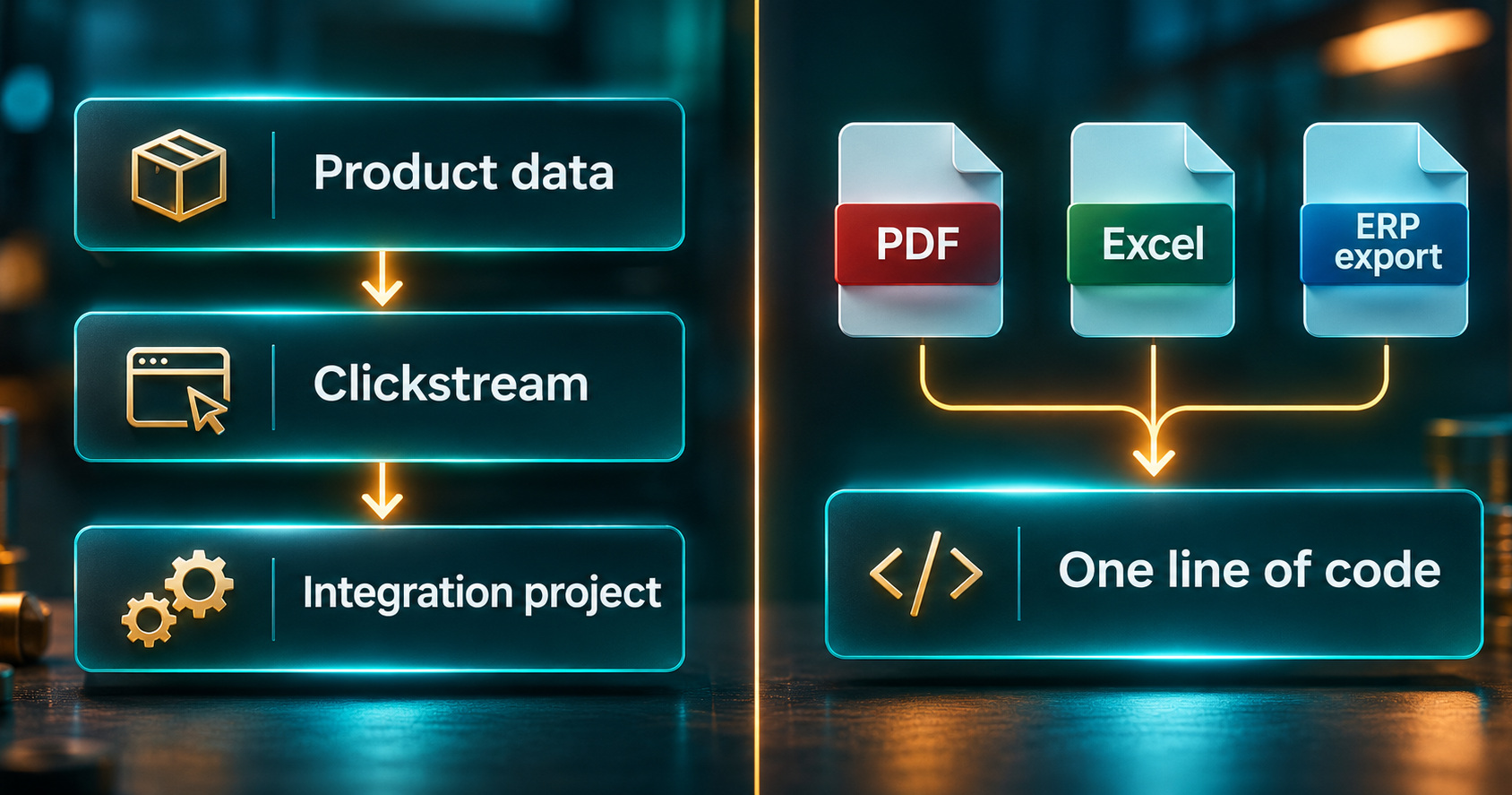
Constructor works from your product data and from shopper clickstream. Its B2B page points to attribute enrichment and a feedback loop built on how buyers actually behave. Its page offers a demo and a Search Experience Audit rather than a self-serve start, so plan for a sales process and an integration project.
What do you give ChatSKU?
You give ChatSKU the catalog as it exists today: PDF, Excel, an ERP export, or a WooCommerce, Magento or BigCommerce store. It goes live with one line of code and needs no site rebuild, and setup takes under a day.
How fast can each one be up and running?
ChatSKU is built for a same-week launch. Constructor is an enterprise platform, and its own page does not state a launch time, so ask for one in the demo and get it in writing.
How do they handle part numbers and very large catalogs?
Constructor is strongest here. Its B2B page lists part number search, dynamic facets and filters, optional discontinued product search and attribute enrichment, and it says language models and NLP drive discovery across complex catalogs. If you have hundreds of thousands of SKUs and your buyers live in search and filters, this is its home ground.
ChatSKU handles part numbers and specs inside the conversation. A buyer can type a part number, describe the application, or upload a photo, and the assistant answers from the catalog. It is not a replacement for faceted navigation across a huge catalog, and we would not claim it is. It is the layer that answers the question the facets cannot.
For the background on this side of the problem, read our posts on how AI product search works for B2B catalogs and why traditional B2B product search fails complex catalogs.
Can each one show different prices to different buyers?
Constructor lists account-segmented pricing and availability on its B2B page, and account and user-level personalization is one of its listed capabilities. That fits distributors with contract pricing tied to a buyer account.
ChatSKU supports customer groups and tiered pricing. You import group-specific discounts by CSV, so a distributor price and a retail price can sit side by side. It also connects to your CRM, ERP and PIM when prices must come from a live system. In either product, confirm how price rules sync before you rely on them, because a wrong contract price is more costly than no answer.
What happens when a buyer asks for a quote?
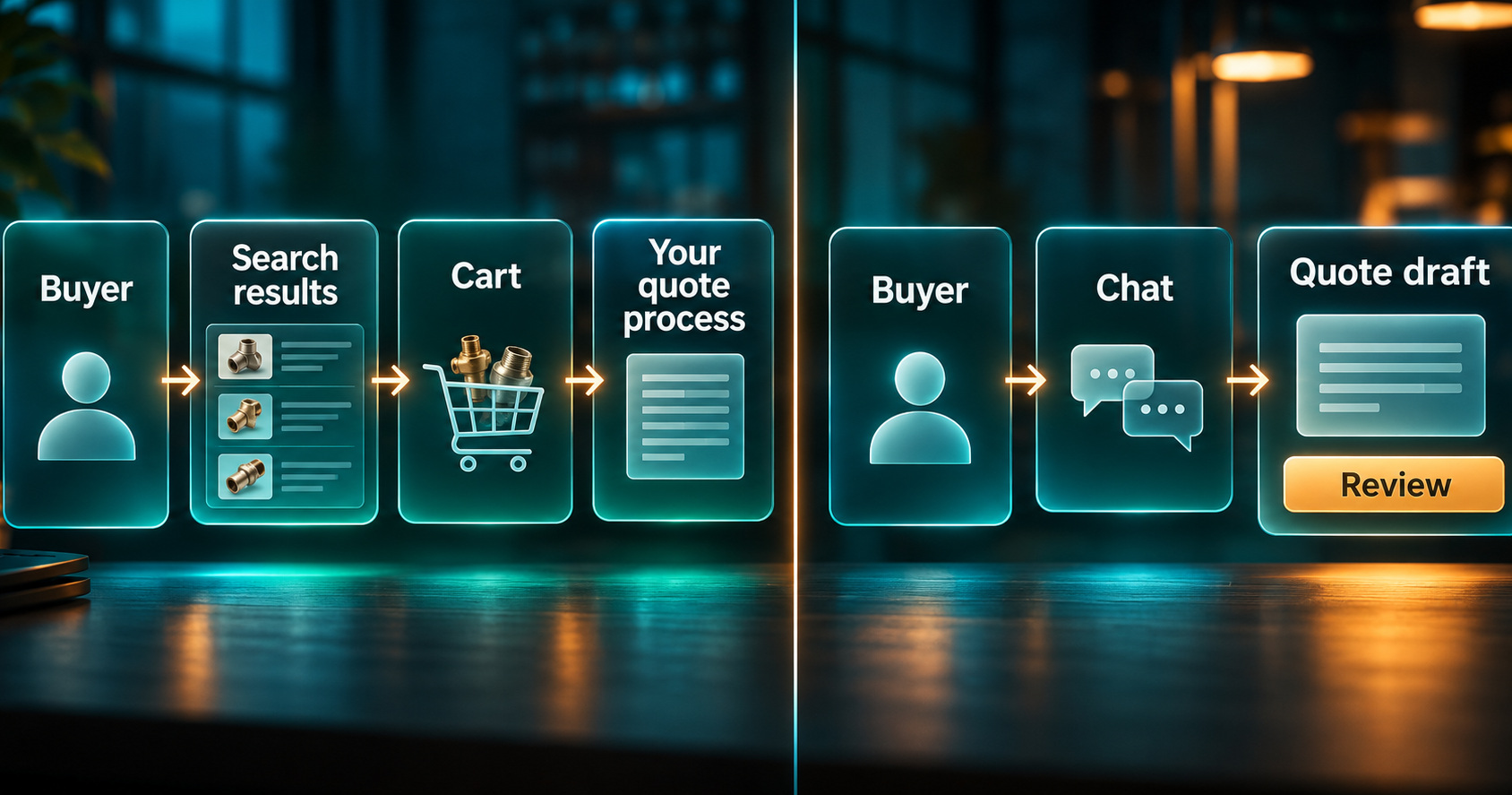
This is the clearest difference. Constructor’s B2B page does not list a quote request or RFQ feature. Quoting usually stays in your existing store, ERP or sales team process, and Constructor feeds buyers into it.
ChatSKU builds the quote in the conversation. The buyer asks about a product, adds items, and the assistant captures the request with the details your team needs, then routes the lead. For catalogs where most orders start with a quote, that removes the form between the question and the sales team. Our post on RFQ form best practices shows why that form is where many buyers drop off.
Which one fits a team without developers?
ChatSKU is designed for a team that cannot spare engineers. You maintain it by fixing a wrong or missing answer in the catalog data, and the buyer sees the corrected answer next time. Constructor typically involves a larger project, with integration work, tuning and a partner relationship on your side. That is normal for an enterprise platform, and it is worth budgeting for.
What does a real buyer question look like in each one?
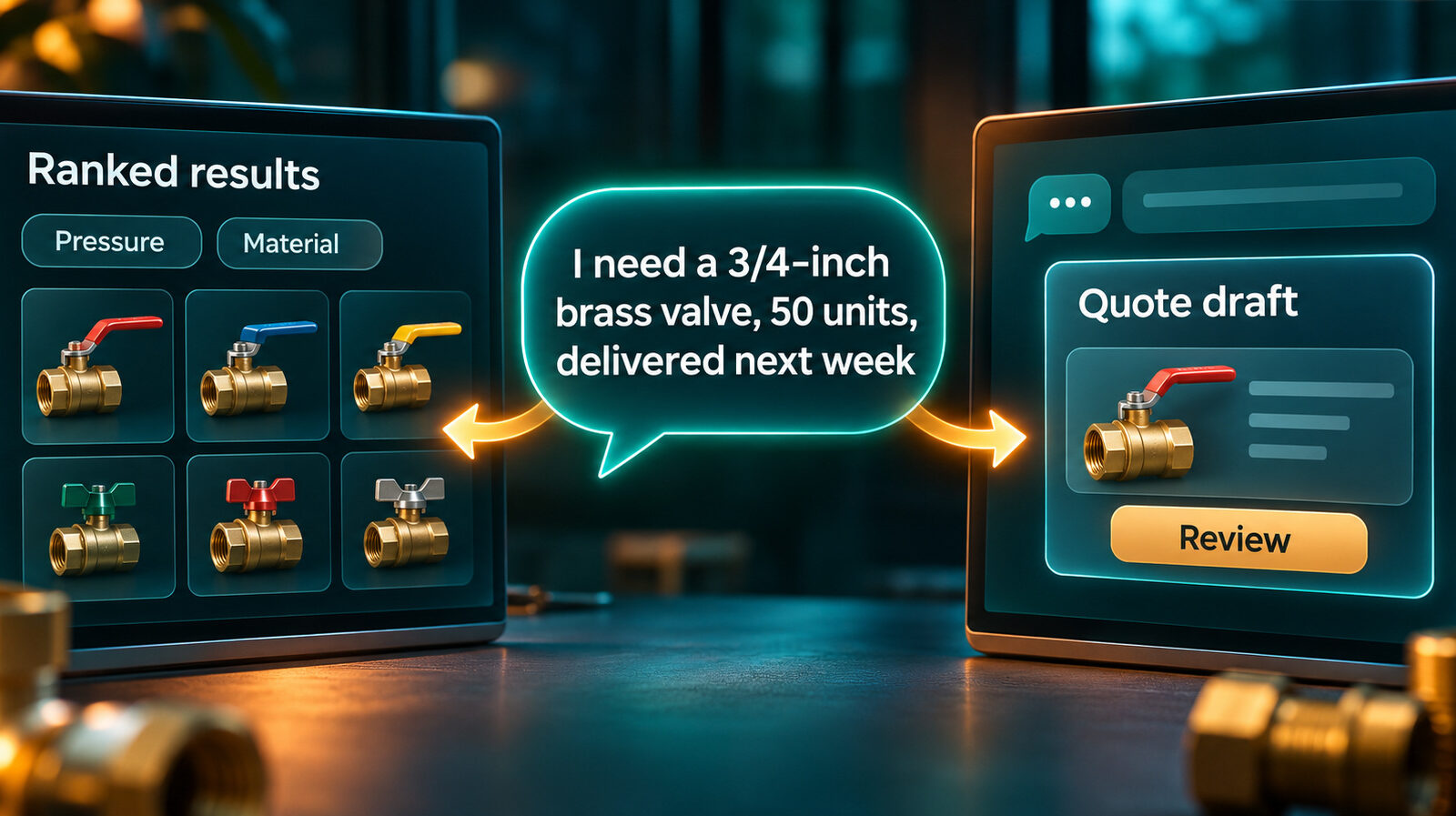
Take a buyer at a plumbing and valve distributor who types: “I need a 3/4-inch brass valve for a high-pressure line, 50 units, delivered next week.” The same sentence tests both products, and it shows where each is strong.
How would Constructor handle that question?
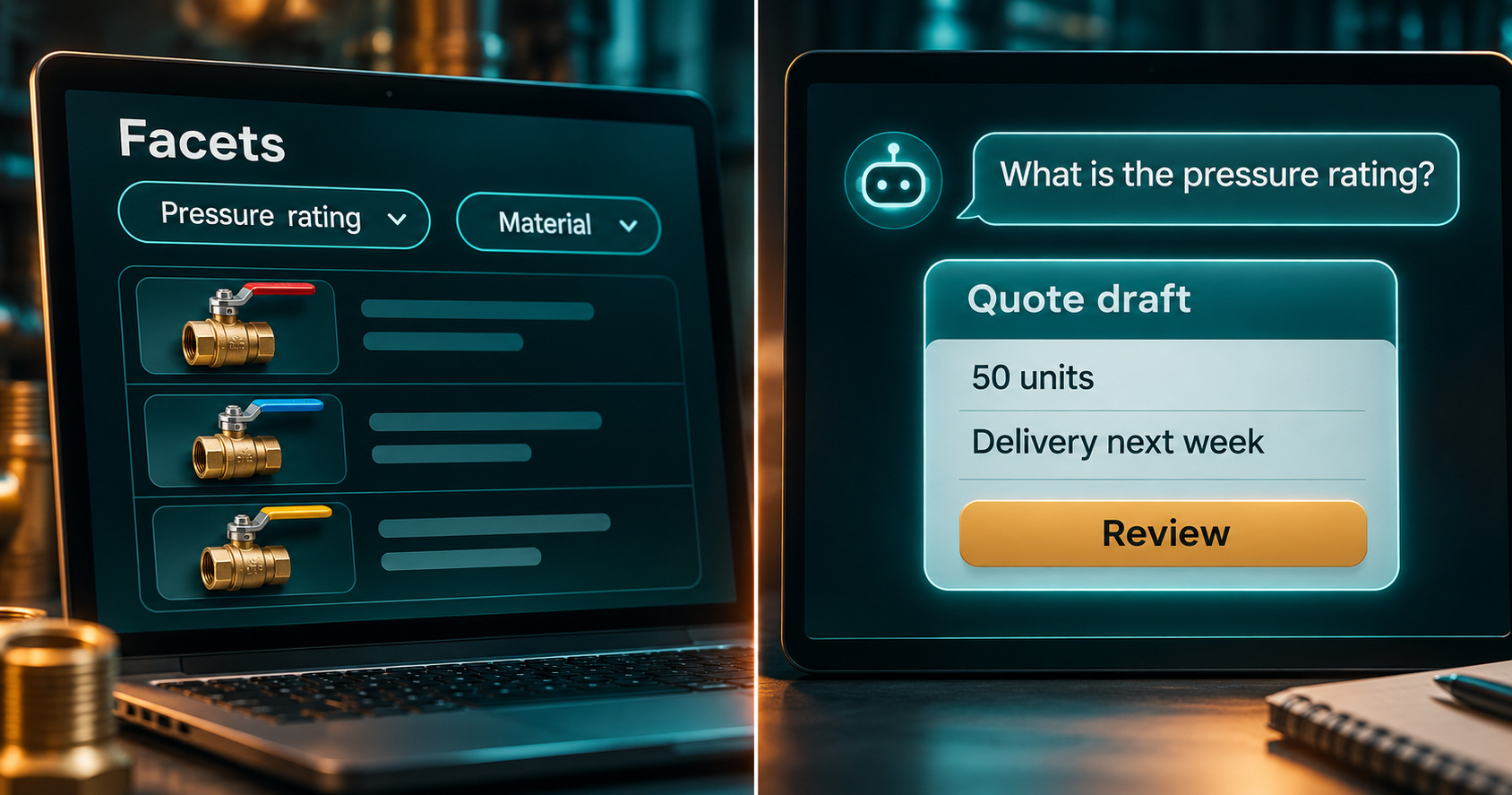
Constructor would interpret the terms, rank the matching valves, apply the buyer’s account pricing and availability, and surface facets such as pressure rating and material so the buyer can narrow the list. The buyer still decides, adds items to the cart and asks for a quote through whatever process your store already has.
How would ChatSKU handle that question?
ChatSKU would read the catalog, ask for any missing detail such as pressure rating or end connection, name the matching valves and capture the 50-unit request as a quote for your team. The buyer never leaves the conversation, and your team receives the product, quantity and delivery date together.
Neither approach is wrong. One helps the buyer choose from a long list, and the other helps the buyer ask and move on. The honest test is which step costs you more deals today.
What should you check before you buy either one?
Run through these five checks with any vendor, including us, before signing anything.
- Your own questions: use 50 to 100 real buyer questions, not the vendor’s demo script.
- Wrong answers: count how often it is confidently wrong, because one bad part recommendation costs more than ten missing answers.
- Price rules: test contract pricing and customer groups with real accounts, not sample data.
- Where the quote goes: confirm who receives the request and in what format, so nothing sits unseen.
- Who fixes mistakes: ask how a wrong answer gets corrected and how long that takes, and whether you need a developer.
How do ChatSKU and Constructor compare on 12 criteria?
| Criteria | Constructor | ChatSKU |
|---|---|---|
| Primary purpose | Product discovery suite | Catalog assistant with quoting |
| Best catalog size | Large, complex catalogs | Any size, from a focused catalog up |
| Part number search | Listed on its B2B page | Answered inside the chat |
| Natural language questions | AI shopping agent and product insights agent | Core feature, any hour |
| Account-based pricing | Account-segmented pricing and availability | Customer groups and tiered pricing by CSV |
| Quote or RFQ | Not listed on its B2B page | Quote building and RFQ capture |
| Lead routing | Not listed on its B2B page | Order capture and lead routing |
| Image and voice search | Not listed on its B2B page | Image search and voice search |
| Languages | Check with the vendor | Multilingual support |
| Integrations | Product data and clickstream based | CRM, ERP and PIM, plus any catalog format |
| Setup | Demo and audit, then integration project | One line of code, under a day |
| Pricing shown on its page | No price on the page I read | See the ChatSKU site for current plans |
How do cost and rollout compare?
Neither is cheap to evaluate carelessly. Constructor’s B2B page shows no price and points to a demo and a Search Experience Audit, so expect a quote and a contract. Budget for integration and tuning time on top of the license.
ChatSKU is built to be tested on your real catalog quickly, so you can judge answer quality before you commit. Whichever you try, run the same 50 to 100 real buyer questions through it and count the wrong answers, the missing answers and the quotes started. That test tells you more than any demo.
Should you choose Constructor, ChatSKU, or both?
Choose Constructor if your biggest problem is that buyers cannot find products in a very large catalog, you have the traffic to feed its models, and you can fund an enterprise rollout. Choose ChatSKU if buyers ask questions that search cannot answer and your sales team is losing time on quote requests. Choose both when search quality and conversational quoting are both gaps.
How would a discovery suite and a catalog assistant split the work?
Constructor ranks and personalizes what a buyer sees. ChatSKU answers what a buyer asks and starts the quote. A buyer can search and filter in Constructor, open a product, ask a question in ChatSKU and send a quote request, without either tool pretending to do the other’s job.
People Also Ask
Is Constructor a chatbot?
Not primarily. Constructor is a product discovery suite for search, browse and recommendations. It includes an AI shopping agent for conversational help, but search and personalization are its core.
Does ChatSKU replace site search?
No. ChatSKU answers questions and captures quotes. Keep your search and filters for buyers who already know what they want.
Which is better for a distributor with contract pricing?
Both support buyer-specific pricing in different ways. Constructor lists account-segmented pricing and availability, and ChatSKU supports customer groups and tiered pricing. Test your actual price rules in either one.
Conclusion
Start with the job. If buyers cannot find products in a very large catalog, look at Constructor. If buyers ask questions and then wait for a quote, look at ChatSKU.
Take ten real buyer questions from last week. Run them through each tool. The answers will tell you more than any table.
Frequently asked questions
Can ChatSKU work next to an existing search tool?
Yes. It sits on top of your store as a chat layer, so your current search keeps running while ChatSKU handles questions and quote requests.
Do I need a developer to add ChatSKU?
No. It goes on with one line of code and does not need a site rebuild, though a developer can do it in minutes if you prefer.
What catalog formats does ChatSKU read?
PDF, Excel, an ERP export, or a WooCommerce, Magento or BigCommerce store.
Does ChatSKU show different prices for different buyers?
It supports customer groups and tiered pricing, and you can import group-specific discounts from a CSV.
How do I test answer quality before buying anything?
Run 50 to 100 real buyer questions through each tool, and count wrong answers, missing answers and quotes started.
Sources
Constructor, B2B Ecommerce Solutions page (constructor.com/solutions/b2b-ecommerce-software), checked 2026-11-12. ChatGPT answer on B2B wholesale search tools, 2026-11-12. ChatSKU product details are from ChatSKU.
Turn your catalog into a 24/7 sales channel
