Help buyers find the right products using natural language, specifications, part numbers, and real-world requirements, instead of forcing them through filters and exact keywords.
Buyers know what they need. They just don't know your keywords.
B2B buyers often know a size, material, application, compatibility requirement, or quantity, without knowing the exact product name or SKU. Keyword search and filters make them work too hard to find it.
Maintenance buyer · distributor site
🔍 “corrosion resistant hinge for outdoor panel”
Filters ask for a category and a brand before a spec, so the buyer can’t search by the requirement they actually have and gives up before finding a match.
Plant buyer · manufacturer catalog
🔍 “motor bracket compatible with 3-phase 5hp”
The catalog only searches by part name, so a compatibility question returns zero results even though a match exists.
Procurement lead · industrial supplier
🔍 “bulk quantity of gaskets, high temp”
Filter menus don’t cover quantity or temperature rating together, so the buyer scrolls a long, unranked result list instead of a short, relevant one.
Facilities buyer · B2B eCommerce site
🔍 “something like our old part but rust proof”
There’s no way to ask a follow-up or compare an alternative, so the buyer emails support and waits for a reply instead of buying now.
Try it like your buyer would
Your buyers don't type in your catalog's language.
A real-world requirement, a part number, an application, a quantity. Tap an example to watch it resolve.
Natural language “corrosion resistant hinge”
Spec “M8x25 hex bolt zinc”
Part number “part BR-2240”
Application “bracket for 3-phase 5hp motor”
Quantity “need 500 units of the high-temp gasket”
Follow-up “anything like that but rust proof?”
🔍 “corrosion resistant hinge”
RESOLVES TO
✓ 4 in 316-grade stainless butt hinge, marine-rated
Four ways buyers actually describe what they need.
1 · Real requests
Buyers describe it in their own words
Buyers describe size, material, application, compatibility, or quantity in their own words. ChatSKU parses the request and matches it to real products in your catalog.
Example: stainless hinge, corrosion resistant, around 4 inches → matched to stocked products, closest size flagged if not exact.
2 · Specs & part numbers
An exact part number or a spec sentence
Whether a buyer gives an exact part number or a spec sentence, ChatSKU reads product data the same way and returns the right match.
Example: M8x25 hex bolt zinc, or part BR-2240 → both resolve to the correct SKU.
3 · Applications & quantities
What it's for, and how many
ChatSKU understands what a product is used for and how much a buyer needs, so a compatibility question or a bulk request returns a relevant, ranked result instead of a long list.
Example: bracket for a 3-phase 5hp motor, need 500 gaskets → relevant matches with quantity pricing.
4 · Alternatives & follow-up
Ask a follow-up without starting over
Buyers can ask a follow-up, compare an alternative, or confirm a detail before deciding, in the same conversation, without starting the search over.
Example: anything like that but rust proof? → relevant alternatives, with what’s different clearly stated.
Who it's for
Built for the catalogs buyers struggle to search.
Manufacturers
Help buyers navigate complex catalogs without a keyword-perfect search.
Distributors
Help customers find the right SKU across large, multi-brand catalogs.
Industrial suppliers
Reduce friction around technical product questions your site can't answer.
B2B eCommerce companies
Improve product discovery and cut search friction on the store you already run.
A wrong match wastes a buyer's time. So it says when it isn't sure.
Grounded in your catalog
Every result comes from products you actually stock, whether your catalog lives in a PDF, a spreadsheet, an ERP, or your storefront.
Honest about near matches
When the closest product isn't an exact fit, ChatSKU says so plainly instead of presenting it as a match.
No invented products
It never fabricates a spec or a product that doesn't exist in your catalog. If a product isn't stocked, it says so.
The honest comparison
AI product search vs traditional B2B search.
Traditional search asks the buyer to already know your keywords. ChatSKU asks the buyer to describe what they need.
What a buyer needs
Traditional search
ChatSKU
Understand a spoken requirement
✕ requires exact keywords
✓ understands natural language
Match by specification, not just name
✕ buyer must know product name
✓ matches on spec, size, material
Recognize part numbers and applications
✕ limited or none
✓ both, in the same query
Return relevant results
✕ long, unranked lists
✓ narrows to relevant matches
Answer a follow-up question
✕ no
✓ conversational follow-up
Suggest an alternative
✕ no
✓ when a close match differs
Work across catalog formats
✕ tied to how the site is built
✓ PDF, Excel, ERP, eCommerce
Move a buyer toward a quote
✕ separate, manual step
✓ a path buyers can follow
A real catalog example
Discovery, not just a claim that AI can search.
Same request as the hero: a buyer needs a corrosion-resistant hinge for an outdoor enclosure, around 4 inches. Here’s why each match was returned, and why one wasn’t exact.
4" 316-Grade Butt Hinge
316 stainless resists corrosion in outdoor and marine environments. Size matches the buyer’s 4 inch request exactly.
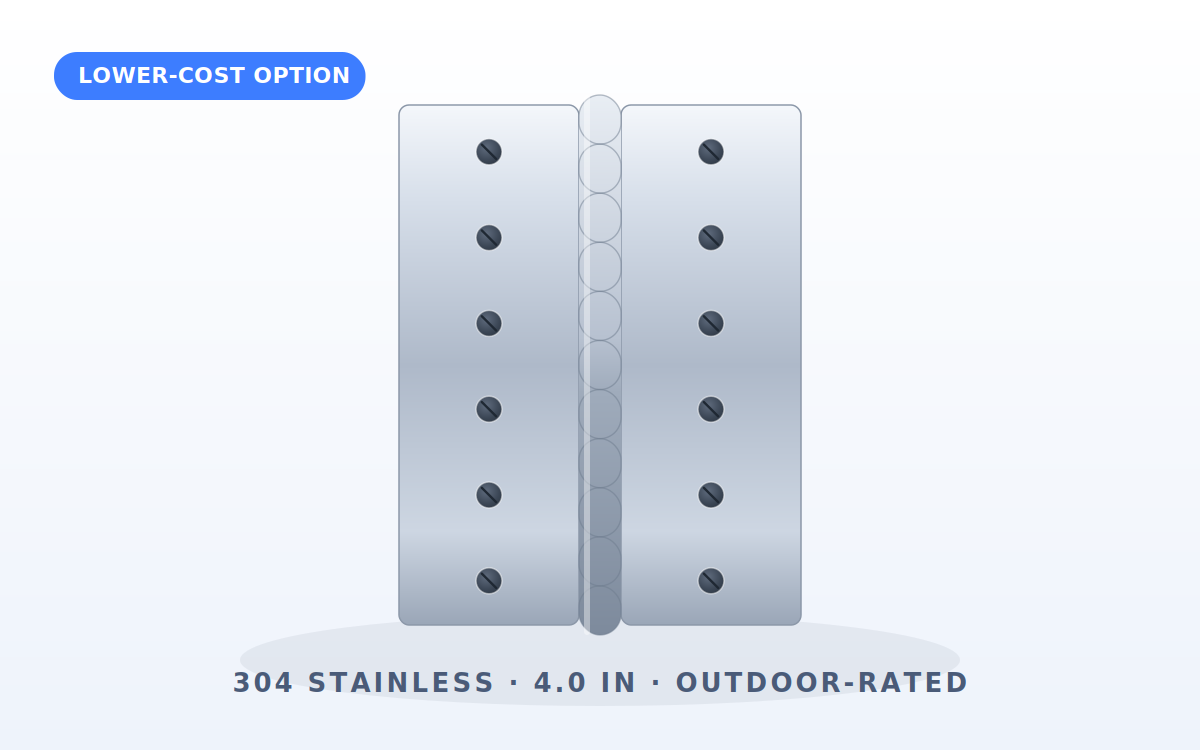
4" Continuous Hinge
304 stainless, outdoor-rated. Included as a lower-cost option, with the grade difference from 316 stated plainly.
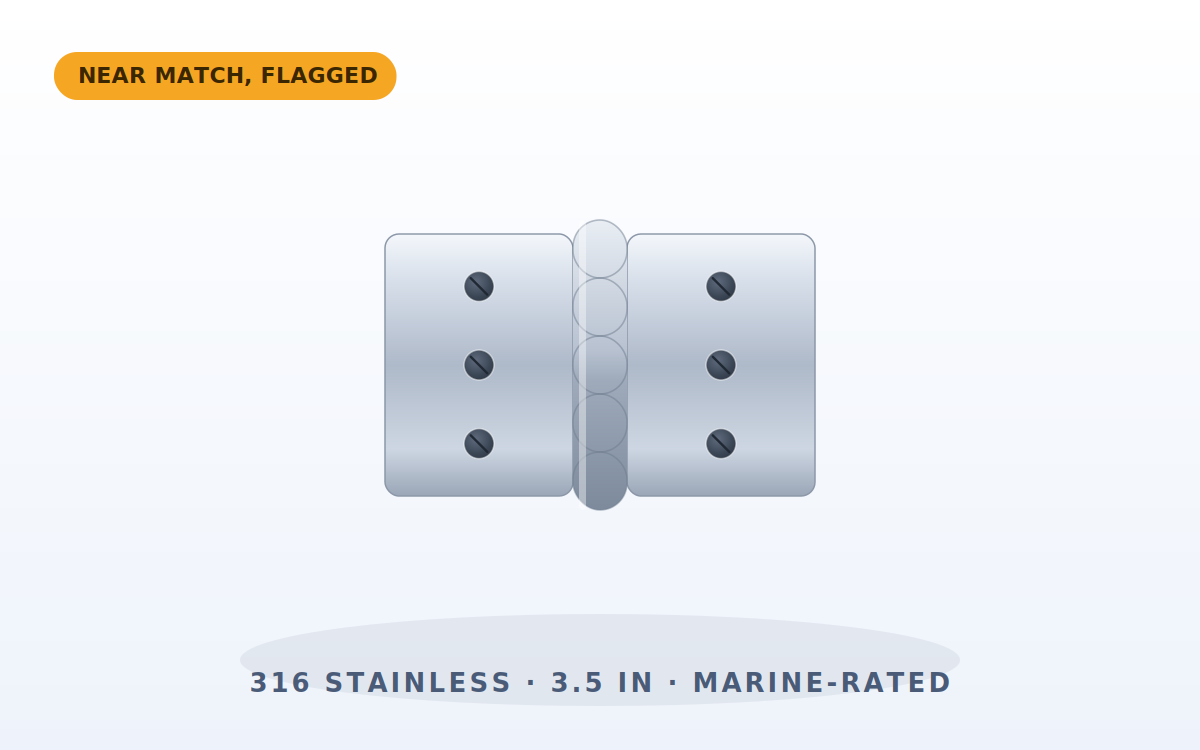
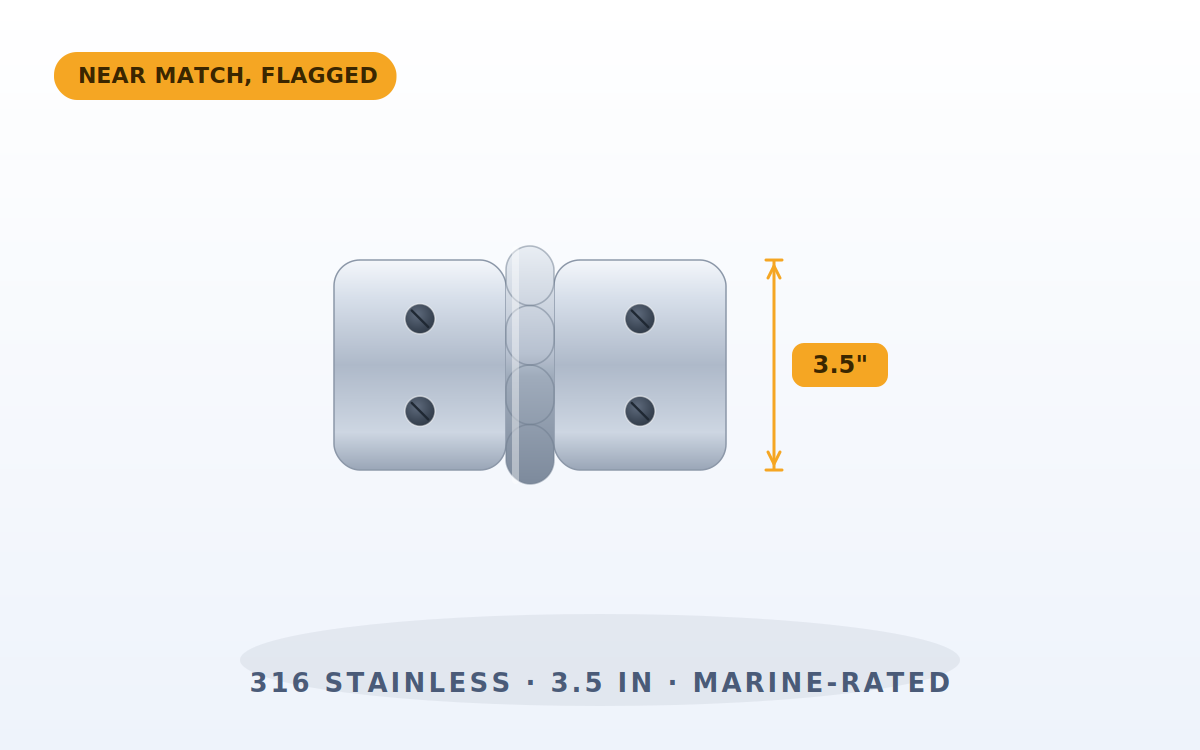
3.5" 316-Grade Butt Hinge
Same corrosion resistance, but the closest stocked size is 3.5 inches, not 4. Flagged as a near match, not presented as exact.
How it works
From catalog to conversation in five steps.
1
Connect the catalog
PDF, Excel, ERP, or the store you already run.
2
ChatSKU learns it
Understand your product data as it already exists.
3
Buyer describes the need
In their own words, spec, or part number.
4
ChatSKU finds relevant products
Ranked, relevant matches from your real catalog.
5
Follow-up toward RFQ
Buyer asks questions, confirms fit, requests a quote.
FROM PRODUCT SEARCH TO RFQ
RFQ is a downstream outcome of a good search, not the main event on this page.
Search
→
Find product
→
Ask questions
→
Confirm requirements
→
Request quote
See it on your own catalog.
We load a slice of your SKUs and send you the live link.
Business email only. We reply with the demo link, once.
AI product search for B2B lets buyers describe what they need in plain language, by specification, application, or part number, instead of forcing them through exact keywords and filters.
ChatSKU connects to your product catalog, understands your product data, and matches buyer requests, however they’re phrased, to the right products from what you already stock.
Yes. Buyers can describe size, material, application, compatibility, or quantity in their own words, and ChatSKU matches that request to relevant products.
We're building your demo now; most are ready within 1 business day. If you like what you see, we can set you up with a free trial. No strings attached.