

Executive Summary
If your team is spending their day copy-pasting numbers from PDFs into Excel, you aren’t doing procurement — you’re just doing data entry. You’re burning your best people’s time on busywork instead of letting them add value to the shop floor.
In a market as fast-paced as Dallas, manual quoting is a liability. RFQ automation isn’t about buying fancy software; it’s about ditching the “spreadsheet shuffle” so you can stop wrestling with data and start making decisions.
It’s the difference between chasing quotes and actually winning jobs.
Introduction
Dallas isn’t a city that just talks a big game — it’s a city that builds stuff. From the aerospace parts flying off the line to the heavy steel skeletons of our skyline, this whole place runs on the shop floor. It’s built on grit, the real kind, where you get your hands dirty because that’s what the job takes.
But let’s be real about where we are. Talk to any shop owner in DFW today, and you’ll hear the same gripe. We live in an era where speed is everything. As manufacturers look for ways to speed up operations, many are turning to solutions like an AI chatbot to handle repetitive RFQ communication and reduce manual workload. Industry is advancing, and AI is speeding up everything, but most of our back-office processes are lagging behind. Email chains, endless PDFs, and Excel sheets loaded with data. It is expensive and a complete mess. So what is the solution? We will discuss that in this blog.
Introducing RFQ Automation
Request for Quote (RFQ) automation is a way to stop doing the grunt work that doesn’t actually pay the bills. Think about your current routine. You need a part, so you email five different suppliers. Then you wait. When the quotes finally trickle in, you’re stuck playing data entry clerk — opening attachments, copy-pasting prices, and praying you didn’t miss a line item or mistype a digit.
That’s not procurement. That’s just asking for a mistake that eats into your profit margins.
In many cases, a B2B ecommerce chatbot can help automate these interactions by collecting RFQ details and managing supplier communication efficiently. With RFQ automation the heavy lifting is done — the platform handles everything from handling the request to replying to that mail, saving time and improving efficiency while giving you a complete view of the process.
How RFQ Automation Works
- Standardization — Automation makes every supplier use the exact same order form, so you know exactly where the price and shipping info are on every single submission. No more quotes written in ten different formats.
- Digital Ingestion — Instead of manually reading every email or attachment, the system extracts the important numbers and puts them straight into your records — no typing required.
- Side-by-Side Comparison — A centralized scoreboard lets you see all supplier options at once. You don’t have to guess or remember who was cheaper. You look at the data and pick the winner.
- Workflow Integration — Once you select a supplier, the platform automatically updates your main record-keeping system. No double entry. No manual handoff. It just happens.
Why Traditional RFQ Processes Are No Longer Enough

Manual RFQ processes may work for a very small operation, but they become harder to manage as the business grows.
Slow Turnaround
Every manual step adds time. Writing emails, attaching files, following up, opening responses, and entering data all slow the process down. In manufacturing, that delay can affect purchasing, production schedules, and customer response times.
Higher Risk of Errors
Manual data entry always comes with risk. Prices can be entered incorrectly, specifications can be missed, and revised documents can get lost in email chains. Even small mistakes can affect profitability, create supplier confusion, or delay production. Automation helps reduce that risk by keeping data organized and structured.
Poor Visibility
Manual systems make it hard to answer basic questions. Which supplier is consistently the fastest? Which one gives you the best price over time? Where do delays usually happen? When data is buried in emails and disconnected files, those answers are difficult to find.
Administrative Waste
Highly skilled employees should not spend a significant portion of the day copying information from one system to another. That work adds cost, but not much value. Automation frees up procurement teams, engineers, and managers to focus on supplier strategy, planning, and relationship management instead.
The Dallas Factor: Why Local Manufacturers Need RFQ Automation Now
RFQ automation helps manufacturers deal with the same core challenges, but in Dallas-Fort Worth, the pace is even faster. Local manufacturers are facing pressure from three directions at once.
1. Supply Chains Shift Quickly
DFW is a bustling hub for business, which is fantastic. But that proximity comes with a catch — when one supplier hits a roadblock, it tends to cause a ripple effect that hits the rest of us pretty quickly. If your go-to supplier suddenly falls through, you don’t have the luxury of spending days on the phone hunting for a callback. Automation acts as a super-fast assistant that instantly reaches out to all your other options. Instead of being stuck in the waiting game, you’ve got a backup plan ready in seconds.
2. Talent Is Too Valuable for Busy Work
Hiring strong people is hard. When you finally bring in a great engineer, sourcing manager, or shop lead, you want them focused on the work they are best at. If they are stuck moving numbers between emails and spreadsheets, their time is being wasted. Automation removes that burden so they can focus on work that actually drives the business forward.
3. Margins Are Under Pressure
DFW is a brutal market to compete in. If you’re pricing jobs based on messy or incomplete quotes, you’re basically gambling with your profit margins. When you automate, you don’t just get a better look at today’s numbers — you’ve got your entire price history at your fingertips. You compare apples to apples, so you know exactly where you stand before you pull the trigger. Stop relying on gut feelings and start making decisions based on what you’ve actually paid in the past.
Key Benefits of RFQ Automation for Manufacturers
Win More Quotes, Faster
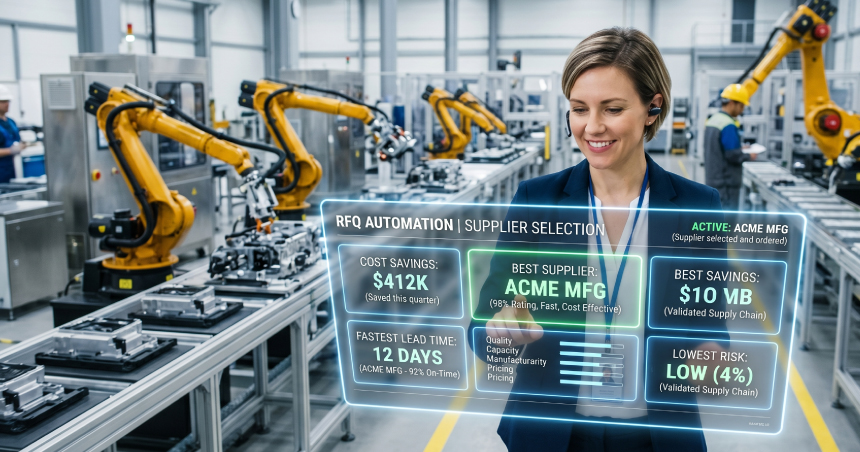
In this industry, speed is literally the only thing that separates a win from a loss. If you’re manually pulling quotes together while your competitor has already sent theirs out, you’ve already lost the battle. Automation shortens the gap between the customer’s request and your response. If you can answer while they’re still interested, you get the job. A B2B ecommerce chatbot for Dallas businesses can further support faster responses and improve quote turnaround.
Make Supplier Responses Easier to Trust
When you automate, you force every supplier to answer the same questions in the same format, every single time. Suddenly, you aren’t doing detective work anymore. You’re just looking at the facts and making a decision — no more discovering that a “great” quote left out shipping or quietly changed the material spec.
Stop Losing Time in Your Inbox
Communication at most shops is a disaster — drawings in one thread, revision updates in another, and half the time someone is looking at the wrong file. A centralized system puts everyone on the same page. No more hunting for the latest revision; everyone works from the same source of truth.
Turn Buried Data Into Better Decisions
You’re sitting on a massive amount of data in your old spreadsheets and buried emails, but it’s completely useless because you can’t actually see it. Automation pulls that noise together and turns it into real intel. You start to see the patterns — which suppliers are actually reliable, who’s inflating prices, and where your lead times are really going. You stop guessing and start knowing.
RFQ Automation as a Strategic Capability
Automating your RFQ isn’t just about fixing office work — it can give your business a genuine competitive advantage. A strong RFQ process helps you save money, get better service from your suppliers, answer customers faster, and helps your teams work much better together.
When you automate this, leaders can also see what is happening more clearly — spotting trends, finding delays, and seeing exactly where work is getting stuck before it becomes a crisis.
A Practical Roadmap for Implementation
Watch the Process First
Before you buy any software, take a hard look at what’s actually happening on your floor. Spend a day watching how a quote travels from the moment it hits your inbox until you actually get a part. Who touches it? Where does it get stuck? If you’re retyping the same data into three different spots just to keep the master spreadsheet alive, that’s where you start. Don’t guess — watch the process.
Start With One Pain Point
Find the one thing that drives everyone the most nuts — maybe it’s those high-volume parts you’re chasing daily or the complex quotes that seem to burn a whole afternoon. Fix that one specific pain point first. When the team sees that the new system actually saves them an hour of spreadsheet hell, they’ll be the ones asking to roll it out to the rest of the shop.
Choose Tools That Actually Connect
If your new platform doesn’t plug directly into your ERP or inventory system, walk away. The whole point is to kill busywork, not create more of it. If your team has to spend their afternoon double-keying data between two different programs, you haven’t automated anything — you’ve just traded one spreadsheet headache for another.
Bring Suppliers In Early
Don’t just drop a new portal on your suppliers and expect them to celebrate. They’ve got their own fires to put out every day. Instead, treat it like a partnership:
- Make it personal: Before you go live, pick up the phone or shoot a quick email to your key partners.
- Sell the benefit: Don’t just explain how it helps you. Show them exactly what’s in it for them — fewer emails, faster approvals, and crystal-clear instructions.
If you don’t get them on your side, the best technology in the world won’t make a bit of difference.
Pilot First, Then Scale
Don’t go company-wide on day one. Pick one team, one product category, or just a few suppliers to start with. Let the kinks happen on a small scale, listen to feedback from the people actually using it, and fix the bugs. It’s way easier to put out a fire in a trash can than it is to handle one in the whole building. Once it’s running smooth, then you take it wide.
Conclusion
For anyone running a business in Dallas, this isn’t a “someday” problem — it’s a “right now” problem. Supply chains are a headache, labor costs are climbing, and margins are getting thinner every month. Customers expect speed, and they expected it yesterday.
If you are still handling quotes manually, you are burning time you don’t have. Automating this process is the most practical way to protect your bottom line. It’s not about turning your shop into a software company — it’s about using the right tools so you can stop fighting the process and start focusing on the actual work. Get the manual junk out of the way, or get left behind.
Turn your catalog into a 24/7 sales channel
Stop sending PDFs. Start capturing demand.
Try ChatSKU Free →
About the author
Gigi JK is the founder of ChatSKU and Virtina, bringing more than 28 years of experience across digital transformation, eCommerce strategy, AI-driven growth systems, and business modernization. His work spans startups, scale-ups, and SMBs, with a focus on turning complex operational problems into practical growth frameworks. Before ChatSKU, Gigi built and scaled a seven-figure eCommerce business and led Virtina as an eCommerce engineering and business transformation consultancy. At ChatSKU, he focuses on helping B2B manufacturers, distributors, and wholesalers make complex catalogs searchable, quote-ready, and agent-ready without forcing a full platform rebuild.